
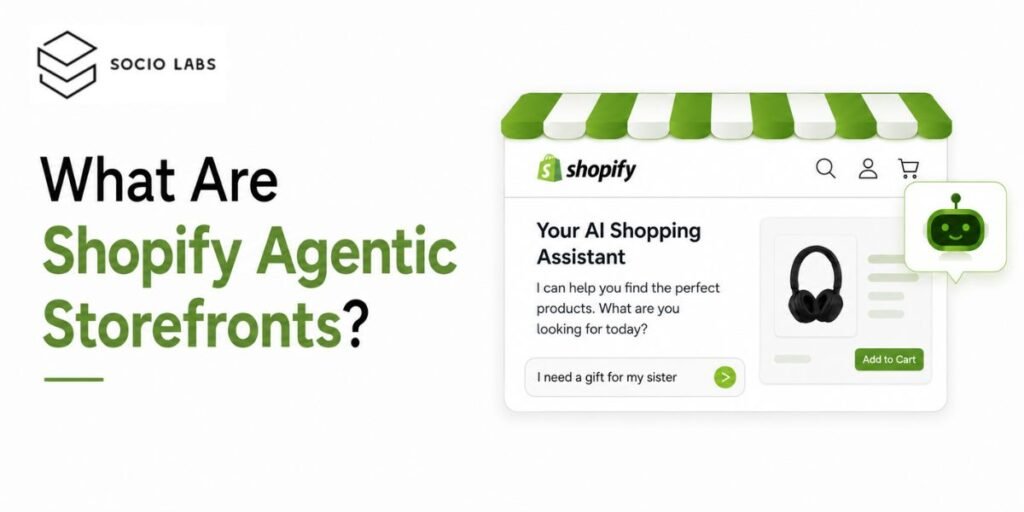
The Next Frontier of Online Shopping Has Arrived
Imagine a customer typing “I need a gift for my fitness-obsessed friend under $50” into an AI assistant — and your Shopify store’s products appearing directly in the response, ready to purchase without ever visiting your website. That’s not a distant future. That’s Shopify Agentic Storefronts, and it’s happening right now.
In 2026, artificial intelligence has fundamentally changed how consumers discover and buy products. Search is no longer just about typing keywords into Google. Millions of shoppers are now turning to AI assistants like ChatGPT, Google Gemini, and Microsoft Copilot to guide their purchasing decisions — and Shopify has built a powerful bridge between these AI channels and your store.
For merchants, understanding Shopify Agentic Storefronts isn’t just a nice-to-have. It’s quickly becoming a critical part of any growth strategy. In this guide, we’ll break down everything you need to know: what agentic storefronts are, how they work, which AI platforms they connect to, what the benefits are for your business, and how to set everything up.
What Are Shopify Agentic Storefronts?
Shopify Agentic Storefronts are a new type of AI-powered sales channel that allow customers to discover and purchase your products directly through AI platforms — including ChatGPT, Google AI Mode, Google Gemini, and Microsoft Copilot.
In simple terms: your store becomes shoppable inside an AI conversation.
When a user asks an AI assistant for product recommendations — “What are the best waterproof hiking boots under $150?” — the AI can now surface your products directly in the response. Customers can browse, evaluate, and even complete purchases right within the AI interface, without needing to navigate to your site in many cases.
Agentic storefronts are active by default for eligible Shopify stores, meaning if your store qualifies, you may already be discoverable on these AI channels today.
Key Definition: An “agentic storefront” is a version of your store that’s optimized to operate within an AI agent’s interface, allowing the agent to act on your customer’s behalf — surfacing products, answering questions about them, and facilitating purchases seamlessly.
Why Does This Matter? The Rise of AI-Powered Shopping in 2026
The shift toward AI-assisted commerce is dramatic and accelerating. Here are some industry data points that illustrate the scale of this change:
- According to Salesforce’s State of Commerce 2024 report, 17% of all online purchases are influenced by AI recommendations — a number projected to exceed 35% by end of 2026.
- ChatGPT surpassed 200 million weekly active users in 2024, with shopping-related queries growing by over 300% year-over-year.
- Google’s AI Mode (powered by Gemini) has been rolling out as a default search experience for hundreds of millions of users globally, making product discovery through Gemini a mainstream behavior.
- Microsoft Copilot is deeply embedded across Windows 11, Edge, and Microsoft 365 — products used by over 1.5 billion people worldwide.
What this means for merchants: if your products aren’t showing up in AI-powered discovery channels, you’re increasingly invisible to a massive and growing segment of shoppers.
Shopify Agentic Storefronts directly address this visibility gap.
How Do Shopify Agentic Storefronts Work?
Understanding the mechanics behind agentic storefronts helps you appreciate both the opportunity and how to maximize it.
H3: Step-by-Step: The Customer Journey
- A user opens an AI assistant (e.g., ChatGPT or Google Gemini).
- They ask for product recommendations: “I’m looking for navy running shorts for men.”
- The AI searches available product catalogs and merchant listings.
- Your products — if eligible and relevant — appear in the AI’s response with images, prices, and descriptions.
- The customer can click to learn more or proceed to purchase.
- Depending on the platform:
- On ChatGPT: The customer completes checkout on your Shopify store via an in-app browser or a new tab.
- On other AI channels with direct checkout: The customer can complete the full purchase without leaving the AI conversation, powered by Shopify’s checkout infrastructure.
- The order appears in your Shopify admin with channel attribution, so you know exactly where it came from.
How Your Products Get Listed in AI Channels
Shopify feeds your product catalog to AI channels in two primary ways:
- Shopify Catalog: This is the core product discovery engine for most agentic storefronts. Shopify automatically makes your eligible products available to AI platforms through a structured catalog feed, similar to how products are fed to comparison shopping engines.
- Google & YouTube Sales Channel: For Google AI Mode and Gemini specifically, product visibility is managed through the Google & YouTube sales channel you may already be using. Merchants need to have this channel set up and products approved to appear in Google’s AI-powered results.
Which AI Platforms Are Supported?
Here’s a breakdown of the key AI channels currently integrated with Shopify Agentic Storefronts:
| AI Platform | Purchase Method | Status | Notes |
|---|---|---|---|
| ChatGPT (OpenAI) | Redirects to your Shopify store checkout | Available | Uses in-app browser or new tab |
| Google AI Mode | Direct Shopify-powered checkout | Early Access | Requires Google & YouTube channel |
| Google Gemini | Direct Shopify-powered checkout | Early Access | Requires Google & YouTube channel |
| Microsoft Copilot | Direct checkout (where enabled) | Available | Available for eligible stores |
Socio Labs – India’s Most Trusted Shopify Development Company
Socio Labs makes it happen. As one of India’s leading Shopify development companies, we create powerful, conversion-focused online stores that help brands scale faster. Our team specializes in Shopify store setup, custom theme design, app integration, and AI-powered optimization tailored to your business goals.
From sleek eCommerce stores to advanced Shopify Plus and headless commerce solutions, we build websites that are fast, secure, and visually stunning. Every store we develop combines high-performance UX/UI, seamless functionality, and mobile-first design — ensuring your brand stands out and sells smarter.
Important Note on Google AI Mode and Gemini: As of mid-2026, Shopify’s agentic storefront for Google AI Mode and Gemini is in early access and not yet available to all Shopify stores. Eligible merchants receive an email and an in-admin notification when access becomes available.
ChatGPT Agentic Storefronts — A Closer Look
ChatGPT operates as a discovery-focused referral platform for Shopify merchants. Here’s what that means in practice:
- ChatGPT acts like a highly intelligent referrer — it introduces your products to customers based on their needs and questions.
- Customers do not complete purchases inside ChatGPT itself. Instead, they are directed to your store’s checkout.
- When using the ChatGPT mobile app or desktop app, the checkout opens in a ChatGPT in-app browser.
- When using ChatGPT web, a new tab opens to your store’s checkout page.
- This maintains the full Shopify checkout experience, including your store’s branding, upsells, discount codes, and post-purchase flows.
Benefits of the ChatGPT channel:
- Top-of-funnel discovery among high-intent shoppers.
- No disruption to your existing checkout and conversion optimization.
- Full customer data ownership post-purchase.
- Channel attribution in your Shopify dashboard.
AI Channels With Direct Checkout — The Full In-Conversation Purchase
Beyond ChatGPT, some AI platforms support what Shopify calls “direct purchasing” — where a customer can complete an entire transaction without leaving their AI conversation.
This is powered by Shopify’s checkout infrastructure running behind the scenes within the AI platform’s interface.
How to activate direct purchasing:
- Go to your Shopify admin.
- Navigate to the Agentic section.
- Enable direct purchasing for supported AI channels.
What merchants need to know about direct checkout:
- You retain full ownership of the customer relationship and post-purchase experience, even when purchases happen inside an AI platform.
- All orders from direct checkout appear in your Shopify admin with full channel attribution.
- Returns, refunds, and customer service remain your responsibility — just like any other order.
- Shopify’s standard payment processing, fraud protection, and order management apply.
Managing Your Agentic Storefronts — The Agentic Section in Shopify Admin
Shopify has built a dedicated management area for agentic storefronts, accessible within your Shopify admin panel.
What You Can Do in the Agentic Section:
- View all AI channels where your products are currently active.
- Enable or disable individual AI channels for product selling.
- Monitor insights about search and sales performance across AI platforms.
- Manage product visibility and catalog settings.
- Review channel-level order attribution data.
“Manage for Me” Feature
Shopify offers a streamlined “Manage for Me” option that automatically manages which AI channels your products appear on, based on eligibility and performance data. Merchants who prefer a hands-off approach can use this setting to let Shopify optimize their agentic storefront distribution automatically.
Shopify Catalog and Product Discovery — Getting Your Products Found
The quality and completeness of your product catalog directly impacts how often your products appear in AI-generated recommendations. AI systems rely heavily on structured, accurate data to make relevant suggestions.
Best Practices for AI-Ready Product Listings
To maximize your discoverability across AI channels, optimize your product data in the following ways:
- Write detailed, natural-language product descriptions: AI agents parse your descriptions to understand what your product is, who it’s for, and what problem it solves. Avoid keyword-stuffing — write for humans, not bots.
- Use precise, descriptive product titles: “Men’s Lightweight Waterproof Trail Running Shorts — Navy Blue” performs far better than “Running Shorts.”
- Fill in all product attributes: Size, color, material, use case, and category tags all help AI systems match your products to the right queries.
- Keep pricing and inventory current: Outdated prices or out-of-stock items create poor customer experiences and may reduce your product’s AI ranking.
- Use high-quality images: Many AI interfaces display product images alongside recommendations. Compelling photography increases click-through rates.
- Add structured data via Shopify’s product metafields: The more structured your data, the more precisely AI systems can recommend your products.
How Shopify Catalog Feeds AI Channels
Shopify’s catalog system acts as the backbone of agentic storefront discovery. It automatically formats and syncs your product data in a way that’s optimized for AI platforms to read and use. This is handled on Shopify’s side — merchants don’t need to create separate feeds for each AI channel.
Data, Privacy, and What You Own
One of the most important questions merchants have about agentic storefronts is: what happens to customer data?
What Shopify Has Confirmed About Data Sharing:
- Customer data is governed by Shopify’s data sharing and privacy policies for agentic storefronts.
- Merchants retain ownership of the customer relationship following a purchase.
- Orders placed through AI channels appear in your Shopify admin just like any other order.
- Channel attribution data is provided so you can understand which AI platform drove each sale.
What You Own as a Merchant:
- Full post-purchase customer relationship (email, order history, loyalty programs).
- All order data and analytics.
- Control over returns, refunds, and customer service.
- Marketing rights to customers who opt-in through your standard processes.
It’s important to review Shopify’s data sharing and privacy documentation for agentic storefronts as this space evolves rapidly and policies may be updated.
Performance Insights — Measuring Your AI Channel ROI
Unlike some emerging channels that lack measurement tools, Shopify’s agentic storefronts come with built-in analytics.
H3: What Metrics You Can Track:
- Product impressions in AI channels: How often your products appear in AI-generated responses.
- Click-through rates: How often customers click on your products after seeing them in AI responses.
- Conversion rates by channel: Compare ChatGPT-driven purchases vs. Copilot vs. Gemini.
- Revenue attribution: Total sales driven by each agentic storefront channel.
- Search query data: Understand what customers are asking AI assistants that surfaces your products.
These insights are accessible through the Agentic section of your Shopify admin, giving you a centralized view of your AI channel performance.
Shopify Agentic Plan — What Is It?
For merchants on the Shopify Agentic Plan, there is a dedicated setup process for configuring agentic storefronts. This plan is specifically designed for businesses that want deeper AI-commerce functionality and more advanced agentic storefront features.
If you are on the Agentic Plan, Shopify provides step-by-step setup guidance within your admin to configure all relevant agentic storefront settings.
Check Shopify’s official documentation to confirm eligibility and features associated with the Agentic Plan, as details continue to evolve through 2026.
Agentic Storefronts vs. Traditional Sales Channels — Key Differences
| Feature | Traditional Sales Channels | Agentic Storefronts |
|---|---|---|
| Discovery Method | Keyword search, browsing | AI-driven conversational queries |
| Customer Intent | Often early-stage browsing | High intent, need-based queries |
| Purchase Location | Your store or marketplace | AI interface or your store |
| Personalization | Limited (ad targeting) | Deep (AI understands context) |
| Setup Required | Often extensive | Largely automatic for eligible stores |
| Attribution | UTM tracking, referrer data | Channel attribution in Shopify admin |
| Customer Relationship | Depends on platform | Retained by merchant post-purchase |
Challenges and Considerations for Merchants
While Shopify Agentic Storefronts represent a significant opportunity, there are practical considerations merchants should be aware of:
Eligibility requirements: Not all stores are immediately eligible. Google AI Mode and Gemini integrations are in early access as of mid-2026.
Product data quality is critical: AI channels are only as good as the data they work with. Poorly written product descriptions or incomplete attributes reduce discoverability.
Direct checkout requires activation: The ability for customers to purchase without leaving an AI conversation isn’t automatic — merchants need to enable it for supported channels.
Evolving policies: The AI commerce landscape is moving fast. Data sharing agreements, platform rules, and feature availability may change. Stay connected to Shopify’s official documentation and admin notifications.
Competition within AI results: Just like traditional search, multiple merchants can appear in AI recommendations for the same query. Product quality, pricing, reviews, and catalog data all influence who gets recommended.
The Future of Agentic Commerce — What's Coming Next
Agentic storefronts are just the beginning of a broader shift toward what industry analysts are calling “ambient commerce” — the idea that shopping becomes integrated into every digital interaction rather than confined to dedicated shopping platforms.
Here’s what industry experts and trends suggest is on the horizon:
- Personalized AI shopping agents: Customers will increasingly use personal AI assistants that know their preferences, size, budget, and past purchases — and shop proactively on their behalf.
- Voice-activated purchasing: AI assistants integrated into smart speakers and wearables will enable voice-driven purchases.
- Visual AI search: Customers photographing items in the real world and instantly finding them across merchant catalogs.
- AI-powered post-purchase experiences: AI agents managing returns, exchanges, and reorders on behalf of customers.
- Deeper merchant analytics: Richer data on how AI recommendations influence purchase behavior at every stage of the funnel.
Shopify’s investment in agentic storefronts positions merchants to be part of this evolution from the ground up.
How to Get Started With Shopify Agentic Storefronts — Action Plan
If you’re ready to activate and optimize your agentic storefronts, here’s a practical step-by-step action plan:
Step 1 — Check your eligibility: Log into your Shopify admin. Check for an email or in-admin notification confirming agentic storefront access, particularly for Google AI Mode and Gemini.
Step 2 — Navigate to the Agentic section: In your Shopify admin, find the Agentic section and review which AI channels are currently active for your store.
Step 3 — Audit your product catalog: Review your product titles, descriptions, images, pricing, and attributes. Optimize for natural-language discovery and completeness.
Step 4 — Set up the Google & YouTube sales channel: If you haven’t already, configure the Google & YouTube sales channel to ensure your products are eligible for Google AI Mode and Gemini discovery.
Step 5 — Enable direct purchasing (where supported): For AI channels that support in-conversation checkout, enable direct purchasing in the Agentic section of your admin.
Step 6 — Monitor performance: Use the insights available in the Agentic section to track impressions, clicks, and revenue from each AI channel.
Step 7 — Iterate and optimize: Use channel attribution data to understand what’s working and continuously improve your catalog and pricing strategy.
Conclusion — AI Commerce Is Here, and Agentic Storefronts Are Your Ticket In
The way customers discover and buy products is undergoing the most significant transformation since the rise of mobile shopping. AI assistants are becoming the new search engines — and increasingly, the new storefronts.
Shopify Agentic Storefronts give merchants an unprecedented opportunity to participate in this shift without requiring technical expertise or complex integrations. Products become discoverable across ChatGPT, Google Gemini, Google AI Mode, and Microsoft Copilot, with purchases powered by Shopify’s trusted checkout infrastructure and full merchant ownership of the customer relationship.
The merchants who act now — auditing their catalogs, activating eligible channels, and monitoring AI channel performance — will be best positioned to capture this growing wave of AI-driven commerce.
The future of shopping is conversational, ambient, and AI-powered. Your store can be a part of it, starting today.
Ready to make your Shopify store discoverable in the AI channels your customers are already using?
Log into your Shopify admin right now, navigate to the Agentic section, and check your eligibility for Shopify Agentic Storefronts. Audit your product catalog, activate your eligible AI channels, and start capturing the attention of the next generation of AI-powered shoppers.
Don’t wait for AI commerce to mature before you act — the merchants winning on these channels in 2026 are the ones setting up today.
If you’re an agency or developer helping merchants grow their Shopify stores, now is the time to add Shopify Agentic Storefront setup and optimization to your service offerings. Your clients need this — and they need it now.
Socio Labs – India’s Most Trusted Shopify Development Company
Socio Labs builds high-converting Shopify stores designed for growth. From custom development and theme design to AI-powered optimization, Shopify Plus, and headless commerce, we create fast, secure, and mobile-friendly eCommerce experiences that drive sales.