
The Search Landscape Has Changed Have You?
Picture this: a user pulls out their phone and says, “Hey, what’s the best digital marketing agency in India for e-commerce brands?” They don’t type a string of keywords. They ask a full, natural-language question just as they would ask a friend.
This is the reality of search in 2026.
Between Google’s AI Overviews dominating the top of the SERP, ChatGPT being used by millions as a daily search engine, and Perplexity and Gemini becoming serious research tools, the old rules of SEO are being rewritten in real time. Keyword stuffing, thin content, and backlink-only strategies are relics. The new currency? Conversational query optimization the art and science of structuring your content so it is understood, trusted, and surfaced by AI-powered search systems.
This is not a future trend. It is the present competitive battleground.
This guide is for:
- SEO professionals who want to stay ahead of algorithmic and AI-driven changes
- Digital marketers managing content strategies for brands in 2026
- Business owners who want their websites to appear in AI Overviews and LLM responses
- Content creators seeking to write for both human readers and machine comprehension
Whether you are optimizing for Google’s generative AI features, trying to get cited in ChatGPT responses, or building topical authority that Perplexity and Gemini trust this guide gives you the complete 2026 playbook
What Is Conversational Query Optimization?
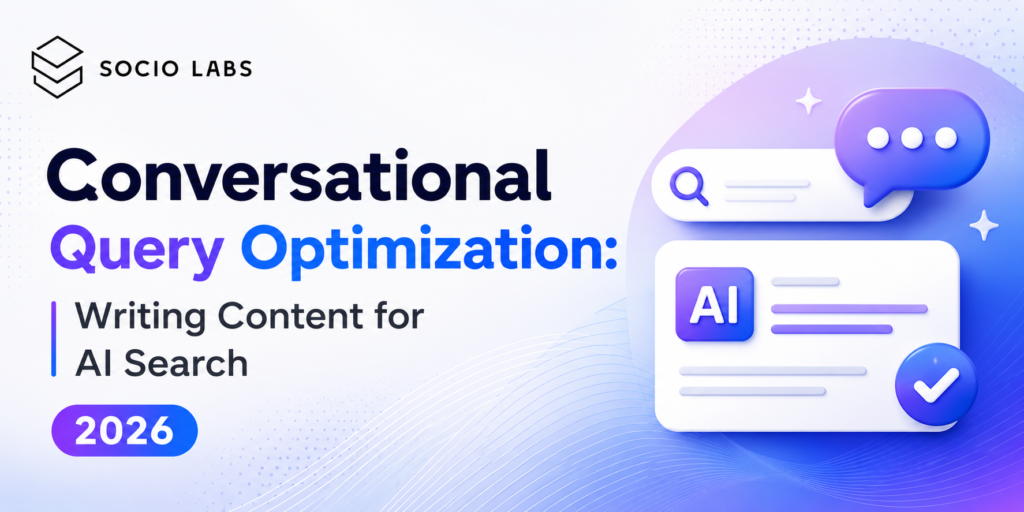
Conversational query optimization (CQO) is the process of structuring, writing, and semantically enriching your content to match the way people naturally speak and ask questions and the way AI systems interpret, synthesize, and answer those questions.
Traditional SEO focused on matching keywords. Conversational query optimization focuses on matching intent, context, and meaning.
When someone searches “best time to post on Instagram for B2B,” they are not just looking for a keyword match they want a specific, direct, authoritative answer. AI search engines like Google AI Overviews, ChatGPT, and Perplexity read your content and decide: Is this source trustworthy enough to cite? Does it directly answer the question? Is the information current and well-supported?
Conversational query optimization ensures the answer to all three is yes.
Why Conversational Query Optimization Matters More Than Ever in 2026
The Rise of AI-First Search Behavior
The numbers tell a clear story:
- Google’s AI Overviews now appear in a significant majority of informational and navigational search queries
- ChatGPT, Perplexity, and Gemini collectively handle hundreds of millions of search-intent queries each month
- Voice search which is inherently conversational continues to grow rapidly on mobile and smart devices
- Users increasingly expect direct answers rather than a list of blue links to click through
The implication for content creators and SEO professionals is significant: your content must now satisfy two audiences simultaneously the human reader and the AI model that may extract and synthesize it into a generated response.
Zero-Click Searches Are Now the Norm
A growing share of search queries are resolved on the SERP itself, without the user ever clicking through to a website. This is the reality of zero-click search. AI Overviews, featured snippets, knowledge panels, and LLM-generated summaries all pull answers directly from indexed content.
If your content is not optimized to be the source of these answers, you are effectively invisible to a large segment of your audience even if you technically rank on page one.
Google E-E-A-T and AI Trust Signals
Google’s updated E-E-A-T framework (Experience, Expertise, Authoritativeness, Trustworthiness) is now a core signal for both traditional rankings and AI Overview inclusion. LLMs like Gemini and the models powering AI Overviews are increasingly trained and prompted to favor content that demonstrates:
- First-hand experience (real examples, case studies, original data)
- Deep expertise (comprehensive topic coverage, accurate terminology)
- Authoritativeness (citations, author credentials, trusted backlinks)
- Trustworthiness (transparent sourcing, factual accuracy, clear authorship)
CQO is, in essence, the practical implementation of E-E-A-T in your content strategy
Traditional SEO vs. Conversational Query Optimization: A Side-by-Side Comparison
| Dimension | Traditional SEO | Conversational Query Optimization |
|---|---|---|
| Query Type | Keyword-based (“digital marketing agency India”) | Natural language (“which digital marketing agency in India is best for startups?”) |
| Content Goal | Rank for keywords | Be cited by AI, answer intent, rank for topics |
| Writing Style | Keyword-dense, structured for crawlers | Conversational, structured for comprehension |
| Search Engines | Primarily Google | Google, ChatGPT, Perplexity, Gemini, Bing Copilot |
| Success Metric | Keyword rankings, organic traffic | Featured in AI Overviews, cited in LLM answers, topic authority |
| Content Structure | H1 + keyword placement | Semantic HTML, FAQ schema, entity-rich content |
| Backlink Focus | High volume of backlinks | Authority + relevance of backlinks + brand mentions |
| Update Frequency | Periodic | Continuous (AI systems favor fresh, updated content) |
| User Signals | CTR, bounce rate | Engagement depth, answer completeness, dwell time |
| Zero-Click Strategy | Often ignored | Central to content architecture |
Core Pillars of Conversational Query Optimization in 2026
1. Understanding and Mapping Conversational Search Intent
Before you write a single word, you must understand how your target audience asks questions, not just what they search for. Conversational queries tend to fall into distinct intent patterns:
The Four Intents of Conversational Search:
- Informational Intent — “How does AI search optimization work?”
- Navigational Intent — “SocioLabs SEO services page”
- Transactional Intent — “Hire an AI SEO agency in India”
- Investigational/Comparative Intent — “Is conversational SEO better than traditional SEO in 2026?”
For each piece of content, map it to one primary intent and ensure the content fully resolves that intent without requiring the user to go elsewhere.
Practical Action: Use tools like Google Search Console’s query data, AnswerThePublic, and AlsoAsked to harvest the actual questions your audience is typing and speaking. These are your content briefs.
2. Writing for Natural Language and Semantic Search
Search engines in 2026 do not match pages to keywords they match meanings to concepts. This is the foundation of semantic search optimization.
How to write for semantic search:
- Write in full, complete sentences that mirror how people speak
- Use natural question-and-answer structures within your content
- Answer follow-up questions proactively (anticipate what a reader or AI system might ask next)
- Use synonyms, related terms, and topic-specific vocabulary naturally — not forced
- Avoid keyword cannibalization by ensuring each page owns a distinct semantic territory
Example — Old Approach:
“SEO 2026 tips best practices AI search optimization.”
Example — CQO Approach:
“In 2026, effective SEO requires aligning your content with how AI systems interpret user intent. This means writing clear, complete answers to the questions your audience is actually asking — and structuring that content so language models can extract and cite it accurately.”
The second version reads naturally, is richer in meaning, and is far more likely to be extracted by an AI system as a trustworthy answer.
3. Entity-Based SEO: Building Topical Clusters That AI Understands
Modern search engines particularly Google’s Knowledge Graph and the models behind Gemini — think in terms of entities, not keywords. An entity is any clearly defined concept: a person, place, brand, product, concept, or event.
What this means for your content:
- Your brand (SocioLabs, for example) should be consistently associated with a defined set of entities: AI SEO, digital marketing, content strategy, India-based agency
- Your content should establish clear relationships between entities: “SocioLabs specializes in AI search optimization for e-commerce brands”
- Use structured data (Schema.org markup) to explicitly declare entities and their relationships to search engines
Entity-Based Content Strategy Steps:
- Identify the core entities your brand or content should own
- Create pillar pages for each primary entity
- Build supporting cluster content that reinforces entity relationships
- Cross-link intentionally using anchor text that reinforces semantic relationships
- Use Schema markup (Organization, Article, FAQ, HowTo, BreadcrumbList)
Internal Link Opportunity: Explore SocioLabs’ entity-based SEO services at [/services/seo]
4. Structuring Content for Google AI Overviews
Google AI Overviews are generated answers that appear at the top of the SERP for many queries. They pull content directly from indexed pages — and if your content is the source, you gain enormous visibility even in a zero-click world.
How to optimize for AI Overview inclusion:
- Use clear, direct answer formats. Place the direct answer to the query within the first 100 words of your content or section.
- Write concise definitions. AI Overviews frequently extract definition-style answers (“X is Y that does Z”).
- Use structured subheadings. H2 and H3 headings should be phrased as questions or clear topic labels.
- Add FAQ sections. FAQs with natural language questions and direct, complete answers are prime candidates for AI extraction.
- Support claims with specificity. Vague generalities are rarely cited. Specific, actionable, and accurate statements are.
- Mark up your content with FAQ Schema. This signals to Google exactly which Q&A pairs are answer-worthy
{
“@context”: “https://schema.org”,
“@type”: “FAQPage”,
“mainEntity”: [{
“@type”: “Question”,
“name”: “What is conversational query optimization?”,
“acceptedAnswer”: {
“@type”: “Answer”,
“text”: “Conversational query optimization is the process of writing and structuring content to match natural language search patterns used by humans and AI search systems like ChatGPT, Google AI Overviews, and Perplexity.”
}
}]
}
5. Optimizing for LLM-Based Search: ChatGPT, Perplexity, and Gemini
Beyond Google, a growing segment of your audience is using LLMs as their primary research tool. ChatGPT, Perplexity, and Gemini all index, crawl, and synthesize web content — and they have their own trust signals.
How LLMs decide what to cite:
- Brand mention frequency across authoritative domains (news sites, academic references, industry publications)
- Content clarity — well-structured, logically organized content is easier for LLMs to parse
- Factual accuracy — LLMs are increasingly trained to cross-reference and filter inaccurate claims
- Author and organizational credibility — clear bylines, author bio pages, and organizational About pages matter
- Freshness — outdated content is deprioritized by systems that aim to surface current information
LLM SEO Tactics:
- Earn brand mentions in authoritative publications. A mention in a recognized industry publication signals to LLMs that your brand is a credible entity in your space.
- Create structured, scannable content. LLMs parse text hierarchically. Use clear H2/H3 headers, short paragraphs (3–4 sentences), and bulleted summaries.
- Build a robust author identity. Every article should have a clearly attributed author with a linked bio page that lists credentials, experience, and areas of expertise.
- Publish original research and data. LLMs frequently cite sources that contain original statistics, surveys, or proprietary insights — because they cannot fabricate specific data.
- Maintain content freshness. Update your highest-value content regularly to reflect current information, trends, and examples.
6. Conversational Content Architecture: How to Structure Every Page
The architecture of your content — how it is organized at the page, section, and paragraph level — directly affects both human readability and AI extractability.
H1: Primary Query (exact or semantic match to user question)
│
├── Introduction: Direct answer + context (100–150 words)
│
├── H2: Supporting Concept 1
│ ├── H3: Sub-topic or Question
│ └── Short paragraph + bullet list
│
├── H2: Supporting Concept 2
│ ├── H3: Sub-topic or Question
│ └── Short paragraph + numbered steps (if process-oriented)
│
├── H2: Comparison or Data Section
│ └── Table
│
├── H2: FAQ Section
│ ├── H3: Question 1?
│ ├── H3: Question 2?
│ └── H3: Question 3?
│
└── Conclusion + CTA
Key Principles:
- Every H2 should be able to stand alone as a mini-answer to a sub-query
- Use short paragraphs (2–4 sentences max) for maximum scannability and AI parseability
- Lead with the answer, follow with the explanation
- Avoid walls of text — break up content with bullets, tables, and callout boxes
- Include a dedicated FAQ section at minimum for every informational post
7. Voice Search and Conversational SEO
Voice search is inherently conversational — and it is still growing as smart speakers, in-car assistants, and mobile voice features become more embedded in daily life.
Voice search optimization principles:
- Optimize for question phrases. Voice searches most commonly start with “how,” “what,” “where,” “when,” and “why.”
- Target featured snippets. Voice assistants predominantly read out featured snippet answers.
- Write at a natural spoken cadence. Shorter sentences, plain language, no jargon-heavy density.
- Focus on local conversational queries. “Best SEO agency near me” and location-specific natural language queries are high-volume voice search patterns.
- Use speakable schema where appropriate to mark content intended for voice readout.
8. Zero-Click Search Strategy: Being the Answer, Not Just Ranking for the Query
In a zero-click search world, the goal shifts from getting the click to being the cited source. This requires a strategic rethinking of content goals.
Zero-click optimization tactics:
- Own featured snippets for your most important informational queries
- Target “People Also Ask” (PAA) boxes by writing concise, question-answering H3s that directly respond to related queries
- Build brand recall through repetition — even when users don’t click, seeing your brand cited builds familiarity and trust
- Use structured data aggressively — FAQ, HowTo, Article, and Organization schema all increase your chances of appearing in rich results
- Track impressions separately from clicks — measure your zero-click visibility as a distinct KPI in Search Console
Real-World Application: How Businesses Are Adapting to AI Search in 2026
Case Study Scenario: E-Commerce Brand Shifting to CQO
Consider a mid-sized D2C skincare brand that historically relied on keyword-optimized product pages. In early 2025, their organic traffic dropped sharply as AI Overviews began answering questions like “what ingredients help with hyperpigmentation” directly on the SERP.
Their response — and the right one — was to rebuild their blog content strategy around conversational query optimization:
- Rewrote product education content as question-and-answer articles targeting specific consumer questions (“Does niacinamide help with dark spots?” rather than “niacinamide benefits”)
- Added FAQ schema to every informational page
- Developed a topical authority cluster around skin concern entities (hyperpigmentation, acne, aging) rather than fragmented keyword pages
- Built author credibility signals by publishing content attributed to dermatologists and skincare experts with linked bios
- Updated content quarterly to reflect new ingredient research and consumer trends
Result: Their content began appearing consistently in AI Overviews for high-intent informational queries, driving brand awareness and referral trust even for zero-click searches.
How SocioLabs Applies CQO for Clients
At SocioLabs, our AI search optimization process begins with a Conversational Query Audit — analyzing how your target audience actually asks questions related to your product or service. From there, we restructure content architectures, implement schema markup, build entity relationships, and create content that is designed to be cited by AI systems and ranked by Google simultaneously.
Traditional SEO focuses on optimizing for specific keywords and earning backlinks to rank in search results. Conversational SEO also called conversational query optimization focuses on matching the natural language patterns of how people actually ask questions, optimizing for AI-generated answers, and building topical authority that both Google and LLMs recognize as trustworthy.
To increase your chances of appearing in Google AI Overviews, write content that directly and concisely answers specific questions, use FAQ schema markup, organize content with clear H2/H3 headings, and demonstrate E-E-A-T signals throughout your page. Freshness and factual accuracy are also strong signals.
Yes — B2B buyers increasingly use AI-powered search tools for vendor research, comparison, and due diligence. Optimizing your case studies, service pages, and thought leadership content for conversational queries ensures your brand appears when high-intent B2B queries are asked on ChatGPT, Perplexity, and Google.
LLM SEO focuses on earning trust signals that AI language models use to determine citation-worthiness: authoritative brand mentions, structured and scannable content, clear authorship, original data, and factual accuracy. Standard SEO focuses heavily on keyword rankings and backlink volume. In 2026, the best strategy addresses both simultaneously.
For high-value informational content, aim to review and update every 3–6 months. AI systems favor freshness, and outdated statistics or examples reduce trust signals. Priority updates should include checking for new data points, updating examples to reflect current reality, and expanding FAQ sections based on emerging questions.
Conclusion: The Future of Search Is Conversational — And It's Already Here
Conversational query optimization is not a niche specialization within SEO. In 2026, it is the foundation of any content strategy that aims to remain visible in a search landscape increasingly dominated by AI-generated answers.
Google AI Overviews, ChatGPT, Perplexity, Gemini — these are not replacements for search. They are the new front-end of search. And they are selecting their sources right now, from the content that already exists on the web.
The question is: will your content be among those sources?
The businesses and creators who invest in conversational SEO, semantic search optimization, entity-based content, and AI-ready content architecture today will hold a compounding competitive advantage for years to come. Those who continue writing for the 2018 version of Google will find themselves increasingly invisible — not because they were penalized, but because they were simply never cited.
At SocioLabs, we specialize in building content strategies and SEO frameworks that are designed for the AI-first search era. From conversational query audits to full AI search optimization implementations, we help brands get found — by humans and AI alike.
Ready to Optimize Your Content for AI Search?
About SocioLabs: SocioLabs is a full-service digital marketing agency specializing in SEO, AI search optimization, content strategy, and performance marketing. We help businesses build lasting visibility in an AI-driven search world.
If you want your content to appear in Google AI Overviews, get cited by ChatGPT and Perplexity, and rank for the conversational queries your customers are asking in 2026 — it’s time to build an AI-first content strategy.
SocioLabs can help you:
- Audit your existing content for conversational query gaps
- Build semantic topic clusters that AI systems recognize as authoritative
- Implement schema markup and structured data for AI Overview eligibility
- Develop an ongoing content strategy aligned with LLM SEO best practices
Contact SocioLabs Today — Let’s build your AI-ready SEO strategy.
Explore Our SEO Services — See how we approach AI search optimization.
Read More on Our Blog — Stay ahead with the latest in AI SEO, content strategy, and digital marketing.