

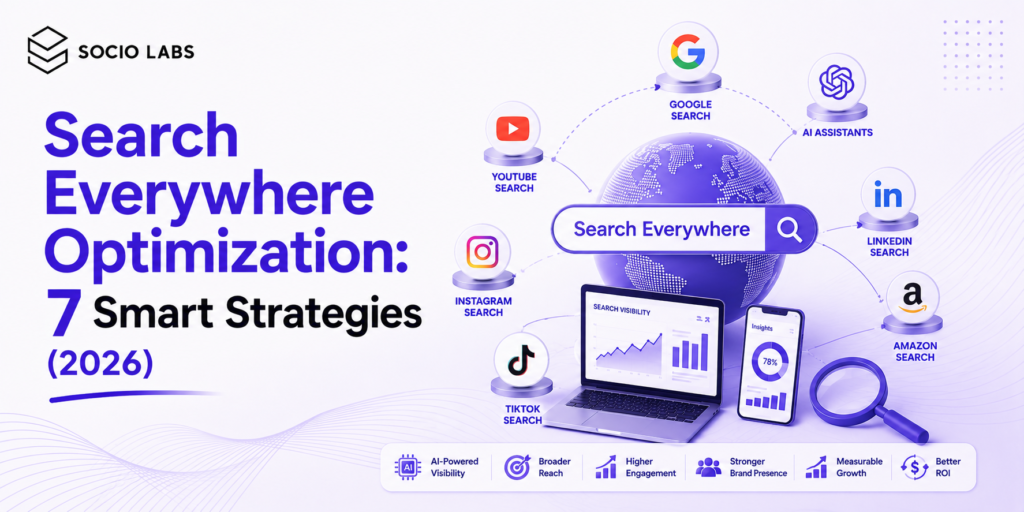
Search Everywhere Optimization is the practical response to a shift most brands haven’t fully registered yet: a growing share of buying research now happens inside ChatGPT, Gemini, Perplexity, and Google’s AI Overviews not on a traditional ten-blue-links results page. Ranking #1 on Google no longer guarantees visibility when the answer itself gets generated and summarized before a user ever clicks through.
This guide breaks down what Search Everywhere Optimization actually means, how it differs from traditional SEO and AI SEO, and how startups, local businesses, e-commerce brands, and SaaS companies can each apply it in 2026. Our team at Socio labs has been restructuring client content specifically for AI citation and entity visibility, so this reflects live implementation work, not speculation.
What Is Search Everywhere Optimization?
Search Everywhere Optimization (SEvO) is the practice of optimizing brand content, entities, and structured data so they appear consistently across every discovery surface a customer might use Google Search, Google AI Overviews, ChatGPT, Gemini, Perplexity, YouTube, Reddit, and LinkedIn rather than optimizing for Google rankings alone. It treats each platform as a distinct discovery channel with its own ranking and citation logic.
Definition of Search Everywhere Optimization
At its core, Search Everywhere Optimization combines traditional SEO, AI Search Optimization, and entity SEO into one coordinated strategy, ensuring a brand’s authority signals are recognizable to both search crawlers and large language models.
Why SEvO Exists
SEvO exists because AI search visibility now depends on how clearly and consistently a brand’s expertise is represented across the web not just how well one website is optimized for Google’s algorithm.
Why Traditional SEO Is No Longer Enough
Traditional SEO alone is no longer enough because a growing share of search queries now get answered directly inside AI Overviews or chat interfaces, meaning a page can rank well and still receive far fewer clicks than it would have two years ago. Visibility now depends on whether content gets cited inside the answer, not just whether it ranks below it.
Changes in Search Behavior
Users increasingly ask conversational, multi-part questions inside ChatGPT or Perplexity instead of typing short keyword queries into Google a shift that rewards clearly structured, directly-answerable content over keyword-dense pages.
Rise of AI Search Engines
Platforms like Perplexity and Gemini now generate synthesized answers by pulling from multiple sources simultaneously, meaning a single ranking position matters less than being one of several trusted, cited sources.
Businesses working with Socio labs are increasingly asked to report AI citation visibility alongside standard keyword rankings a sign of where reporting expectations are heading in 2026.
Search Everywhere Optimization vs Traditional SEO
Search Everywhere Optimization differs from traditional SEO primarily in scope and success metrics: traditional SEO optimizes for ranking position on Google, while SEvO optimizes for citation and mention frequency across Google, AI Overviews, ChatGPT, Gemini, and Perplexity simultaneously. Both rely on quality content, but SEvO adds entity clarity and structured data as core requirements, not optional extras.
Key Differences
Traditional SEO metrics center on rankings, organic traffic, and backlinks; Search Everywhere Optimization Strategy adds AI citation rate, entity recognition, and cross-platform brand mention tracking as equally important signals.
What Businesses Must Change
Businesses shifting toward SEvO need to prioritize clear, standalone definitions and structured content formats the exact style that AI Overview Optimization and LLM SEO reward when models select which sources to cite.
| Factor | Traditional SEO | Search Everywhere Optimization |
|---|---|---|
| Primary goal | Rank on Google search results | Be cited across Google, AI Overviews, ChatGPT, Gemini, Perplexity |
| Core signal | Backlinks, keywords, rankings | Entity clarity, structured data, citation frequency |
| Success metric | Organic traffic, ranking position | AI citation rate + traditional traffic combined |
| Content style | Keyword-optimized long-form | Direct-answer, standalone, structured paragraphs |
How AI Platforms Discover Content
AI platforms discover and select content largely through a combination of crawled web data, structured data (schema markup), and real-time retrieval from search indexes, then rank sources based on clarity, authority signals, and how directly the content answers the query. Each platform weighs these signals slightly differently.
How ChatGPT Finds Information
ChatGPT relies on a mix of its training data and live web browsing (when enabled), favoring content that states definitions and facts clearly in the opening sentences of a section rather than burying them in narrative.
How Gemini and Perplexity Rank Sources
Gemini draws heavily on Google’s search index and Knowledge Graph, while Perplexity actively cites multiple live sources per answer both tend to favor pages with strong entity consistency across the broader web, not just on-page optimization.
- Clear, standalone definitions in the first 1–2 sentences of a section
- Structured data (FAQ schema, Article schema) supporting content claims
- Consistent entity information (name, description, expertise) across multiple sites
- Recent publication or update dates signaling current relevance
Search Everywhere Optimization Strategy for 2026
A working Search Everywhere Optimization Strategy for 2026 combines five components: entity building, multi-platform content distribution, AI citation optimization, knowledge graph optimization, and brand authority signals each reinforcing how consistently and credibly a brand appears across AI systems.
Entity Building
Entity building means ensuring your brand, founders, and core services are described consistently across your website, Google Business Profile, LinkedIn, and industry directories, since inconsistent entity data weakens AI confidence in citing your brand.
Multi-Platform Content Distribution
Publishing the same core expertise across your blog, YouTube, and LinkedIn reworded for each platform’s format increases the surface area for AI systems to encounter and cross-verify your brand’s authority.
AI Citation Optimization
AI citation optimization means writing direct, quotable definitions and data points early in each section, since LLM SEO research shows models tend to pull the clearest standalone statement rather than synthesizing across a long paragraph.
Knowledge Graph Optimization
Structured data Organization schema, Article schema, and consistent NAP (name, address, phone) details helps Google’s Knowledge Graph and, by extension, Gemini correctly associate your brand with its area of expertise.
Brand Authority Signals
Third-party mentions, genuine reviews, and consistent citations across industry sites build the kind of trust signal that both traditional rankings and AI citation frequency depend on.
SocioLabs recommends auditing entity consistency how your brand is described across at least 10 external sources before investing heavily in new content, since inconsistent entity signals undermine even strong content.
Search Everywhere Optimization for Local Businesses
Local businesses apply Search Everywhere Optimization by ensuring consistent NAP data, Google Business Profile optimization, and locally relevant structured data appear not just on their website but across directories AI systems commonly reference. Local SEO has historically focused on Google Maps rankings; SEvO extends that same consistency requirement to AI-generated local recommendations.
Local SEO Evolution
Local SEO is evolving from ranking in the Google Maps 3-pack toward also being the business an AI assistant recommends when someone asks “best [service] near me” conversationally.
AI Search Visibility for Local Brands
AI Search Visibility for local brands depends heavily on review volume, review recency, and consistent business information across Google, Justdial, and other regional directories gaps here directly reduce AI citation likelihood.
Search Everywhere Optimization for E-commerce Brands
E-commerce brands apply Search Everywhere Optimization by ensuring product data is structured consistently across Google Merchant Center, their website, and marketplace listings, since AI-powered shopping search increasingly pulls from structured product feeds rather than page copy alone. Feed accuracy has become as important as content quality for AI-driven product discovery.
Product Discovery Across AI Platforms
Products with complete, accurate structured data (price, availability, reviews, specifications) are more likely to surface correctly when AI shopping assistants compare options across brands.
AI-Powered Shopping Search
As AI-powered shopping search grows, brands with clean Merchant Center feeds and consistent product descriptions across channels are positioned to be recommended, while inconsistent listings risk being filtered out entirely.
Search Everywhere Optimization for SaaS Companies
SaaS companies apply Search Everywhere Optimization primarily through authority building and demand generation content designed to be cited when prospects ask AI tools comparison-style questions like “best [category] software for [use case].” This shifts SaaS content strategy from purely keyword-driven blog posts toward clear, comparison-ready positioning.
Authority Building
Publishing original research, benchmarks, or data-backed comparisons gives AI systems concrete, citable facts to reference generic feature-list content rarely gets cited over more specific, data-driven sources.
Demand Generation Through AI Search
As buyers increasingly research software through ChatGPT or Perplexity before ever visiting a vendor site, demand generation now depends partly on being the cited source inside that AI-generated comparison.
Best Tools for Search Everywhere Optimization
The most useful tools for Search Everywhere Optimization combine traditional SEO platforms with direct testing on AI search interfaces themselves since no single dashboard yet reports AI citation data the way Search Console reports rankings.
- Google Search Console and GA4 for traditional traffic and ranking data
- Google Tag Manager and Looker Studio for consolidated reporting
- Google Merchant Center for e-commerce structured product data
- Semrush and Ahrefs for entity and backlink authority tracking
- ChatGPT, Gemini, Claude, and Perplexity used directly to manually test whether your brand appears in relevant AI-generated answers.
Common Search Everywhere Optimization Mistakes
The most common Search Everywhere Optimization mistakes are over-relying on Google rankings as the sole visibility metric, weak or inconsistent entity signals, thin content that doesn’t stand alone as a citable answer, and having no dedicated AI optimization strategy at all. Each of these quietly limits AI citation potential even when traditional SEO metrics look healthy.
Over-Reliance on Google
Treating Google ranking as the only visibility metric means missing the growing share of research happening inside ChatGPT, Gemini, and Perplexity entirely.
Weak Entity Signals
Inconsistent brand descriptions across your website, social profiles, and directories make it harder for AI systems to confidently associate your brand with its actual area of expertise.
Thin Content
Content that requires reading several paragraphs to extract one clear answer is less likely to be cited than content offering a direct, standalone definition upfront.
No AI Optimization Strategy
Publishing content without considering structured data, entity consistency, or direct-answer formatting means missing citation opportunities that better-structured competitor content will capture instead.
Conclusion
Search Everywhere Optimization reflects a real shift in how people find businesses through AI Overviews, ChatGPT, Gemini, and Perplexity, not just a traditional search results page. Brands that build strong entity consistency, structured data, and direct-answer content now are positioned to stay visible as AI agents and discovery engines continue to reshape search through 2026 and beyond. At Socio labs, this is exactly the shift client strategies are being rebuilt around today.
Ready to improve your visibility across Google, ChatGPT, Gemini, and Perplexity? Talk to SocioLabs and discover how our AI SEO Services and Digital Marketing Services can help your brand stay visible across the next generation of search.
FAQs
It means optimizing brand content and structured data to appear consistently across Google, AI Overviews, ChatGPT, Gemini, and Perplexity, rather than optimizing for Google rankings alone.
They overlap significantly, but SEvO is broader it includes AI SEO plus traditional SEO and entity consistency across every platform where AI systems might discover your brand.
GEO marketing typically focuses specifically on optimizing for generative AI answer engines, while SEvO takes a wider view that also includes traditional search rankings and multi-platform presence.
Yes starting with entity consistency (accurate, matching business information everywhere online) and clear, direct-answer content delivers meaningful gains without requiring a large budget.
No it builds on traditional SEO fundamentals like quality content and technical health, while adding entity and AI citation optimization as additional, necessary layers.