

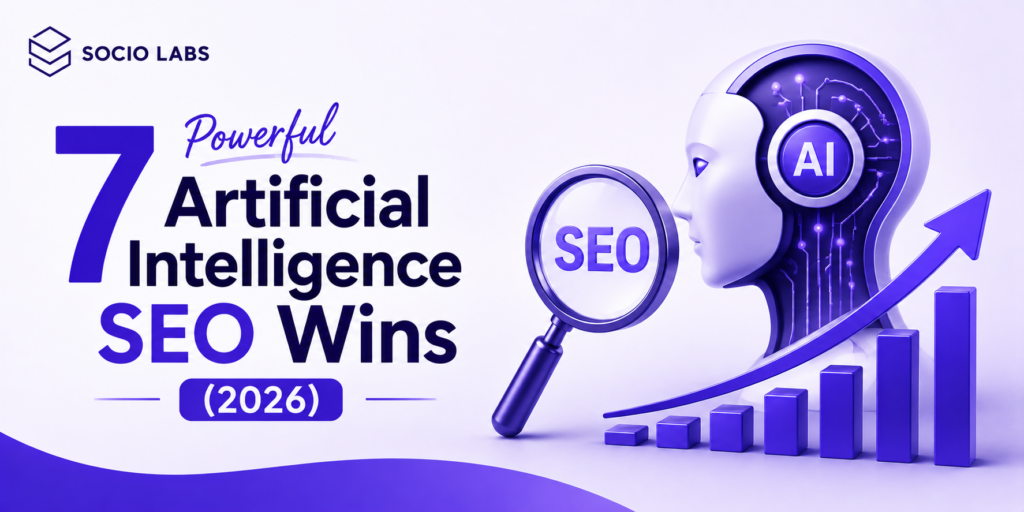
Artificial Intelligence Search Engine Optimization is what separates brands still showing up in ChatGPT, Gemini, and Perplexity answers from those quietly losing visibility as AI reshapes how people search. A page ranking #1 on Google no longer guarantees it gets read increasingly, an AI system reads it, summarizes it, and decides whether to mention your brand at all.
This guide breaks down how AI search engines actually work, what separates AI SEO from traditional SEO, and the specific strategies, tools, and mistakes that determine whether your content gets cited or skipped entirely. Our team at Socio labs has been restructuring client content specifically for AI citation over the past year, so this reflects live campaign work, not theory.
What Is Artificial Intelligence Search Engine Optimization?
Artificial Intelligence Search Engine Optimization is the practice of structuring content, data, and technical signals so AI-powered search systems including Google AI Overviews, ChatGPT, Gemini, Claude, and Perplexity can accurately understand, trust, and cite your content when generating answers. It builds on traditional SEO but adds new requirements specific to how language models process information.
How It Builds on Traditional SEO
Artificial Intelligence SEO still depends on strong technical foundations site speed, mobile usability, and quality backlinks but adds clear entity signals and structured data as equally important ranking factors.
Why the Definition Keeps Evolving
Because AI search engines update their retrieval and citation methods frequently, Artificial Intelligence Search Engine Optimization strategy has to be treated as an ongoing practice, not a one-time technical fix.
Why AI Is Transforming Search
AI is transforming search because a growing share of queries now get answered directly inside a generated response through Google AI Overviews or a chat interface rather than through a list of links a user has to click through themselves. This fundamentally changes what “ranking well” even means.
The Shift From Clicks to Citations
Instead of competing purely for click-through rate, brands are now competing to be one of the few sources an AI system actually references or quotes when constructing its answer.
Why This Matters for Every Industry
AI Search Engine Optimization now affects informational, commercial, and even local queries, meaning virtually no industry is exempt from adapting its content strategy.
Based on campaigns managed by Socio labs, clients who adapted content structure early for AI citation are seeing more consistent visibility than those still optimizing purely for traditional keyword rankings.
Artificial Intelligence Search Engine Optimization vs Traditional SEO
Artificial Intelligence Search Engine Optimization differs from traditional SEO mainly in what counts as success: traditional SEO optimizes for ranking position and click-through rate, while AI SEO optimizes for citation frequency and accurate representation inside AI-generated answers. Both share a foundation in quality content, but the newer discipline adds entity clarity as a core requirement.
What Stays the Same
Site speed, mobile-first design, and genuine topical authority remain just as important under AI Search Optimization as they were under traditional SEO.
What’s Genuinely New
Structured, standalone definitions and consistent entity data across the web are new requirements that traditional SEO checklists rarely prioritized.
| Factor | Traditional SEO | Artificial Intelligence Search Engine Optimization |
|---|---|---|
| Primary goal | Rank on search results page | Get cited inside AI-generated answers |
| Core signal | Backlinks, keywords, on-page SEO | Entity clarity, structured data, direct-answer content |
| Success metric | Organic traffic, ranking position | AI citation frequency + traditional traffic |
| Content style | Long-form, keyword-optimized | Concise, standalone, snippet-ready paragraphs |
How AI Search Engines Understand Content
AI search engines understand content primarily through a mix of crawled web data, structured data markup, and semantic analysis of language evaluating not just keywords, but the actual meaning and relationships between concepts on a page. This is where semantic SEO becomes essential rather than optional.
Semantic Analysis and Context
AI systems assess how clearly a page explains a topic in context, favoring content that defines terms directly rather than assuming prior reader knowledge.
Why Structure Matters as Much as Content
Content broken into clear headings, direct-answer paragraphs, and structured lists is easier for AI systems to parse and extract accurately than dense, unstructured blocks of text.
- Clear, standalone definitions early in each section
- Logical heading hierarchy (H1 → H2 → H3)
- Structured data supporting on-page claims
- Consistent terminology used throughout the page
How Google AI Overviews Impact Rankings
Google AI Overviews impact rankings by inserting a synthesized answer above traditional search results, often pulling from multiple sources at once meaning a page can rank #1 organically and still receive fewer clicks if it isn’t the source quoted inside the Overview itself. This makes being cited inside the Overview arguably more valuable than the ranking position below it.
What Gets Selected for AI Overviews
Google AI Overviews tend to favor concise, well-structured answers backed by credible, established sources rather than pages that require significant scrolling to find the relevant fact.
Adjusting Content Strategy Accordingly
Brands increasingly need to track AI Overview appearance alongside standard rankings in Google Search Console and GA4, since traffic patterns are shifting even for well-ranked pages.
Optimizing Content for ChatGPT, Gemini and Perplexity
Optimizing content for ChatGPT, Gemini, and Perplexity means ensuring your brand’s expertise is represented clearly and consistently across the broader web, since these platforms often draw on both training data and live retrieval rather than a single page’s on-site SEO. Each platform weighs sources somewhat differently, but consistency across all of them compounds trust.
How Perplexity Cites Multiple Sources
Perplexity actively displays multiple cited sources per answer, meaning content with clear factual claims and credible backing has a stronger chance of appearing among the sources shown.
How Gemini Draws on Google’s Ecosystem
Gemini leans heavily on Google’s search index and Knowledge Graph, so strong traditional SEO and Entity SEO work directly benefits Gemini visibility as well.
SocioLabs recommends manually testing brand visibility across ChatGPT, Gemini, and Perplexity monthly, since no automated tool yet reports AI citation data as reliably as Search Console reports rankings.
Entity SEO and Semantic SEO Explained
Entity SEO is the practice of ensuring your brand, products, and expertise are consistently and accurately represented as recognizable “entities” across the web, while Semantic SEO focuses on the meaning and relationships between concepts within your content itself. Both work together to help AI systems confidently understand and cite your brand.
Building Strong Entity Signals
Consistent business information name, description, and area of expertise across your website, Google Business Profile, LinkedIn, and industry directories strengthens entity recognition significantly.
Applying Semantic SEO to Content
Semantic SEO means writing content that clearly connects related concepts (for example, explicitly linking “AI SEO” to “entity consistency” and “structured data”) rather than treating each as an isolated keyword.
Expert Tip: An entity audit checking how your brand is described across at least 10 external sources often reveals inconsistencies most businesses don’t realize are limiting their AI visibility.
Schema Markup and Structured Data for AI Search
Schema markup and structured data help AI search systems accurately parse and trust your content by explicitly labeling what a page is about such as marking up FAQs, articles, products, or organizations in a machine-readable format. Pages without structured data force AI systems to infer context, increasing the chance of misinterpretation.
Most Valuable Schema Types for AI SEO
FAQ schema, Article schema, and Organization schema are among the most directly useful for Artificial Intelligence Search Engine Optimization, since they map cleanly to the kinds of questions AI systems are answering.
Implementation Without Breaking Your Site
Structured data should be tested through Google Search Console and validated carefully, since incorrect markup can create more confusion for search engines than having none at all.
Best Artificial Intelligence Search Engine Optimization Strategies
The best Artificial Intelligence Search Engine Optimization strategies combine entity consistency, structured data implementation, direct-answer content formatting, and multi-platform authority building treated as one coordinated system rather than separate initiatives. No single tactic compensates for weakness in the others.
A Practical Implementation Framework
- Audit entity consistency across your website and major directories
- Implement FAQ, Article, and Organization schema across key pages
- Rewrite top-performing pages with clear, standalone definitions upfront
- Publish original data or research that AI systems can cite directly
- Track AI citation manually across ChatGPT, Gemini, and Perplexity monthly
Where to Start With Limited Resources
Businesses working with Socio labs with limited budgets typically see the fastest returns from entity consistency work first, since it strengthens every other AI SEO effort that follows.
Tools Used in AI Search Optimization
The core tools used in AI Search Optimization combine traditional SEO platforms with direct, manual testing on AI interfaces themselves, since dedicated AI citation tracking tools are still maturing as a category.
| Tool | Primary Use |
|---|---|
| Google Search Console | Tracking rankings, AI Overview appearances |
| GA4 & Looker Studio | Traffic and conversion reporting |
| Google Ads & Microsoft Ads | Paid visibility alongside organic AI SEO |
| ChatGPT, Gemini, Claude, Perplexity | Manual testing of brand citation |
| Schema markup validators | Verifying structured data accuracy |
Expert Tip: Set a recurring monthly reminder to manually check AI citation across at least 3 platforms for your top 5 target queries this single habit catches visibility drops faster than most automated tools currently can.
Common AI SEO Mistakes to Avoid
The most common AI SEO mistakes are relying solely on keyword optimization without addressing entity consistency, publishing thin content that can’t stand alone as a citable answer, ignoring structured data entirely, and tracking only traditional ranking metrics while missing AI citation trends. Each mistake quietly limits visibility even when traditional SEO scores look strong.
Underestimating Entity Consistency
Businesses often assume strong on-page SEO is enough, overlooking that inconsistent brand descriptions across the web actively weaken AI citation confidence.
Ignoring Structured Data
Skipping schema markup because “the content speaks for itself” removes a signal AI systems increasingly rely on to interpret content correctly.
Future of Artificial Intelligence Search Engine Optimization
The future of Artificial Intelligence Search Engine Optimization points toward AI agents that don’t just summarize information but complete tasks comparing, booking, or purchasing on a user’s behalf making brand visibility inside those decision processes more consequential than today’s citation frequency alone. Search is shifting from a results page toward a single synthesized recommendation.
Search Becoming More Conversational
As tools like SearchGPT and voice-driven AI assistants grow, queries are becoming longer and more conversational, rewarding content written to directly answer specific questions.
Preparing for an Agent-Driven Future
Brands with strong entity consistency and structured data today are better positioned as AI agents mature, rather than retrofitting visibility strategy after the shift accelerates further.
How Businesses Can Prepare for AI-First Search
Businesses can prepare for AI-first search by auditing entity consistency across the web, implementing core schema markup, restructuring key content around direct-answer formatting, and building a habit of manually tracking AI citation alongside traditional SEO metrics. None of these require abandoning existing SEO investment they extend it.
A Realistic 90-Day Starting Point
A focused 90-day plan entity audit in month one, schema and content restructuring in month two, citation tracking and refinement in month three gives most businesses a workable starting structure.
Aligning Teams Around One Strategy
SocioLabs recommends briefing content, SEO, and paid media teams on the same entity and positioning data, so every channel reinforces the same AI-recognizable brand signals.
Conclusion
Artificial Intelligence Search Engine Optimization reflects a real, ongoing shift in how people find information through AI Overviews, ChatGPT, Gemini, and Perplexity, not just a traditional list of search results. Businesses that build strong entity consistency, structured data, and direct-answer content today are positioned to stay visible as AI-first search continues to mature through 2026. At Socio labs, this is exactly the shift client SEO strategies are being rebuilt around right now.
Ready to make sure your brand gets cited, not skipped, by AI search engines? Talk to SocioLabs and see how our AI SEO Services and Digital Marketing Services can help your business stay visible across Google, ChatGPT, Gemini, and Perplexity.
FAQs
It's the practice of structuring content and data so AI systems like Google AI Overviews, ChatGPT, and Gemini can accurately understand, trust, and cite your brand when generating answers.
No it builds on traditional SEO fundamentals like site speed and quality content while adding entity consistency and structured data as additional, necessary layers.
Entity and schema improvements can show citation changes within 4–8 weeks, though building broader authority signals typically takes longer, similar to traditional SEO timelines.
Small businesses can start in-house with entity audits and basic schema markup, though an AI SEO agency helps significantly once multi-platform citation tracking and content restructuring are needed at scale.
Keyword optimization targets specific search terms, while Entity SEO focuses on ensuring your brand itself is consistently and accurately recognized as a trusted source across the web.