
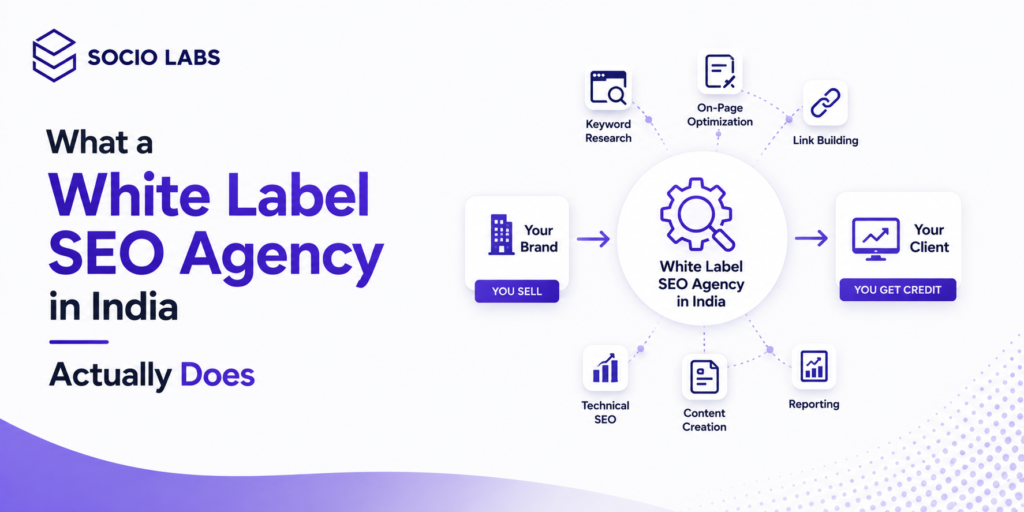
Most agency owners hit the same wall eventually: clients keep asking for SEO, but hiring an in-house SEO team means months of recruitment, training, and a fixed cost that doesn’t scale down when work slows. A white label seo agency in india solves this specific problem letting an agency sell SEO under its own brand while a specialized partner handles fulfillment behind the scenes.
Businesses evaluating this model can start by exploring SEO Services from SocioLabs to understand what fulfillment actually looks like in practice. This guide walks through how white-label SEO works, what’s typically included, realistic pricing structures, and exactly what to ask before choosing a partner written for agency owners actually making this decision, not marketers browsing definitions.
What Is a White Label SEO Agency in India?
A white label seo agency in india is a specialized SEO provider that delivers SEO work strategy, execution, reporting on behalf of another agency, while that agency’s own branding stays visible to the client. The client never sees or interacts with the fulfillment partner directly.
This differs from an “SEO reseller” only in emphasis reseller typically implies pure resale with minimal involvement, while white-label fulfillment often includes closer collaboration on strategy, even though the end branding arrangement is the same.
A simple example makes this concrete: Agency A sells an SEO package to Client X under Agency A’s own brand. A white-label partner, Agency B, handles the actual keyword research, technical audits, and content execution. Client X only ever sees reports and communication branded as Agency A Agency B’s involvement stays invisible.
This model exists because SEO requires specialized, continuously updated expertise that’s expensive to build in-house for agencies whose core focus might be web design, branding, or PPC instead.
How Does White Label SEO Work?
White-label SEO works through a defined handoff process the reselling agency manages the client relationship, while the fulfillment partner executes the technical and content work, with reporting flowing back branded under the agency’s own name.
The typical workflow follows a consistent sequence:
- Client acquisition the reselling agency sells the SEO package under its own brand
- Requirement gathering — the agency shares client goals, website access, and target markets with the fulfillment partner
- Strategy development — the white-label partner builds a technical audit and keyword strategy, often reviewed jointly with the agency
- Fulfillment execution — technical fixes, content, and link building get carried out by the partner’s team
- Content and technical delivery — deliverables get packaged for agency review before anything goes live
- Reporting — performance data gets compiled into white-labeled reports carrying the agency’s branding
- Client communication — the agency presents results directly, keeping the fulfillment relationship invisible
- Ongoing optimization — the partner adjusts strategy monthly based on performance data and agency feedback
Ownership matters here: the reselling agency owns the client relationship and communication entirely, while the fulfillment partner owns execution quality and technical delivery a clear split most well-structured partnerships maintain deliberately.
What Services Does a White Label SEO Provider Offer?
A white-label SEO provider typically offers the full range of standard SEO services audits, technical fixes, keyword research, content, link building, and local SEO packaged so an agency can present them as its own without building internal capability for each.
| Service | What the Provider Does | What the Agency Receives | Client Benefit |
|---|---|---|---|
| SEO audit | Technical and content site analysis | White-labeled audit report | Clear baseline and priorities |
| Technical SEO | Site speed, crawlability, indexing fixes | Implementation summary | Stronger site performance |
| Keyword research | Search demand and intent mapping | Keyword strategy document | Content aligned to real demand |
| On-page optimization | Titles, content structure, internal linking | Optimized page deliverables | Better relevance and rankings |
| Content strategy & blog content | Content calendar and writing | Ready-to-publish content | Ongoing organic visibility |
| Local SEO | Google Business Profile, citations | Local optimization report | Improved local search presence |
| Link building | Outreach and placement | Link acquisition report | Stronger domain authority |
| Monthly reporting | Performance data compilation | Branded client-ready report | Transparent progress tracking |
Some providers, including those offering AI SEO Services, now also fold in structured data and entity optimization work aimed at visibility inside AI-powered search results, not just traditional rankings worth asking about specifically if this matters for your clients.
Why Do Agencies Use White Label SEO Services?
Agencies use white-label SEO primarily to scale service offerings without the cost and time of hiring specialized in-house talent letting them say yes to SEO clients immediately rather than turning away work outside their core expertise.
Faster scaling is the clearest benefit. An agency can start offering SEO the same week a client asks for it, rather than spending months recruiting and training a team that may sit underutilized between projects.
- Faster scaling — start offering SEO without a hiring cycle
- Lower hiring burden — no recruitment, training, or management overhead for a specialized skill
- Access to specialists — technical SEO and content expertise without building it internally
- Recurring revenue opportunities — SEO retainers add predictable monthly income to existing accounts
- Operational flexibility — scale fulfillment up or down based on actual client demand
None of this guarantees profitability on its own margin depends on pricing structure and how efficiently the partnership runs, which is why choosing the right provider matters more than the model itself.
White Label SEO vs In-House SEO vs SEO Outsourcing
White-label SEO, in-house SEO, and traditional outsourcing differ mainly in branding control and management effort white-label preserves the agency’s branding entirely, in-house offers full control at higher cost, and traditional outsourcing sits in between with less branding consistency.
| Factor | White Label SEO | In-House SEO | Traditional Outsourcing |
|---|---|---|---|
| Cost structure | Pay per client/project, scales with volume | Fixed salary and overhead | Variable, often project-based |
| Hiring | None required | Recruitment and training needed | None required |
| Scalability | High — scales with client volume | Limited by team size | Moderate |
| Control | Shared, agency directs strategy | Full control | Limited, less strategic input |
| Expertise access | Immediate, specialized | Depends on hires made | Varies by vendor |
| Management effort | Low to moderate | High (team management) | Low |
| Branding | Fully agency-branded | Naturally agency-branded | Often not white-labeled |
| Client ownership | Agency retains full ownership | Agency retains full ownership | Sometimes shared or unclear |
| Fulfillment responsibility | Partner executes, agency reviews | Internal team executes | Vendor executes, less oversight |
Smaller agencies without existing SEO capability typically benefit most from white-label arrangements, while larger agencies with consistent SEO demand across many clients may eventually find in-house hiring more cost-effective at scale.
How Much Does White Label SEO Cost?
White-label SEO pricing is typically structured as per-client fees, monthly retainers, package-based tiers, or per-project pricing the right model depends on how predictable and scalable an agency needs its costs to be.
Per-client pricing charges a flat or scaled fee for each client account, while monthly retainers work well for agencies with steady, recurring SEO demand across their client base. Package-based tiers (basic, growth, premium) simplify quoting for agencies reselling to their own clients, and per-project pricing suits one-off work like audits or migrations.
What Actually Drives Cost
Several factors determine actual pricing regardless of model: website size and technical complexity, industry competitiveness, number of target keywords, content volume required, and link-building intensity all scale cost up or down.
Agency margins depend on the gap between wholesale fulfillment cost and what the agency charges its own client this varies significantly by market positioning and shouldn’t be assumed at a fixed percentage without checking actual provider quotes.
How to Choose a White Label SEO Partner in India
Choosing a white-label SEO partner means evaluating technical capability, reporting transparency, and communication reliability not just price, since the fulfillment partner’s quality directly reflects on the reselling agency’s own reputation.
A practical evaluation checklist:
- SEO expertise across technical, on-page, and content work
- Transparent reporting that’s genuinely white-labelable
- Clear turnaround times for deliverables and revisions
- Sample work or case studies demonstrating real capability
- Confirmed NDA and client confidentiality practices
- Defined account management and communication process
- Scalability to handle growing client volume without quality drops
Red Flags to Watch For
Be cautious of partners unwilling to share sample reports, vague about who actually performs the work, or offering pricing significantly below market without a clear explanation of reduced scope.
What Should Agencies Ask Before Hiring a White Label SEO Provider?
Before hiring, agencies should ask specific operational questions not general capability questions since the answers reveal whether a partner can reliably support an ongoing client relationship.
- Who actually performs the SEO work in-house team or further subcontracted?
- Can all deliverables and reports be fully white-labeled?
- How are reports branded, and can templates be customized?
- How is keyword research conducted, and is it client-specific?
- What link-building methods are used, and can sources be reviewed?
- How are technical issues communicated, and how quickly?
- What’s the standard turnaround time for deliverables?
- Can fulfillment capacity scale as client volume grows?
- How are revisions handled, and is there a revision limit?
- What happens to work in progress if a client cancels?
- Is client data and account access kept confidential?
- How much direct account management support is included?
Vague or evasive answers to any of these matter more than how polished the sales pitch sounds SocioLabs recommends treating this list as a hard filter, not a formality.
Common White Label SEO Mistakes to Avoid
The most common white-label SEO mistakes are choosing a partner on price alone, skipping a review of sample work, and failing to define clear responsibilities upfront all of which surface as client-facing problems months later.
Choosing purely on price often means accepting reduced scope or lower-quality link building without realizing it until rankings underperform or, worse, a client’s site gets penalized.
- Choosing only on price — verify what’s actually included before comparing numbers
- Poor communication — confirm response times before signing, not after an issue arises
- Low-quality backlinks — always ask about link sources and methods specifically
- Generic content — request writing samples relevant to your client’s industry
- No clear SLA — define turnaround times and revision policies in writing upfront
- Overpromising rankings — avoid partners guaranteeing specific rankings or positions
- Not checking sample work — always review real examples before committing
- Failing to define responsibilities — clarify who handles client communication versus execution
Conclusion
A white label seo agency in india gives agencies a practical way to offer SEO without the cost and delay of building an internal team but the model only works well when the partnership is chosen carefully. Transparency, defined responsibilities, and honest reporting matter more than price alone, since fulfillment quality directly reflects on the reselling agency’s own reputation. Agencies ready to explore this can look at Performance Marketing Services from SocioLabs alongside SEO fulfillment to understand how a broader partnership might work.
Looking for a reliable SEO fulfillment partner to expand your agency’s service offering? Talk to SocioLabs about a scalable, white-labeled approach built around transparent reporting and clear ownership from day one.
FAQs
A white-label SEO agency delivers SEO work strategy, execution, reporting on behalf of another agency, while that agency's own branding remains visible to the end client throughout.
The reselling agency manages the client relationship while a fulfillment partner executes the technical and content work, with reports and communication branded under the reselling agency's name.
It can be, depending on the margin between wholesale fulfillment cost and client pricing profitability isn't guaranteed and depends heavily on partner selection and pricing structure.
Typical services include technical audits, on-page optimization, keyword research, content strategy, link building, local SEO, and monthly reporting, packaged for agency resale.
Evaluate technical capability, reporting transparency, sample work, and communication reliability and treat vague answers to direct operational questions as a warning sign.