

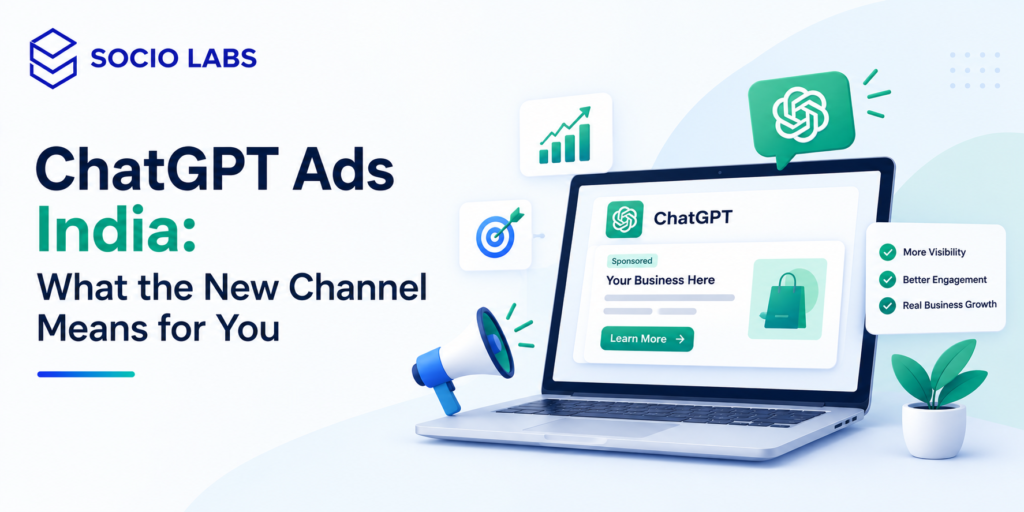
Advertising inside a conversation is a genuinely different discovery moment than advertising inside a search results page and it’s now live in India. ChatGPT Ads India stopped being a hypothetical in late August 2026, which means marketers who were watching from the sidelines now have an actual channel to evaluate, not a future prediction.
Our team at SocioLabs has been mapping what this launch actually means for Indian advertisers rather than repeating the hype where genuine early opportunity exists, what remains unproven, and how this fits alongside existing paid media work with a performance marketing agency in India. This guide covers how the platform works, what to realistically expect, and how to prepare before committing meaningful budget.
What Are ChatGPT Ads?
ChatGPT advertising is a form of conversational digital advertising that lets businesses reach users through sponsored placements appearing beneath relevant ChatGPT responses, distinct from traditional search or feed-based display advertising.
Unlike a Google search results page or a Meta feed, ads here appear inside an ongoing conversation a single labeled card beneath the AI’s answer, built from six fixed elements: advertiser name, favicon, headline, description, image, and landing page link. This compactness forces a different creative approach than a multi-asset Google or Meta campaign.
The format matters because it meets users at a genuinely different moment mid-conversation, often while actively working through a decision rather than interrupting a scroll or capturing an explicit search query.
Are ChatGPT Ads Available in India?
Yes ChatGPT Ads India launched on August 28-29 2026,
India matters significantly here given the scale of its digital user base and OpenAI’s stated interest in the market. This isn’t a limited pilot in a small test market it’s a genuine, prioritized launch.
Self-serve access for Indian advertisers came with a ₹725 daily minimum budget, a relatively accessible floor compared to some international markets, though actual campaign costs will depend heavily on competition and targeting choices.
How Do ChatGPT Ads Work?
ChatGPT Ads work through relevance matching advertisers describe the conversational contexts where their product fits, and OpenAI’s system serves the closest-matching ad beneath a response when that context is genuinely relevant to the conversation.
The ad itself never influences what ChatGPT actually says. The AI-generated response stays the same regardless of advertising, with a clearly labeled sponsored card appearing separately beneath it OpenAI has been explicit about maintaining this separation.
For a business owner, the practical takeaway is that ad delivery depends on genuine contextual relevance, not simply outbidding competitors for a fixed keyword slot the way Google Ads auctions work.
What Is ChatGPT Ads Manager?
ChatGPT Ads Manager is OpenAI’s self-serve platform for creating, launching, and monitoring ad campaigns, built around a Campaign → Ad Group → Ad structure similar in concept to other digital advertising platforms, though with its own specific mechanics.
Campaign-level settings cover budget, schedule, and bidding approach; ad groups hold the plain-language “context hints” that drive targeting and can each pursue different conversion goals; ads themselves carry the actual creative. Performance data impressions, clicks, spend, and conversions where configured is available in dashboard, table, and chart views.
Platform capabilities here are genuinely still evolving. Features available today may expand meaningfully over the coming months as adoption grows, so treat current functionality as a starting point, not a finished product.
ChatGPT Ads vs Google Ads vs Meta Ads
ChatGPT Ads differ from Google and Meta primarily in targeting logic and discovery moment Google captures explicit search intent, Meta targets audience demographics and interests, while ChatGPT Ads target conversational context through descriptive hints rather than either mechanism.
| Factor | ChatGPT Ads | Google Ads | Meta Ads |
|---|---|---|---|
| User intent | Active, in-conversation decision-making | Explicit search query | Passive browsing/discovery |
| Discovery behavior | Mid-conversation, contextual | Query-triggered | Feed-triggered |
| Ad format | Single labeled card | Text/shopping/display | Feed/story/reel |
| Targeting | Context hints (plain language) | Keywords (exact/broad match) | Demographics/interests |
| Measurement | Native metrics + emerging Conversions API | Mature, granular | Mature, granular |
| Funnel stage | Consideration, often research-heavy | Intent-to-action | Awareness to consideration |
| Best use case | Testing a new discovery surface | High-intent conversion | Broad awareness/consideration |
Given how new the measurement infrastructure is here compared to Google and Meta’s years of refinement, most advertisers are better served treating ChatGPT Ads as a test allocation rather than a primary budget line right now.
How Can Indian Businesses Use ChatGPT Advertising?
Indian businesses across e-commerce, SaaS, education, travel, and local services can use ChatGPT advertising to reach users during genuine research and comparison moments though the value varies significantly by how naturally your category fits conversational discovery.
E-commerce and D2C brands may find value reaching shoppers actively comparing options mid-conversation. SaaS and B2B companies could reach buyers researching solutions during genuinely evaluative conversations, a stage where traditional display ads rarely land well. Education and travel businesses, where users often ask detailed, multi-turn questions, may find particularly natural fit for contextual ad placement.
Local service businesses face a harder path currently ChatGPT Ads targeting works through conversational context rather than the hyperlocal geographic precision that Google Maps or local search ads offer, so expectations should be calibrated accordingly.
ChatGPT Ads Targeting and Audience Capabilities
ChatGPT Ads targeting currently works through context hints and country-level targeting, describing relevant conversation topics in plain language rather than the keyword lists, demographic filters, or custom audience uploads common on Google and Meta.
Confirmed today: context hints at the ad-group level, country targeting, and conversion goal selection per ad group.
Emerging or evolving: more granular audience capabilities and product feed integration are areas the platform will likely develop further as advertiser tools mature don’t assume feature parity with Google or Meta’s targeting depth yet.
Advertisers cannot target individual users based on private conversation content targeting operates on aggregate contextual relevance, not personal data drawn from what any specific user has typed.
How Does CPC Bidding Work in ChatGPT Ads?
CPC bidding in ChatGPT Ads means you pay per click your ad receives, set at the ad-group level alongside CPM (pay per thousand impressions) and oCPC (bidding optimized toward a downstream conversion action once tracking is configured).
CPC suits campaigns focused on driving traffic and engagement, CPM suits pure visibility and awareness goals, and oCPC suits advertisers with conversion tracking already in place who want the system optimizing toward actual outcomes rather than clicks alone.
For performance marketers used to Google Ads’ mature bidding algorithms refined over two decades, ChatGPT’s bidding system should be treated as considerably less proven. Businesses already running structured PPC services in India across Google and Meta have a natural head start here, since the underlying bid-management discipline transfers even though the mechanics differ.
How to Measure ChatGPT Ads Performance
Measure ChatGPT Ads performance through native metrics impressions, clicks, CTR, CPC or CPM in Ads Manager, then connect actual business outcomes through conversion tracking rather than judging campaigns on platform-reported clicks alone.
Clicks and impressions tell you about reach, not revenue. Setting up a Conversions API or pixel-based measurement connection, alongside standard UTM tagging into GA4, is essential before you can honestly evaluate cost per acquisition or ROAS from this channel pairing this with generative engine optimization services can also help ensure your broader content and entity signals are ready for the kind of cross-platform, AI-driven discovery this channel represents.
- Impressions, clicks, and CTR (platform-native)
- CPC or CPM (cost efficiency)
- Conversions via API/pixel once configured
- Cost per acquisition and ROAS, calculated against actual revenue
- New customer acquisition specifically, not just total conversions
Privacy, Data and Trust in ChatGPT Advertising
No advertisers do not get access to the private content of ChatGPT conversations. Advertisers receive aggregate performance data (impressions, clicks, conversion events), not the ability to view what any individual user actually typed.
This separation is a deliberate design choice OpenAI has stated publicly, distinguishing conversational advertising from a system that would raise far more significant privacy concerns. Ads also remain clearly labeled and structurally separate from ChatGPT’s actual generated responses.
For Indian businesses, this means campaign optimization has to rely on aggregate patterns and conversion outcomes rather than granular user-level insight a genuine constraint worth factoring into expectations upfront.
What Opportunities Do ChatGPT Ads Create for Indian Businesses?
ChatGPT Ads create a genuine early-mover opportunity reaching users during active research conversations, diversifying acquisition beyond Google and Meta, and testing a new discovery surface before it becomes as competitive and expensive as established channels.
Early advertiser advantage is real but time-limited; costs and competition on any new ad platform typically rise as more advertisers arrive. There’s also a strategic diversification benefit reducing dependence on two dominant paid channels by building experience on a third, meaningfully different one.
The realistic limitation: measurement maturity and historical benchmarks don’t yet exist the way they do for Google or Meta, so early results should inform learning, not large-scale budget decisions immediately.
Challenges Indian Advertisers Should Expect
The main challenges are a genuine learning curve on new mechanics, limited historical performance benchmarks, and measurement infrastructure that’s still less mature than established platforms.
Creative experimentation will take longer to converge on what works, since there’s no multi-year playbook of proven ad formats to reference yet. Attribution also gets harder in a multi-channel environment when one of the channels lacks the granular tracking history of Google or Meta.
Budget testing should be treated as genuinely exploratory expect to learn more about what doesn’t work initially than to find an immediately optimized formula.
How Should Indian Businesses Prepare for ChatGPT Ads?
Preparing for ChatGPT Ads means getting measurement and creative foundations right before spending meaningfully most early mistakes come from skipping this groundwork, not from the platform itself.
Step 1: Define Conversion Goals
Decide specifically what a successful conversion looks like a purchase, a lead form, a sign-up before launching, since this determines your bidding and tracking setup entirely.
Step 2: Prepare Landing Pages
Ensure landing pages match exactly what your ad promises, since inconsistency between ad and page hurts conversion rates regardless of channel.
Step 3: Improve Conversion Tracking
Set up GA4, Google Tag Manager, and the Conversions API or pixel integration before launch, not after you’re already spending.
Step 4: Build Creative and Messaging Assets
Develop creative specific to conversational context rather than repurposing existing display or search ad assets directly.
Step 5: Start With Controlled Budgets
Begin with a small, defined test budget rather than a significant initial commitment, given how new and unproven this channel currently is.
Step 6: Measure Incremental Results
Compare performance against a genuine baseline rather than assuming any conversion is incremental to what would have happened anyway.
Step 7: Integrate AI Advertising Into Your Wider Marketing Strategy
Treat ChatGPT Ads as one part of a coordinated plan alongside Google Ads, Meta Ads Manager, and your CRM not an isolated experiment disconnected from everything else.
Will ChatGPT Ads Replace Google and Meta Ads?
No new advertising channels typically complement established platforms rather than replacing them, and ChatGPT Ads is very unlikely to be an exception given how differently it currently operates from mature search and social advertising.
Channel diversification is the more realistic framing. Businesses that build ChatGPT Ads into their broader budget allocation as one testable channel among several tend to make better decisions than those treating it as either irrelevant or a wholesale replacement for proven strategies.
Multi-channel marketing has always rewarded measured testing over all-or-nothing bets on any single platform, and that principle applies here as much as it did to any previous new advertising channel’s launch.
Conclusion
ChatGPT Ads India represents a genuinely new discovery surface, not a minor feature update but the realistic path forward is measured testing, not an immediate budget overhaul. Businesses that get conversion tracking and creative foundations right before scaling spend will learn far more useful information than those rushing in without proper measurement. SocioLabs treats this the same way any new channel deserves to be treated: test deliberately, measure honestly, and integrate what works into a broader strategy rather than chasing a new platform in isolation.
Ready to test ChatGPT Ads alongside your existing paid media strategy? Talk to SocioLabs about building a measured, cross-channel approach that puts proper tracking and creative foundations in place before you scale spend on this emerging channel.
Frequently Asked Questions
Yes ChatGPT Ads launched in India in late August 2026.
India's self-serve access came with a ₹725 daily minimum budget; actual cost per click or impression depends on competition and targeting, with no established universal benchmark yet given how new the channel is.
Not inherently they serve different discovery moments and intent types, so "better" depends on your specific goals, with most businesses better served testing both rather than choosing one over the other.
No OpenAI has stated that sponsored ads appear separately beneath a response and don't influence the actual AI-generated answer content itself.
Businesses with existing paid media discipline, proper conversion tracking, and budget flexibility to treat this as a genuine test allocation are best positioned to evaluate the channel responsibly right now.