
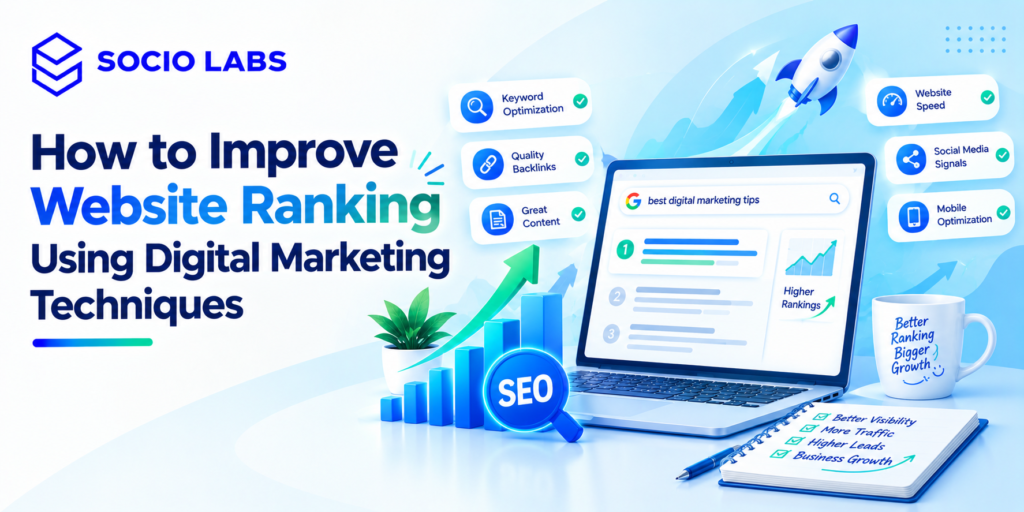
Most businesses treat “improving website ranking” as a single task handed to one person doing SEO in isolation when in reality, ranking improvements usually come from several digital marketing techniques working together: content, links, technical fixes, and even social and paid activity that indirectly supports organic visibility. Search engine optimization and digital marketing aren’t separate disciplines competing for budget; the strongest ranking results tend to come from treating SEO as the core, supported by the rest of the marketing mix. This guide breaks down exactly which digital marketing techniques actually move website rankings, and how to combine them into one coherent approach. Along the way, we’ll reference how an agency such as SocioLabs typically structures this combined approach for businesses across India.
How Does Digital Marketing Improve Website Ranking?
Digital marketing improves website ranking by combining search engine optimization content, technical structure, and backlinks with supporting activities like content distribution, social engagement, and brand visibility that indirectly strengthen the trust and relevance signals search engines use to rank pages.
Website ranking isn’t driven by SEO alone in isolation. A well-optimized page still needs traffic, engagement, and visibility to build the authority signals search engines reward which is where broader digital marketing techniques come in. Content marketing creates the material worth ranking in the first place, social media marketing helps that content get discovered and shared, and even paid marketing can indirectly support rankings by driving traffic and brand searches that build overall site authority.
Treating these as one connected system, rather than separate departments working independently, is typically what separates businesses that see steady ranking improvement from those stuck with technically correct but under-promoted content.
What Is the Relationship Between SEO and Digital Marketing?
Search engine optimization is one component within the broader discipline of digital marketing SEO focuses specifically on organic search visibility, while digital marketing also includes paid advertising, social media, email, and content distribution, many of which directly or indirectly support SEO performance.
SEO depends on signals like content quality, technical health, and backlinks, all of which are strengthened by other digital marketing activities: content marketing produces the pages that can rank, social media marketing increases content visibility and potential link acquisition, and email marketing drives repeat traffic and engagement signals. In this sense, SEO isn’t competing with digital marketing it’s the organic search layer within a larger, interconnected marketing strategy, and website ranking typically improves fastest when these pieces are planned together rather than in isolation.
What On-Page Techniques Improve Website Ranking?
On-page techniques improve website ranking by making each page more clearly relevant to its target query through optimized title tags, headings, content depth, and internal linking so search engines can accurately understand and rank the page.
Core on-page techniques include writing unique, keyword-relevant title tags and meta descriptions for every page, using one clear H1 and a logical heading structure (H2s, H3s) that organizes content around subtopics, ensuring content thoroughly answers the target query rather than offering thin or repetitive coverage, adding descriptive alt text to images, and building internal links between related pages to help both users and search engines navigate the site’s content structure.
These fixes are often the fastest, lowest-cost way to see ranking movement, since they directly address how clearly a search engine can interpret what a page is about and how authoritative it appears relative to competing pages.
What Off-Page Techniques Improve Website Ranking?
Off-page techniques improve website ranking primarily through backlinks links from other reputable websites pointing to yours along with brand mentions, reviews, and other external trust signals that search engines use to assess authority.
Effective off-page approaches include earning natural backlinks through genuinely useful, link-worthy content (original research, detailed guides, tools), building relationships with industry publications or partners for guest content opportunities, maintaining a complete, accurate presence on relevant business directories and local listings, and encouraging genuine customer reviews on platforms like Google Business Profile, which support both local ranking and overall trust signals.
Off-page SEO tends to be the slowest-paying technique, since earning genuine authority takes time which is exactly why it benefits from being paired with strong content and consistent promotion rather than pursued as a standalone, rushed tactic.
How Does Content Marketing Support Website Ranking?
Content marketing supports website ranking by producing the pages search engines actually rank well-researched, intent-matched content that targets real search queries tends to earn both organic traffic and the backlinks that strengthen domain authority over time.
Practical ways content marketing drives ranking improvement include targeting specific, researched keywords with dedicated content rather than vague, broad topics, structuring content to directly and thoroughly answer the query behind each target keyword, publishing consistently so the site continues building topical relevance and fresh signals, and updating older content periodically rather than letting it go stale and lose ranking position over time.
Example (hypothetical): A B2B software company publishing one generic “about our industry” post per month sees minimal ranking movement. After shifting to specific, keyword-researched guides answering real buyer questions, several pages begin ranking within a few months the content effort didn’t increase, but its alignment with actual search demand did.
How Does Technical SEO Affect Website Ranking?
Technical SEO affects website ranking by ensuring search engines can properly crawl, index, and understand a site issues like slow load speed, poor mobile experience, broken links, or blocked pages can prevent even excellent content from ranking at all.
Key technical factors influencing ranking include page load speed, since slow sites hurt both rankings and user experience, mobile-friendliness, given Google’s mobile-first indexing approach, a clean XML sitemap and properly configured robots.txt file, so important pages are discoverable, HTTPS security, and the elimination of crawl errors or broken internal links that waste crawl budget and confuse search engines about site structure.
Technical issues often go unnoticed because they don’t show up as obviously as thin content does a regular technical audit through Google Search Console is one of the more reliable ways to catch problems before they visibly affect rankings.
Can Paid Marketing Indirectly Improve Website Ranking?
Paid marketing doesn’t directly influence organic rankings Google has confirmed ad spend isn’t a ranking factor but it can indirectly support ranking efforts by driving traffic that increases brand visibility, search demand, and potential backlink or social sharing opportunities.
Indirect support from paid marketing includes increasing brand awareness that leads to more branded searches over time, which can be a positive trust signal, driving traffic to strong content that’s more likely to be shared or linked to once discovered, and allowing faster testing of which messaging and topics resonate, informing which content is worth investing further SEO effort into. Businesses running performance marketing campaigns alongside SEO often use paid data to validate which topics and offers are worth building deeper organic content around.
This distinction matters: paid ads won’t move your organic ranking position directly, but a well-coordinated paid and organic strategy can accelerate the visibility that supports ranking growth indirectly.
How Does Social Media Marketing Support SEO?
Social media marketing supports SEO indirectly by increasing content visibility and distribution, which can lead to more traffic, more potential backlinks, and stronger brand recognition even though social signals themselves aren’t a confirmed direct Google ranking factor.
Practical ways social media marketing supports ranking include distributing new content to a wider audience immediately after publishing, increasing the likelihood that journalists, bloggers, or industry sites discover and link to it, building brand familiarity that can translate into more direct and branded search queries, and extending the lifespan and reach of content beyond what organic search alone would achieve in its early weeks after publishing.
Social media won’t substitute for strong on-page or technical SEO, but as part of a coordinated strategy, it meaningfully expands the audience that might discover, share, and eventually link to your content.
How Should Businesses Measure Ranking Improvement?
Website ranking improvement should be measured using organic traffic growth, keyword position tracking, and organic conversion metrics tracked through Google Search Console and GA4 reviewed monthly or quarterly rather than expecting rapid, short-term shifts.
Relevant metrics include average keyword position changes for target queries over time, organic sessions and impressions trends in Search Console, click-through rate from search results, which can improve even without a position change through better titles and descriptions, and organic traffic’s contribution to leads or conversions, not just visit volume. Because ranking improvements compound gradually, especially with newly implemented techniques, a realistic review cadence (monthly, with deeper quarterly reviews) gives a more accurate picture than reacting to daily fluctuations.
Common Mistakes That Hurt Website Ranking
Focusing only on on-page SEO while ignoring off-page authority building. Publishing content without keyword research, missing genuine search demand. Ignoring technical issues like slow load speed or poor mobile experience. Treating SEO as a one-time project instead of an ongoing, combined effort. Expecting paid advertising to directly move organic rankings. Neglecting content promotion and distribution after publishing. Chasing backlinks through low-quality or manipulative link schemes, risking penalties. Not tracking keyword position and organic traffic trends to know what’s actually working.
Conclusion
Improving website ranking isn’t about one isolated SEO fix it’s about combining on-page optimization, technical health, content marketing, and supporting digital marketing activities like social distribution into one coordinated effort. Start with the fundamentals keyword-aligned content and technical health then layer in promotion and off-page authority building, tracking progress through Search Console and GA4 over a realistic, multi-month timeline.
Want a digital marketing approach built specifically to improve your website’s search ranking? Explore SEO services from SocioLabs and see how a combined, strategy-first approach could work for your business.
FAQs
Digital marketing supports ranking by combining SEO fundamentals (content, technical health, backlinks) with content distribution, social visibility, and traffic generation that strengthen the overall trust and relevance signals search engines use.
Yes SEO is one component within the broader discipline of digital marketing, specifically focused on organic search visibility, alongside paid advertising, social media, content, and email marketing.
No Google has confirmed ad spend isn’t a direct ranking factor, though paid marketing can indirectly support rankings through increased visibility and content validation.
On-page fixes like optimized title tags, clear headings, and improved content depth typically show the fastest measurable impact, especially on pages with existing but underperforming content.
Not directly, but social media distribution increases content visibility, which can lead to more traffic, shares, and potential backlinks that do support ranking indirectly.