
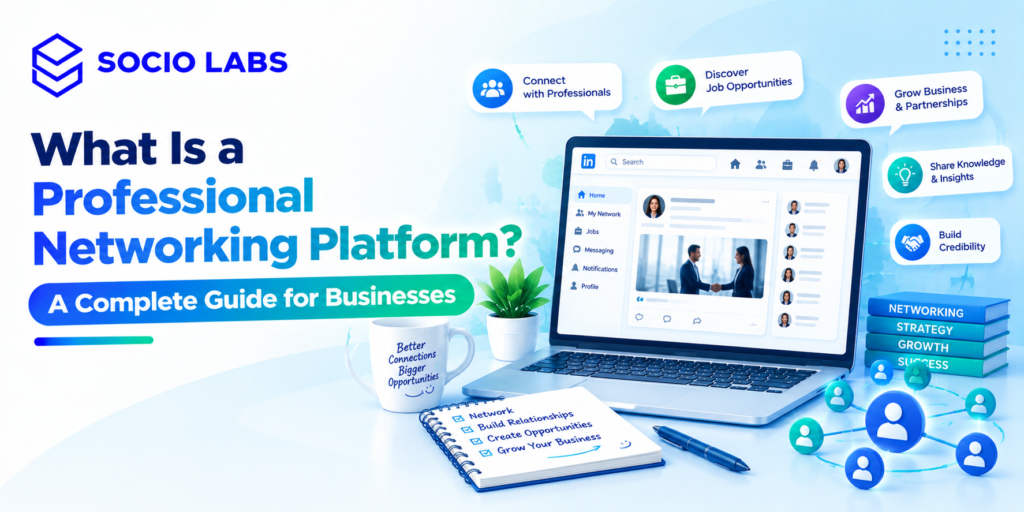
A professional networking platform like LinkedIn often gets treated as a digital resume a place to update a job title once a year and otherwise ignore. For businesses, that’s a missed opportunity: these platforms are where decision-makers research vendors, where B2B leads actually originate, and where thought leadership quietly builds trust long before a sales conversation starts. This guide breaks down what a professional networking platform actually offers businesses, how to build a presence that drives real results, and the mistakes that keep most company pages invisible. Along the way, we’ll reference how an agency such as SocioLabs typically structures professional networking platform strategy for businesses across India.
What Is a Professional Networking Platform?
A professional networking platform is an online service built specifically for career-related and business connections allowing individuals and companies to build profiles, share industry content, and connect with colleagues, prospects, and partners in a professional context rather than a personal or entertainment-focused one.
Unlike general social media, a professional networking platform is built around credibility signals: job titles, company affiliations, endorsements, and industry-specific groups or communities. Businesses use these platforms for recruiting, brand visibility, thought leadership, and B2B lead generation often with far higher-intent audiences than broader social platforms, since users are already in a professional mindset when browsing.
Why Should Businesses Use a Professional Networking Platform?
Businesses should use a professional networking platform because it reaches decision-makers directly, supports B2B lead generation, and builds long-term credibility through consistent, expertise-led content often more efficiently than broader social channels for a B2B audience.
Specific reasons businesses invest here include direct access to a professional, often senior, decision-making audience, stronger B2B targeting options for paid campaigns based on job title, industry, and company size, organic reach for thought leadership content that builds trust before a sales conversation starts, and recruiting value, since company pages and employee activity also influence hiring perception.
That said, a professional networking platform works best for B2B, service-based, and recruitment-focused businesses D2C and highly visual consumer brands typically see stronger returns on other social channels instead.
What Are the Main Professional Networking Platforms?
LinkedIn is the dominant global professional networking platform for B2B marketing, recruiting, and industry networking, though smaller or regional alternatives and industry-specific networks also exist depending on sector and geography.
For most businesses, especially B2B companies and service providers, LinkedIn represents the primary platform worth serious investment due to its scale, targeting options, and content formats built specifically for professional audiences (articles, newsletters, company pages, and employee advocacy features). Niche or regional professional networks can be relevant for specific industries or markets, but typically with far smaller reach and fewer built-in marketing tools.
How Should Businesses Build a Presence on a Professional Networking Platform?
Building a presence on a professional networking platform starts with a complete, credible company page, consistent posting from both the brand and relevant employees, and genuine engagement within industry-relevant groups or discussions not a one-time profile setup followed by silence.
Practical steps include completing the company page fully (description, logo, banner, services, website link), identifying a small group of employees willing to post and engage authentically, since personal profiles typically reach further than company pages, establishing a realistic, sustainable posting cadence rather than an ambitious one that quickly stalls, and engaging genuinely in relevant industry groups and discussions rather than only broadcasting content outward.
What Content Works Best on a Professional Networking Platform?
The content that performs best on a professional networking platform is genuinely useful, expertise-led, and specific industry insights, case studies, and candid professional opinions tend to outperform generic motivational posts or overt self-promotion.
Formats that typically work well include short-form text posts sharing a specific insight, lesson, or opinion backed by real experience, longer-form articles or newsletters that establish deeper thought leadership on a topic, employee-generated content, since individual voices often reach further organically than brand accounts, and case studies or results-focused posts that demonstrate real expertise without reading as a sales pitch.
Example (hypothetical): A B2B SaaS company’s generic “we’re excited to announce our new feature” post gets minimal engagement, while a founder’s candid post about a lesson learned from a failed product launch generates significantly more comments and shares personal, specific insight tends to outperform polished brand announcements on this kind of platform.
How Can Businesses Generate Leads Through a Professional Networking Platform?
Businesses generate leads through a professional networking platform by combining consistent, value-led content with direct, targeted outreach and, where budget allows, paid advertising aimed at specific job titles, industries, or company sizes.
Practical lead-generation approaches include using the platform’s search and filtering tools to identify genuinely relevant prospects rather than mass-messaging broadly, sending personalized connection requests and messages referencing something specific and relevant, not a generic template, sharing content consistently so prospects encounter your expertise before any direct outreach happens, and running targeted paid campaigns for high-intent audiences when organic reach alone isn’t generating enough volume.
This overlaps closely with broader performance marketing principles targeting precision and message relevance matter just as much on a professional networking platform as they do in any paid acquisition channel.
Organic vs Paid Activity on a Professional Networking Platform
Factor | Organic Activity | Paid Advertising |
|---|---|---|
Reach | Limited to connections, followers, and algorithmic distribution | Extends to precisely targeted audiences beyond the existing network |
Cost | Free, but requires consistent time investment | Paid, with budget-controlled campaigns |
Best For | Long-term credibility and thought leadership | Faster, targeted lead generation and brand visibility |
Trust Building | Builds genuine authority over time | Builds visibility, but does not necessarily build trust on its own |
Targeting Precision | Depends on existing followers and engagement | Highly specific targeting based on job title, industry, and company size |
Most businesses benefit from building organic credibility first, then using paid campaigns to extend reach to audiences beyond their existing network once messaging and content have already shown engagement organically.
How Should Businesses Measure Results?
Results on a professional networking platform should be measured through engagement quality (comments and shares from relevant, industry-appropriate audiences), follower growth among the right audience segments, and most importantly leads or conversations that can be traced back to platform activity.
Relevant metrics include post engagement rate among relevant job titles or industries, not just raw like counts, connection and follower growth within your actual target audience, website referral traffic tracked through GA4 using UTM parameters, and, for paid campaigns, cost per lead and lead quality compared to other channels. Vanity metrics like total follower count matter far less than whether the right people are engaging and eventually converting into real conversations or leads.
What Mistakes Do Businesses Make?
Treating the company page as the only presence, when employee profiles often reach further organically. Posting generic, promotional content instead of genuine, expertise-led insight. Sending mass, generic connection requests instead of personalized, relevant outreach. Posting inconsistently, losing algorithmic momentum and audience familiarity. Ignoring engagement not replying to comments or messages from genuinely interested prospects. Chasing follower count instead of tracking relevant engagement and lead quality. Running paid campaigns without first validating messaging through organic content. Not tracking referral traffic or leads back to specific platform activity.
Conclusion
A professional networking platform works as a genuine growth channel when treated with the same strategic effort as any other marketing activity a complete presence, consistent and genuinely useful content, personalized outreach, and clear tracking of what’s actually generating leads. Build organic credibility first, then layer in targeted paid activity once your messaging is proven.
Want help building a professional networking platform strategy that actually generates leads? Explore social media marketing services from SocioLabs and see how a structured, B2B-focused approach could work for your business.
FAQs
It’s used for career-related and business connections recruiting, B2B lead generation, thought leadership, and professional visibility distinct from general social media’s broader, less business-focused audience.
LinkedIn is the dominant platform for B2B marketing, recruiting, and industry networking globally, with the broadest set of business-specific tools and targeting options.
It can be, especially for B2B or service-based small businesses, since it offers direct access to decision-makers without requiring a large budget to start with organic content.
Combine consistent, genuinely useful content with personalized, relevant outreach, and consider targeted paid campaigns once your organic messaging has already shown engagement.
Employee profiles often achieve greater organic reach than company pages, making employee advocacy a valuable, underused part of most strategies.