
ChatGPT opened the door, but it’s no longer the only option or even automatically the right one for every task. Businesses now choose between general-purpose AI assistants, writing-specific tools, research tools, and workflow automation platforms, each built around different strengths. Picking the wrong one usually means paying for capability you don’t need, or missing capability you do. This guide breaks down the main AI tools like ChatGPT available today, what actually separates them, and how to choose based on what your business is trying to do. Along the way, we’ll reference how an agency such as SocioLabs evaluates and uses AI tools as part of client content and marketing workflows.
What Are AI Tools Like ChatGPT?
AI tools like ChatGPT are conversational AI assistants built on large language models that can draft content, answer questions, analyze documents, summarize information, and increasingly handle multi-step tasks through natural, chat-based interaction.
These tools share a common foundation (a large language model trained to understand and generate human-like text) but differ in their specific strengths: some prioritize broad, general-purpose usefulness, others prioritize accuracy and caution for business-sensitive work, and others focus on deep integration with specific platforms like Google Workspace or Microsoft 365. Three tools dominate the general-purpose category in 2026: ChatGPT, Claude, and Gemini, with the differences between them coming down to what each is specifically optimized for.
What Is ChatGPT Best Used For?
ChatGPT is best used as a general-purpose productivity assistant drafting documents and emails, researching topics, analyzing spreadsheets, summarizing meetings, and supporting a wide range of everyday business tasks rather than one narrow function.
ChatGPT works best as a general-purpose productivity layer rather than a tool for one narrowly defined business function, with teams using it to draft documents and emails, summarize meetings, analyze spreadsheets, create presentations, and find information across business workflows. Its strength also comes from its ecosystem a thinner ecosystem is a stated limitation of some competing writing tools, while ChatGPT’s strength for content comes specifically from how well it connects to other tools and workflows, including custom GPTs built for specific recurring tasks.
What Are the Main Alternatives to ChatGPT?
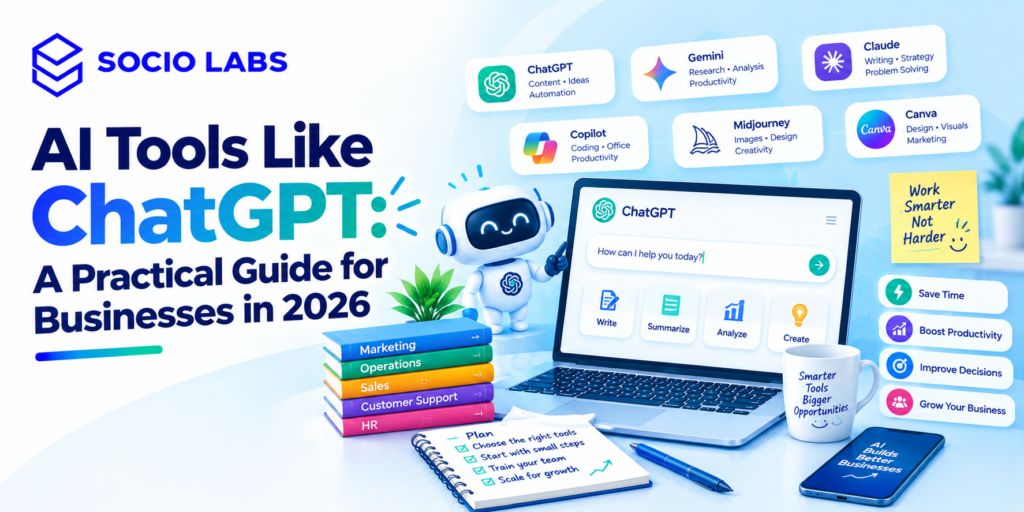
The main alternatives to ChatGPT in 2026 include Claude (from Anthropic), Gemini (from Google), and Microsoft Copilot, alongside specialized tools built for narrower functions like writing (Jasper, Copy.ai), research (Perplexity), and productivity (Notion AI).
Anthropic’s Constitutional AI approach is designed to make Claude less prone to hallucinations and more honest about what it doesn’t know, which matters for business use, and it’s often positioned as a strong second AI tool alongside ChatGPT, or the better first choice for certain use cases. Gemini is positioned as strong for research and works well with Google Workspace tools, while Microsoft Copilot is designed to bring AI directly into everyday productivity tools, helping introduce AI into existing business workflows without disrupting current systems. Beyond these general-purpose assistants, specialized tools address specific needs marketing tools such as Jasper AI, Surfer SEO, and Copy.ai support content creation, design, and ad optimization specifically, rather than general productivity.
How Do These AI Tools Actually Differ?
These AI tools differ primarily in their underlying optimization priorities: ChatGPT prioritizes breadth and ecosystem integration, Claude prioritizes accuracy and caution for sensitive business use, Gemini prioritizes integration with Google’s product suite, and specialized tools prioritize depth within one specific function over general versatility.
Recommended tool pairings by business function include Claude and ChatGPT for writing and content, specialized platforms for customer support, sales automation, and meetings, and dedicated analytics tools for data-heavy work reflecting that no single tool is built to excel equally at every business function. Choosing based on your primary use case, rather than picking the most well-known name, tends to produce better results.
AI Tools Comparison
Tool | Primary Strength | Best Suited For |
|---|---|---|
ChatGPT | Broad, general-purpose capability with strong ecosystem/integrations | General business tasks, content drafting, research, team productivity |
Claude | Caution and accuracy-focused responses, strong document handling | Business-sensitive writing, analysis, and long-document work |
Gemini | Deep integration with Google Workspace and research tasks | Teams already embedded in Gmail, Docs, Sheets, and Drive |
Microsoft Copilot | Built directly into Microsoft 365 applications | Teams standardized on Word, Excel, Outlook, and Teams |
Specialized tools (Jasper, Copy.ai, Perplexity, Notion AI) | Deep functionality within one specific task | Narrow, repeated use cases like SEO content, research, or note-taking |
This reflects current public positioning for each tool rather than a fixed ranking capabilities and pricing in this space continue to shift quickly, so it’s worth checking each provider’s current plans directly before deciding.
How Should Businesses Choose the Right AI Tool?
Businesses should choose an AI tool based on their primary use case general productivity, sensitive document work, platform integration, or a narrow specialized task rather than defaulting to whichever tool is most widely discussed.
A practical approach includes identifying the specific, recurring task you want AI to support (drafting, research, customer support, analytics), testing free tiers of two or three relevant tools against that actual task rather than a generic prompt, checking integration with your existing tools (CRM, Workspace, Microsoft 365) since switching costs matter, and reviewing data handling and privacy practices for any business-sensitive use case before committing.
Example (hypothetical): A marketing team evaluating AI tools for both content drafting and customer support discovers that a single general-purpose assistant handles content well, but a dedicated customer support AI platform produces meaningfully better results for support specifically reinforcing that one tool doesn’t need to cover every function equally well.
What Are Common Business Use Cases for These Tools?
Common business use cases for AI tools like ChatGPT include drafting marketing and sales content, summarizing meetings and documents, researching topics and competitors, analyzing data and spreadsheets, and supporting customer service through chat-based automation.
According to HubSpot’s 2026 State of Marketing Report, 80% of marketers now use AI tools for content and media creation, reflecting how mainstream this use case has become. Beyond marketing, businesses increasingly use AI directly within the applications they already work in, rather than switching to a separate AI window, for tasks like drafting within documents or analyzing data within spreadsheets.
What Are the Limitations of AI Tools Like ChatGPT?
The core limitations of AI tools like ChatGPT include the possibility of inaccurate or fabricated information (often called hallucination), a lack of true understanding of business-specific context without careful prompting, and the need for human review before publishing or acting on AI-generated output.
Other practical limitations include inconsistent performance on highly specialized or niche industry knowledge, data privacy considerations when inputting sensitive business information, and the reality that most off-the-shelf AI tools solve the common, general case well, but struggle with the remaining portion of work that’s highly specific to an individual business. Treating these tools as a draft-generation assistant rather than a final, unreviewed output source remains the safest approach for business use
How Should Businesses Evaluate AI-Generated Content?
AI-generated content should be evaluated for factual accuracy, brand voice consistency, and originality before publishing treating it as a strong first draft rather than finished, ready-to-use material.
A practical review process includes fact-checking any specific claims, statistics, or sources the AI generates, since fabricated details can appear convincingly accurate, editing for brand voice and tone, since default AI output tends toward generic phrasing, checking for originality to avoid content that closely mirrors existing published material, and applying the same editorial standard you’d use for human-drafted content, not a lower bar because it was AI-assisted. This review discipline matters particularly for SEO and content marketing use cases, where published accuracy and originality directly affect both credibility and search performance.
Conclusion
AI tools like ChatGPT have moved well beyond a single dominant option the right choice now depends on what your business actually needs: broad productivity, accuracy-focused writing, deep platform integration, or a specialized, narrow function. Test a few tools against your real recurring tasks, keep a human review step in place for anything published, and expect this space to keep shifting quickly enough that it’s worth revisiting your choice periodically.
Want help figuring out which AI tools actually fit your content and marketing workflow? Explore SEO services from SocioLabs and see how a structured, results-first approach to AI-assisted content could work for your business.
FAQs
The main general-purpose alternatives are Claude, Gemini, and Microsoft Copilot, alongside specialized tools like Jasper, Perplexity, and Notion AI for narrower tasks like content, research, or productivity.
ChatGPT remains a strong, broadly capable choice, particularly for general business tasks and ecosystem integration, but other tools may outperform it for specific needs like accuracy-sensitive writing or deep platform integration.
ChatGPT is generally positioned for broad, general-purpose productivity, while Claude is often favored for accuracy-focused, business-sensitive writing and long-document analysis.
Yes most major AI tools offer usable free tiers, with paid plans typically starting around a modest monthly cost per user for expanded features and usage limits.
Many businesses combine a general-purpose assistant for everyday tasks with specialized tools for specific, high-volume functions like customer support, SEO content, or meeting notes.