

How Much Ad Spend Is Enough Before You Decide a Campaign “Doesn’t Work”?
How Much Ad Spend Is Enough Before You Decide a Campaign “Doesn’t Work”? is a business problem before it is a marketing problem. Teams usually notice it after a dashboard looks better than the bank account: traffic rises, clicks get cheaper, leads increase or ROAS appears healthy, yet qualified pipeline and revenue do not improve at the same pace. That is exactly where a disciplined minimum ad spend performance marketing review becomes useful. The aim is not to chase a prettier marketing metric. The aim is to find the stage where value is leaking and fix that stage before spending more.
For SocioLabs clients and similar growth-focused businesses, the practical rule is simple: diagnose the funnel in the same order a customer experiences it. Start with intent and measurement, then examine the page or offer, then qualification, follow-up and revenue. This article gives you a framework you can use in an internal review, an agency discussion or a campaign audit without relying on vague advice.
Minimum ad spend performance marketing
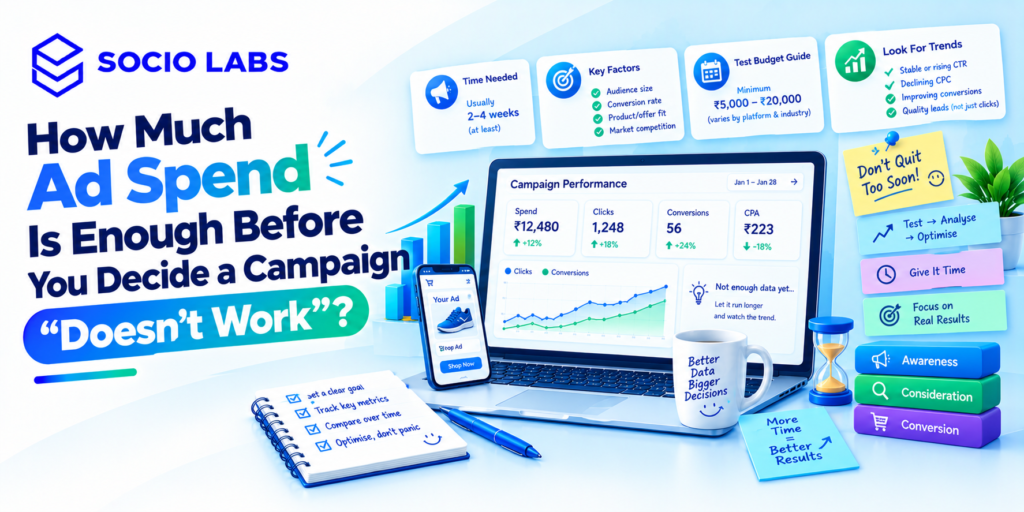
There is no universal minimum ad spend. Set a test budget from your expected conversion rate, CPC or CPM, target CPA and the number of conversions needed to judge direction. A useful starting rule is to fund enough data for several target-CPA equivalents while setting hard stop-loss and quality thresholds.
Why minimum ad spend performance marketing becomes a revenue problem
“We spent ₹20,000 and ads do not work” is meaningless without knowing the expected cost per click, sales cycle, conversion rate and target acquisition cost. Testing is a data problem, not a fixed-budget rule.
The mistake is to react to the first visible symptom. A weak headline can look like a traffic problem; poor targeting can look like a landing-page problem; slow sales follow-up can look like a lead-quality problem. Good diagnosis separates symptoms from causes. That matters because every wrong fix has an opportunity cost: redesigning a page that was never the bottleneck, increasing bids when tracking is broken, or cutting a channel that was generating strong assisted demand.
How to diagnose minimum ad spend performance marketing step by step
1. Start from break-even economics
A test budget should be anchored to what a customer is worth, not an arbitrary round number. Calculate acceptable CAC from margin, repeat value and payback tolerance.
2. Estimate the traffic needed for a conversion signal
Very low conversion-rate funnels need more clicks before conclusions are reasonable. Use historical CVR or a conservative benchmark to estimate required sessions.
3. Separate creative testing from offer testing
Changing audience, creative and landing page simultaneously makes the result hard to interpret. Define the one question each test is meant to answer.
4. Use stop-loss rules
A test should not have unlimited permission to spend while waiting for a miracle. Set thresholds for spend without conversions, poor CTR, low-quality leads or weak engagement.
5. Account for conversion delay
B2B, education and high-ticket sales may close days or weeks after the click. Judge leading indicators first and final CAC after the normal sales window.
6. Do not starve the platform
Tiny daily budgets can fragment learning across too many campaigns. Consolidate tests so each important variable gets enough delivery.
7. Judge quality, not only count
Ten junk leads are not stronger evidence than three qualified leads. Include downstream lead status and revenue in the decision.
8. Scale only after repeatability
One good day can be noise. Look for stable performance across multiple cycles, audiences or creative sets before scaling.
Metrics that should be on the same page
A useful dashboard does not need dozens of widgets. It needs a small set of connected numbers that show whether the system is attracting the right people, converting them, qualifying them and turning them into economic value. For this topic, keep the following measures visible together:
- Spend per conversion
- Cost per qualified lead
- Conversion lag
- Break-even cac
- Test-to-winner rate
- Incremental revenue
The focus keyword minimum ad spend performance marketing should never be evaluated from a single platform report. Where possible, reconcile ad or analytics data with CRM, ecommerce or finance outcomes. That is how you avoid optimising a proxy while the real business result moves in the opposite direction.
A practical decision framework for minimum ad spend performance marketing
Signal you see | Most likely area to inspect first | What to do next |
Volume is weak but downstream conversion is healthy | Traffic / reach / demand capture | Improve targeting, visibility or budget only after tracking is verified |
Traffic is healthy but leads are weak | Offer / page / CTA / trust | Run a focused CRO or message-match review |
Leads are high but sales rejects them | Intent / qualification / targeting | Optimise toward qualified outcomes and feed rejection data back |
Qualified leads are healthy but revenue is weak | Sales process / pricing / follow-up | Audit response time, discovery, proposal and close-rate stages |
Reports disagree with reality | Tracking / attribution / CRM | Fix measurement before scaling or cutting spend |
How to make this article and strategy AI-search friendly
For Google and AI answer engines, lead with a clear definition, use direct answers, descriptive H2/H3s, tables, FAQs, original examples and contextual internal links. Keep claims specific and verifiable. Use Article and BreadcrumbList schema, and FAQPage only when the visible FAQs remain on the page. Do not repeat minimum ad spend performance marketing unnaturally.
Conclusion
The core lesson is to stop treating minimum ad spend performance marketing as an isolated metric. Marketing creates value through a chain: relevant demand, clear message, conversion, qualification and profitable revenue. Diagnose the chain, fix the first proven leak and then scale what works.
FAQs
It means evaluating the marketing activity against the business outcome it is supposed to create, then identifying the first stage where performance drops. The exact metric changes by business model, but the method is the same: verify measurement, inspect intent and conversion, then check qualification and revenue.
Fix the earliest confirmed bottleneck, not the loudest symptom. If tracking is wrong, repair tracking first. If traffic quality is poor, fix targeting before redesigning the website. If qualified leads are strong but revenue is weak, the priority is usually sales execution or economics.
Use enough data to see a repeated pattern across the normal buying cycle. High-volume ecommerce may produce signal quickly; high-ticket B2B can need weeks because conversions and revenue arrive later. Use stop-loss rules, but avoid declaring failure from a tiny sample.
Use leads as a useful intermediate signal, but optimise the system toward the deepest reliable outcome you can measure. That may be qualified lead, booked meeting, purchase, contribution margin or closed revenue depending on the business.
Sometimes, but not always. Marketing performance crosses targeting, website experience, tracking, CRM and sales follow-up. The best results usually come when ownership is clear and each team fixes the part of the funnel it controls.