
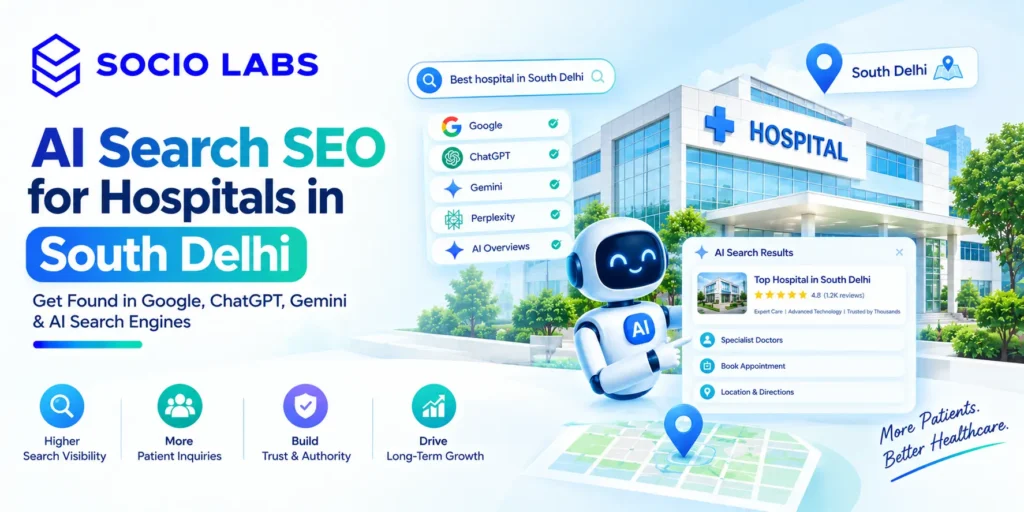
A patient in Saket asks ChatGPT which hospital in South Delhi is good for a knee replacement. Your hospital ranks on page one of Google. It still doesn’t get mentioned.
This is becoming common. More people now ask AI tools like ChatGPT, Google AI Overviews and Perplexity for recommendations, instead of scrolling through search results themselves. If your hospital’s website and online information aren’t built in a way these AI tools can read and trust, you can lose patients even while your Google ranking looks fine.
This is where AI search SEO comes in. It means making sure AI tools can find, understand and recommend your hospital when someone asks a health-related question. Here’s how it actually works, and what it means for a hospital in South Delhi.
What Is AI Search SEO?
AI search SEO is the work of making your hospital’s information clear enough for AI tools to understand and trust. You may also hear it called GEO, short for Generative Engine Optimization.
Traditional SEO tries to get your page to rank high on a Google results page. AI search SEO tries to get your hospital actually mentioned inside the answer an AI tool gives, whether that’s a Google AI Overview at the top of search results, or a direct answer from ChatGPT or Perplexity.
The two goals overlap, but they are not the same. A page can rank well and still never get picked by an AI tool, because AI systems are more selective about what they trust enough to quote.
Why Ranking on Google Isn't Enough Anymore
Google AI Overviews already answer many health questions directly, before the person clicks any link. For a search like “best hospital for cardiac bypass in South Delhi,” the AI summary may name two or three hospitals, and your Google ranking alone does not decide which ones get picked.
AI tools look for information that is accurate, consistent and easy to extract, not just content that is well optimised for keywords. A hospital with a confusing website, outdated doctor pages or mismatched information across platforms often gets skipped, even if it ranks well in normal search.
How AI Search SEO Works for Hospitals in South Delhi
At a basic level, AI tools pull together information from several sources: your website, your Google Business Profile, health directories, review platforms and trusted third-party sites. The more consistent and clearly structured that information is, the easier it becomes for an AI tool to use it confidently in an answer. Here’s what that actually involves.
Give AI Tools Clear, Structured Information
Schema markup is a bit of code added to your website that labels information clearly, such as “this is a doctor,” “this is a department,” or “this is a hospital address.” It helps AI tools and search engines read your site correctly instead of guessing. Hospitals with proper schema for doctors, departments and services are easier for AI tools to summarise accurately.
Answer Real Patient Questions Directly
AI tools favour content that answers a question clearly in the first sentence or two. A page explaining “What to expect before a knee replacement” should answer that question immediately, not after three paragraphs about the hospital’s history.
Keep Doctor and Department Pages Accurate
When someone asks an AI tool “which doctor treats X in South Delhi,” it often pulls from doctor profile pages. Outdated qualifications, missing specialities or inconsistent spellings of a doctor’s name across the website and directories make this harder for AI tools to trust.
Build the Trust Signals AI Tools Look For
Reviews, accreditations, and consistent contact details across Google, Practo, Justdial and your own website all add up to what’s often called E-E-A-T, short for Experience, Expertise, Authority and Trust. AI tools weigh this heavily for health-related answers, more than for most other topics.
Get Mentioned on Trusted Health Sites
If reputable health directories, news articles or medical association listings mention your hospital accurately, AI tools are more likely to treat your hospital as a safe answer to recommend. This isn’t about buying links. It’s about making sure your hospital’s presence on these trusted sites is accurate and up to date.
Track What AI Tools Are Saying About You
It helps to regularly ask ChatGPT, Perplexity and Google AI Overviews the same questions a patient might ask, and check whether your hospital gets mentioned, and what gets said about it. This is a newer kind of tracking most hospitals haven’t started doing yet.
A Realistic Example
Suppose a patient in Hauz Khas is looking for a hospital with a good maternity unit. Instead of searching Google and comparing ten tabs, they ask Perplexity directly: “Which hospital in South Delhi has a good maternity department?”
If your hospital’s maternity department page clearly states services, doctor names and patient-friendly details, and this matches your Google Business Profile and review platforms, there’s a real chance the AI tool includes your hospital in its answer. If the information is scattered, outdated or missing, the AI tool is more likely to default to the two or three hospital names it already knows well.
Common Mistakes Hospitals Make
Treating this exactly like old SEO. Keyword-stuffed pages built for Google rankings often read poorly to an AI tool trying to extract a clear answer.
Outdated or missing doctor profiles. A doctor who left the hospital two years ago still showing up, or a new specialist with no page at all, both confuse AI tools and patients.
No structured data on the website. Without schema markup, AI tools have to guess what information means, and often get it wrong or skip it.
Inconsistent information across platforms. Different addresses, phone numbers or doctor names on Google, Practo and the hospital website make AI tools less confident about which version is correct.
No one checking what AI tools are actually saying. Many hospitals have never asked ChatGPT what it knows about them, so they don’t know if the information is accurate, outdated, or missing entirely.
What Should a Hospital Measure?
Traffic and rankings alone don’t tell the full story anymore. It helps to track appointment enquiries and calls that mention finding you through an AI search, branded searches after a known AI mention, and simple manual checks of what AI tools say when asked common patient questions about your hospital.
Does Location Actually Matter Here?
Yes, in a specific way. South Delhi already has several large, well-known hospital names that AI tools mention by default for many health questions. A mid-size or specialty hospital in this area has to work harder to get included, because AI tools lean toward names they already “know” unless a smaller hospital’s information is clear, consistent and well-cited enough to earn a mention. This makes accurate, structured information more important here than in areas with less hospital competition.
When Professional Help Makes Sense
This becomes difficult to manage without support once your hospital has multiple departments, a growing number of doctors, and information spread across several platforms that all need to stay consistent. It also requires a mix of skills, structured data, healthcare content and ongoing monitoring, that most in-house marketing teams haven’t built yet, simply because the need is new. If keeping this updated and checked regularly feels like more than your team can track alongside everything else, that’s usually the point where bringing in outside help starts to make sense.
Conclusion
AI search visibility isn’t a one-time fix. It shifts as your website, reviews and listings change, so it needs regular checking rather than a single clean-up.
If you want to know where your hospital stands right now, the simplest test is to ask ChatGPT or Google AI Overviews a few questions a patient might ask about your departments or doctors, and see what comes back. If the information is missing, outdated or inaccurate, that’s usually the first thing worth fixing before anything else.
Socio Labs works with hospitals on exactly this kind of review, checking what AI tools currently say about you and building a plan to close the gaps. If you’d like a second opinion on where your hospital stands, that’s a good place to start.
FAQs
It's the work of making your hospital's website and online information clear and accurate enough for AI tools like ChatGPT and Google AI Overviews to find, trust and mention it when someone asks a health-related question.
Regular SEO focuses on ranking high on a search results page. AI search SEO focuses on getting mentioned directly inside an AI-generated answer, which depends more on accuracy, structure and trust than on keywords alone.
Most hospitals start seeing their information appear more accurately in AI answers within a few months, since AI tools need to find and trust updated information before using it confidently.
Cost depends on how many doctors and departments need updated profiles, how much structured data work is needed, and how inconsistent your current information is across platforms. There's no fixed figure that applies to every hospital.
Yes. South Delhi has several large, well-known hospitals that AI tools already recommend by default, so smaller or specialty hospitals need especially clear and consistent information to get included.