
A patient in Green Park wakes up with chest tightness at 11 pm. They don’t open Google and scroll through ten links. They open ChatGPT or ask Google’s AI Overview, “which hospital nearby can handle this right now.” Within seconds, they get a short, confident answer, often with two or three hospital names in it.
If your hospital isn’t one of those names, you’ve already lost that patient. Not because your care isn’t good. Because the AI never mentioned you.
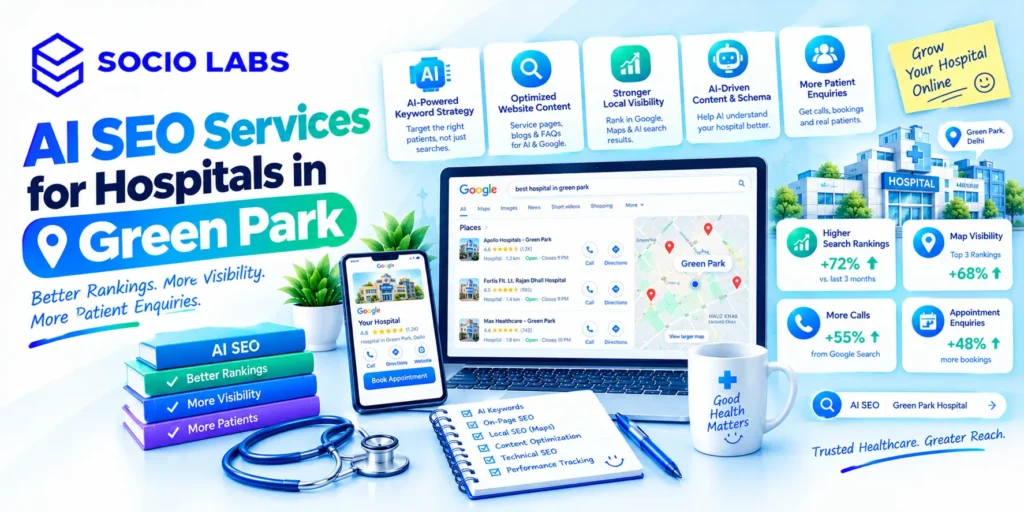
This is the real shift behind AI SEO, also called GEO (Generative Engine Optimization). It’s not about ranking on a results page anymore. It’s about being the answer an AI system gives when someone asks a health question.
Why Hospitals Are Losing Visibility Without Realizing It
Most hospital websites were built for a different kind of search. They have a homepage, a list of departments, maybe a doctors page. That worked when people typed “cardiologist in Green Park” and clicked through a list of links.
AI search doesn’t work that way. It reads your content, pulls out facts, and summarizes them into one answer. If your website doesn’t clearly state what conditions you treat, which departments you have, your location, and your credibility, the AI either skips you or gets the details wrong.
Here’s the part that catches hospitals off guard: even if you rank well on Google’s normal search results, you can still be invisible in AI Overviews. These are two different systems with different rules. Many hospitals discover this only after noticing their enquiry numbers have dropped while their regular traffic looks stable.
How AI SEO Actually Helps a Hospital
AI SEO works by making your hospital’s information easy for AI systems to find, trust, and quote. This involves a few connected things working together, not one single trick.
The AI needs clear, structured facts: your departments, specialities, doctor credentials, hospital location, and the specific conditions you treat. It also needs consistency. If your website says one thing and your Google Business Profile says another, that confusion makes an AI system less likely to trust you as a source.
Trust signals also matter more than before. AI systems lean toward information that looks credible, well-organized, and backed by real detail, not vague marketing language. A page that clearly explains “what happens during a cardiac emergency visit” will get picked up more often than a page that just says “best cardiac care in Delhi.”
A Practical Framework for Hospital AI Visibility
1. Answer-First Content Structure
Every important page should answer its main question in the first few lines. If someone searches “what to do for a suspected stroke,” the page should state the direct answer immediately, then explain further. AI systems pull from the clearest, most direct explanation available.
2. Department and Condition Pages, Not Just Service Pages
A generic “Cardiology Department” page is weak. A page explaining “chest pain treatment in Green Park: when to go to the ER” gives the AI something specific to match against a real search.
3. Structured Data (Schema Markup)
This is technical labeling added to your website code. It tells search engines and AI tools exactly what each piece of information means, like which text is a doctor’s name, which is a department, which is an operating hour. Without it, AI systems have to guess, and guessing often means skipping you.
4. Consistent Information Across Platforms
Your hospital’s name, address, phone number, and department list should match exactly across your website, Google Business Profile, and any directory listings. Small mismatches reduce how much an AI system trusts your data.
5. Doctor and Department Credibility Pages
AI systems favor sources that demonstrate real expertise. Individual doctor pages with qualifications, specialities, and experience give the AI concrete facts to reference, rather than a vague “our expert team” statement.
6. FAQ-Style Content for Common Health Questions
People ask AI tools direct questions: “is a fever of 102 an emergency,” “do I need a referral for an MRI.” Content written to answer these directly, in a few clear sentences, is exactly what AI systems prefer to quote.
A Realistic Example
Suppose someone in Green Park searches, “which hospital treats kidney stones near me.” If your hospital has a clear page explaining kidney stone symptoms, treatment options, and that you have a urology department with listed doctors, the AI has something solid to reference.
If instead your website only says “multi-speciality hospital offering world-class care,” there’s nothing specific for the AI to connect to that search. The visitor moves to a competitor whose content actually answered the question.
Common Mistakes Hospitals Make With AI Search
Treating AI SEO the same as regular SEO. Keyword placement alone won’t help here. AI systems care about clear, factual, well-structured answers, not keyword density.
Writing vague department descriptions. “Comprehensive, patient-centered care” tells an AI nothing useful. Specific conditions, specific treatments, and specific outcomes do.
Inconsistent contact and location details. If your address appears differently on three different platforms, AI systems treat your information as unreliable.
No structured data on the website. Without schema markup, even accurate content can get misread or ignored by AI crawlers.
Ignoring doctor-level content. Hospitals that only promote the brand, and never the individual doctors, lose a major trust signal that AI systems actively look for.
What Should a Hospital Actually Measure?
Tracking should go beyond website traffic. For a hospital, the metrics that matter are:
- Appointment enquiries generated from search and AI-driven visits
- Calls to the hospital reception or specific departments
- Which department pages are driving the most enquiries
- Visibility in AI Overviews and AI chat tools for relevant health questions
- How often your hospital name appears when patients ask AI assistants about conditions you treat
Traffic numbers alone don’t tell you if the right patients are finding you. Enquiry quality does.
Does Green Park Actually Matter Here?
Yes, and not in a small way. Healthcare is one of the most location-sensitive searches there is. A patient rarely wants “a good hospital in Delhi.” They want one they can reach quickly, especially in an emergency.
For a hospital in Green Park, this means your content should reflect real local search behavior: nearby landmarks patients use for directions, proximity to Green Park metro station or surrounding areas, and the kind of local terms patients actually type, like “hospital near Green Park market” rather than generic city-wide phrases.
This isn’t about repeating “Green Park” in every paragraph. It’s about making sure the AI understands exactly where you are and who you serve, so it can confidently recommend you to someone searching nearby.
When It Makes Sense to Get Professional Help
Many hospitals try to handle this internally at first, usually through whoever manages the website alongside other duties. That works for basic updates. It starts breaking down once you need structured data implementation, consistent content across dozens of department and doctor pages, and ongoing tracking of how AI systems are representing your hospital.
At that point, the problem isn’t a lack of effort. It’s that AI search behavior changes often, and keeping a hospital visible across Google, AI Overviews, and chat-based search tools takes dedicated, continuous work. If your enquiries have been inconsistent despite having decent website traffic, that’s usually the sign this has become bigger than an internal task.
Conclusion
AI search is already deciding which hospitals patients hear about, long before they visit a website or make a call. For a hospital in Green Park, that means the real competition isn’t just other hospitals ranking on Google. It’s whether ChatGPT, AI Overviews, and similar tools even know enough about you to mention your name.
If patients in Green Park aren’t finding your hospital when they ask an AI tool for help, that’s worth checking. Sociolabs can help you find out where you stand and fix the gap
FAQs
AI SEO means structuring your hospital’s website and content so AI tools like Google AI Overviews and ChatGPT can understand, trust, and recommend you when patients ask health-related questions, not just when they search with keywords.
Regular SEO focuses on ranking in search results. AI SEO focuses on being quoted or mentioned directly inside an AI-generated answer, which depends more on clear facts and structured data than on keyword placement.
It varies depending on how outdated or unstructured your current website content is. Early visibility changes can appear within a few months, but consistent AI search presence usually builds over a longer period.
Yes. Healthcare searches are highly location-sensitive. AI systems prioritize hospitals with clear, consistent location details and strong local relevance, especially for emergency or urgent-care related searches.
No. Smaller and single-location hospitals often benefit more quickly, since focused, well-structured content about specific departments is easier to build and maintain than for large multi-branch hospitals.