
If you’re searching for “Google Bard” in 2026, the short answer is: it doesn’t exist anymore, at least not under that name. Google retired the Bard brand back in February 2024 and folded everything into Gemini a different underlying model, a different app, and a significantly expanded set of capabilities. A lot of people, documentation, and even business tools still reference “Bard” out of habit, which creates real confusion about what’s actually available today. This guide clears that up: what changed between Bard and Gemini, why Google made the switch, and what to actually use now if you’re still looking for Bard. Along the way, we’ll touch on how an agency such as SocioLabs thinks about AI tools like Gemini when advising clients on search and content strategy.
What Was Google Bard?
Google Bard was Google’s original conversational AI chatbot, first launched in March 2023, built initially on Google’s LaMDA language model and later upgraded to run on PaLM 2.
Bard was Google’s direct response to the early wave of AI chatbots, offering text-based conversation, basic reasoning, and integration with some Google services. It went through several model upgrades during its roughly year-long run under that name, but it was always positioned as a single product a chatbot rather than the broader AI platform Google has since built around Gemini.
For anyone who used Bard during 2023, the product they remember no longer exists in that form; it was absorbed into a larger, rearchitected system.
What Is Google Gemini?
Google Gemini is Google’s current family of AI models and the unified product name for its conversational AI assistant, replacing Bard entirely and consolidating Google’s AI branding (including the earlier “Duet AI” name used in Workspace and Cloud) under one identity.
Unlike Bard, which was a single chatbot, Gemini refers to both the underlying model family (Gemini Nano, Flash, Pro, and higher-tier variants) and the product built on top of it a multimodal assistant capable of processing and generating text, images, audio, code, and video. Gemini is accessible through gemini.google.com, the Gemini mobile app, and embedded directly inside Gmail, Docs, Sheets, Slides, and Drive.
The model family has continued to evolve well past the original 2024 rename, with newer Gemini model generations released through 2025 and into 2026, focused on improved reasoning, reduced hallucination, and expanded agentic capabilities.
When and Why Did Google Rename Bard to Gemini?
Google renamed Bard to Gemini in February 2024, aligning the chatbot’s name with the Gemini model family that was already powering it, and consolidating Google’s separate AI product names into a single brand.
The rename wasn’t just cosmetic. Google had been building the Gemini model family since late 2023 as a more capable, natively multimodal successor to LaMDA and PaLM, and Bard was already running on an early Gemini model by the time of the rename. At the same time, Google retired the separate “Duet AI” branding used in Workspace and Cloud products, folding both consumer and enterprise AI tools under the single Gemini name a brand unification move as much as a technical one.
For users, the practical effect was simple: the product they knew as Bard became Gemini, with the same account and largely the same entry points, but running on meaningfully more capable underlying models.
What Actually Changed Between Bard and Gemini?
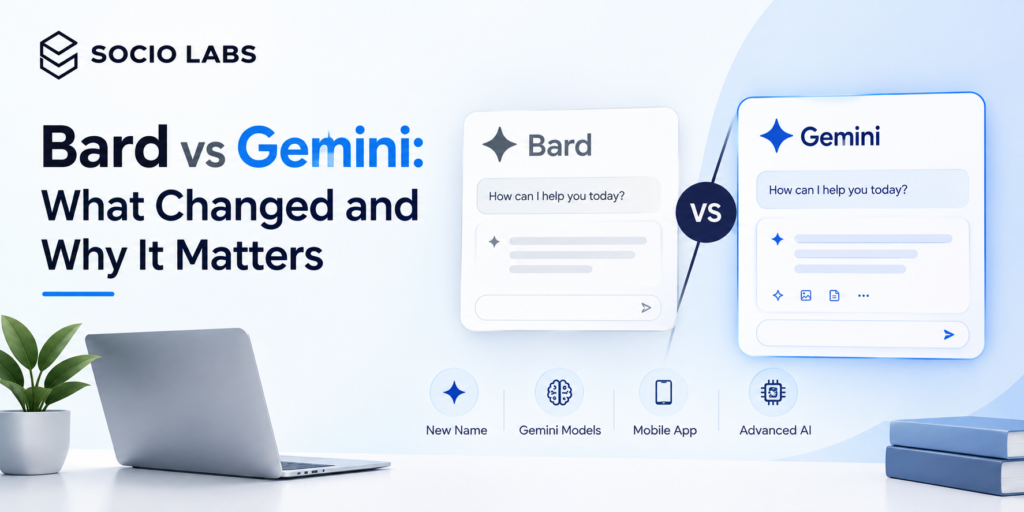
Beyond the name, the core change was the underlying model Gemini replaced LaMDA/PaLM with natively multimodal Gemini models, which expanded what the assistant could actually do, including real-time voice interaction, image generation, and deeper integration across Google’s product ecosystem.
Specific capability changes since the rename include multimodal input and output, handling text, images, audio, and video more natively rather than as bolted-on features, Gemini Live, a real-time voice conversation mode not available under the Bard name, tighter integration with Gmail, Docs, Sheets, and Drive for in-context assistance, and a tiered model lineup (Flash for speed and free access, Pro and higher-tier models for more demanding tasks) that didn’t exist in Bard’s simpler, single-model structure.
In short: the rename marked the starting point of a much faster pace of capability upgrades than Bard ever saw during its roughly one-year run under that name.
Bard vs Gemini: Side-by-Side Comparison
Feature | Google Bard (Formerly Bard) | Google Gemini |
|---|---|---|
Underlying Model | LaMDA, later PaLM 2 | Gemini model family (Flash, Pro, and higher-tier variants) |
Multimodal Ability | Limited, primarily text-based | Native support for text, images, audio, and video |
Voice Interaction | Not available | Gemini Live (real-time voice conversation) |
Workspace Integration | Minimal | Built into Gmail, Docs, Sheets, Slides, and Drive |
Branding | Standalone chatbot name | Unified name across consumer and enterprise AI (also replaced Duet AI) |
Current Status | Retired as of February 2024 | Actively developed, with new model generations released through 2025 and into 2026 |
This table reflects publicly documented product history rather than a live feature comparison always check Google’s own Gemini documentation for the most current feature set, since this is an actively evolving product.
How Do You Access Gemini Today?
Gemini is accessed through gemini.google.com, the dedicated Gemini mobile app, or directly within Gmail, Docs, Sheets, Slides, and Drive for Google Workspace users any old bookmark or link to “Bard” should automatically redirect to Gemini.
A free tier is available with access to standard Gemini models, while Gemini Advanced accessible through a paid Google One or Workspace plan provides access to higher-tier models and expanded usage limits. Google Workspace customers can also access Gemini through dedicated add-on plans (Gemini Business and Gemini Enterprise tiers), separate from the consumer Gemini Advanced subscription.
If you’re a business evaluating which tier fits your needs, it’s worth checking Google’s current pricing and feature pages directly, since plan structures and included capabilities have changed multiple times since the 2024 rename and are likely to keep evolving.
Is Anything Still Called “Bard”?
No official Google product is still branded as “Bard” the name was fully retired in February 2024, though references to it persist in older articles, documentation, bookmarks, and third-party tools that haven’t been updated.
This is also why “Bard” still generates meaningful search volume years after the rename: habit, outdated content, and old integrations referencing the original name all keep the term alive in search behavior even though the product itself no longer exists under that branding. Any current webpage, tool, or guide that treats “Bard” as an active, separate product from Gemini is working from outdated information.
What Does This Mean for Businesses Using AI Tools?
For businesses, the practical takeaway is to standardize internal documentation, training materials, and tool references around “Gemini,” since continuing to reference “Bard” internally creates confusion for teams and signals outdated knowledge externally.
This matters beyond just naming accuracy. Businesses evaluating AI tools for content, research, or workflow automation should treat the Bard-to-Gemini transition as a reminder that AI product names, capabilities, and pricing shift quickly what was true even a year ago may no longer accurately describe the current product. Teams relying on AI tools as part of a broader content marketing or research workflow should periodically verify they’re working from current product information rather than assumptions carried over from an earlier product generation.
Common Points of Confusion
Assuming Bard is a separate, still-available product from Gemini, when it was fully retired and replaced.
Expecting old Bard-specific guides or tutorials to accurately describe current Gemini features, despite substantial changes to the underlying models and interface.
Confusing “Gemini” the model family with “Gemini” the consumer product, since the models power the product.
Assuming Gemini’s free and paid tiers have remained unchanged since 2024, despite multiple updates to pricing and included features.
Treating Duet AI, the former Workspace and Cloud AI branding, as still relevant, even though it was retired and folded into Gemini.
Conclusion
Google Bard hasn’t existed as an active product since February 2024 it was fully replaced by Gemini, a more capable, natively multimodal AI system with real-time voice, deeper Workspace integration, and a faster pace of updates than Bard ever had. If you’re still searching for Bard, Gemini is what you’re actually looking for, accessible directly at gemini.google.com. Keeping internal references and documentation current matters, especially as AI tools continue evolving quickly.
Trying to keep your business’s content and SEO accurate as AI tools and search behavior keep shifting? Explore SEO services from SocioLabs and see how a current, fact-checked approach to fast-moving topics could work for your website.