
If you’re searching for chat gbt 4 hoping to use it right now, there’s a direct answer worth knowing upfront: GPT-4, in every form it ever took inside ChatGPT, is no longer available there as of 2026 it’s been fully retired from OpenAI’s consumer product, though it lives on through the developer API. That’s a meaningfully different situation than it was when GPT-4 was the headline AI model everyone was talking about.
This guide clears up the confusion what GPT-4 actually was, what it could do, and exactly what’s happened to it since, based on OpenAI’s own retirement announcements rather than outdated assumptions. Our team at SocioLabs tracks these product shifts closely since they directly affect how we advise clients on AI-assisted workflows.
What Is GPT-4?
GPT-4 was a large language model developed by OpenAI, first released in March 2023, that powered ChatGPT and other OpenAI products for an extended period it’s a specific AI model, not the same thing as ChatGPT itself, which is the product/interface people actually interact with.
This distinction matters more than it might seem. ChatGPT is the chat application; GPT-4 (and later, models like GPT-4o, GPT-4.1, GPT-5, and beyond) are the underlying engines that have powered it at different points. Saying “I use ChatGPT” doesn’t tell you which model is actually generating your responses, since that’s changed multiple times since GPT-4’s original release.
GPT-4 became significant because it represented a substantial capability jump over the earlier GPT-3.5 model that powered ChatGPT at its initial public launch better reasoning, more reliable instruction-following, and stronger performance across professional and creative tasks.
Why Do People Search "Chat GBT 4"?
People search “chat gbt 4” primarily as a common misspelling of “ChatGPT 4,” reflecting how prominently GPT-4 was discussed when it launched in 2023 and how strongly that association has stuck in public memory even as OpenAI’s actual model lineup has moved on considerably since.
GPT-4’s release was a genuinely major AI news moment, discussed widely enough that “ChatGPT 4” became something of a shorthand for “the advanced version of ChatGPT” in general public usage even now, years and several model generations later. This guide uses “chat gbt 4” to match that search behavior, while using the correct terminology (GPT-4, ChatGPT) when discussing OpenAI’s actual products.
What Were GPT-4's Main Features?
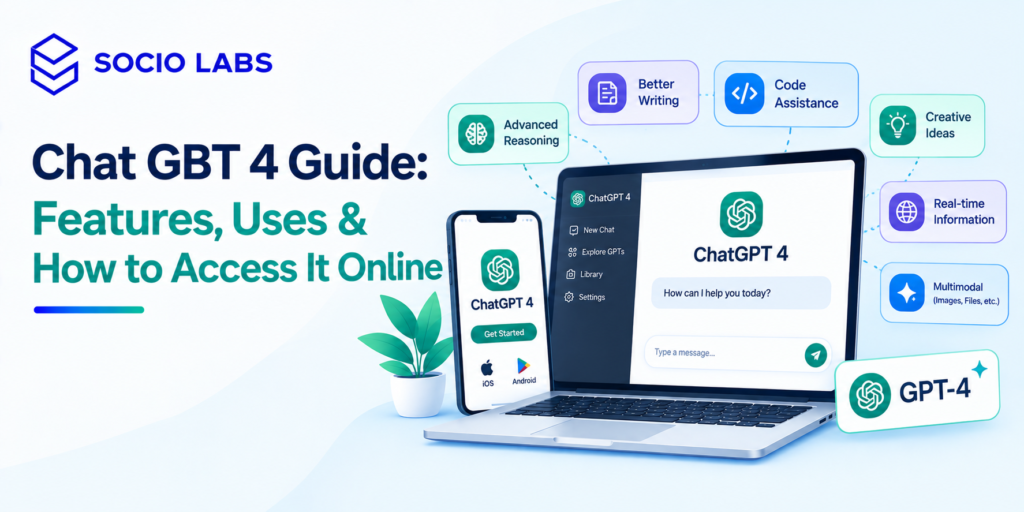
GPT-4’s documented capabilities included stronger reasoning and instruction-following than its predecessor, longer input handling, and in certain product contexts multimodal capability allowing it to process images alongside text.
- Advanced language understanding: More nuanced comprehension of complex or ambiguous requests
- Improved reasoning: Better performance on tasks requiring multi-step logical thinking
- Longer context handling: Ability to work with longer documents and conversations than earlier models
- Multimodal capability: Image understanding in specific products and configurations where enabled
- Stronger coding assistance: More reliable code generation and debugging support
- Better instruction-following: More consistent adherence to specific formatting or task requirements
Not every capability was available in every product or plan simultaneously features rolled out gradually across ChatGPT, the API, and other OpenAI products over GPT-4’s lifecycle, rather than launching all at once everywhere.
What Was GPT-4 Used For?
GPT-4 was widely used for writing assistance, coding help, research support, business communication, and educational explanation the same broad categories of tasks people use current AI models for today, just with GPT-4 as the engine behind them at the time.
- Education: Explaining concepts at different levels of depth for students
- Writing: Drafting, editing, and refining emails, articles, and creative content
- Coding: Writing, explaining, and debugging code across multiple languages
- Business communication: Drafting professional correspondence and documentation
- Research assistance: Summarizing and synthesizing information on a topic
- SEO and marketing: Content brainstorming and draft generation
Example prompts people used with GPT-4-era ChatGPT:
- “Explain technical SEO to a beginner using a simple example.”
- “Review this Python function and identify potential bugs.”
- “Create a 30-day content plan for an Indian e-commerce brand.”
These same prompt patterns work with current ChatGPT models today the underlying skill of writing clear, specific prompts hasn’t changed even as the model powering the responses has.
Can You Still Access GPT-4 Through ChatGPT in 2026?
No as of 2026, GPT-4 and every model in its family have been fully retired from ChatGPT’s consumer product; the retirement process happened in stages between February and June 2026, and GPT-4 is now only accessible through OpenAI’s developer API, not the standard ChatGPT interface.
Here’s the actual timeline, based on OpenAI’s own announcements: on February 13, 2026, OpenAI removed GPT-4o, GPT-4.1, GPT-4.1 mini, and o4-mini from ChatGPT’s model picker for most users, citing that usage had shifted heavily toward newer GPT-5-series models. Business, Enterprise, and Edu customers retained access to GPT-4o specifically within Custom GPTs until April 3, 2026, after which it was fully retired across all plans. Finally, GPT-4.5 the last remaining GPT-4-family model still available in ChatGPT was retired in late June 2026, which OpenAI and multiple outlets described as ending the entire GPT-4 era within the ChatGPT product.
What this means practically:
- You cannot select any GPT-4 variant in ChatGPT’s model picker today
- Old conversations that used a GPT-4 model now default to the current equivalent GPT-5-series model
- Custom GPTs built on retired models automatically moved to current model equivalents
- Developers can still access GPT-4-family models through OpenAI’s API, which was not affected by these ChatGPT-specific retirements
- Voice Mode and image generation in ChatGPT use separate underlying systems and were not directly affected by these text-model retirements
If you’re looking for “the most advanced ChatGPT experience” today, that now means the current GPT-5-series models, not GPT-4 in any form.
GPT-4 vs Current ChatGPT Models
Factor | GPT-4 (and GPT-4 family) | Current ChatGPT Models (2026) |
Generation | Released 2023, retired from ChatGPT in stages through June 2026 | GPT-5-series, actively updated |
Availability in ChatGPT | Not available fully retired | Available now, default experience |
Availability via API | Still available | Available |
Reasoning capability | Strong for its era | Positioned by OpenAI as stronger, with more reasoning control |
Customization | Limited personality/tone controls | Expanded personality and tone customization introduced in later updates |
Typical use | Writing, coding, analysis, general assistance | Same broad categories, refined further |
Best choice today | Only accessible via API for developers | The current default for anyone using ChatGPT directly |
This isn’t a “which is better” comparison in the usual sense GPT-4 simply isn’t an option inside ChatGPT anymore, so the practical choice for most users has already been made by OpenAI’s product decisions.
How ChatGPT Online Relates to Model Access
ChatGPT online refers to using the product through a web browser at chatgpt.com but which model actually powers your conversation depends on OpenAI’s current product configuration, not a fixed, permanent setup tied to any specific model name.
This is worth understanding clearly: the ChatGPT web experience doesn’t guarantee access to every model OpenAI has ever released. Models get added, updated, and retired as the product evolves, and what’s available to you specifically can also depend on your plan (Free, Go, Plus, Pro, Business, Enterprise). The web interface itself hasn’t fundamentally changed in how you interact with it you’re just now talking to a different underlying model than someone using ChatGPT online back in 2023 would have been.
What Are the Limitations to Keep in Mind?
Whether you’re using a current ChatGPT model or recalling how GPT-4 behaved, the same core limitations apply: AI-generated responses can contain factual errors, reflect outdated information, or occasionally sound confident while being wrong.
- Responses can contain factual errors, especially on specific or niche topics
- Information can be outdated depending on the model’s training and access to live data
- Ambiguous prompts can be misinterpreted, producing an answer to a different question than intended
- Code generated by AI should always be tested, not assumed correct
- Context limitations mean very long conversations can lose earlier details
- Product and model availability can change, as GPT-4’s retirement itself demonstrates
- Important, decision-critical information should always be independently verified
Conclusion
If you searched for chat gbt 4 wondering whether you can still use it, the honest 2026 answer is no GPT-4 and its entire model family have been fully retired from ChatGPT as of June 2026, replaced by the current GPT-5-series models, with GPT-4 living on only through OpenAI’s developer API. Understanding this distinction between GPT-4 (a retired model) and ChatGPT (the still-active product) clears up a lot of the confusion around this search term. If you’re exploring how current AI tools can support SEO, content, and digital marketing, explore more practical resources from SocioLabs.
FAQs
"Chat gbt 4" is a common misspelling of "ChatGPT 4," referring to GPT-4 the AI model that powered ChatGPT starting in 2023, distinct from ChatGPT itself, which is the product interface.
GPT-4 is a large language model developed by OpenAI, released in March 2023, known for stronger reasoning, longer context handling, and multimodal capabilities compared to its predecessor.
No ChatGPT is the chat application/product, while GPT-4 was one of several models that have powered it at different points; the model behind ChatGPT has changed multiple times since GPT-4's release.
Not through ChatGPT directly GPT-4 and its entire model family were fully retired from ChatGPT by June 2026, though the models remain accessible through OpenAI's developer API.
No as of 2026, GPT-4, GPT-4o, GPT-4.1, GPT-4.1 mini, and GPT-4.5 have all been removed from ChatGPT's model picker; current conversations run on GPT-5-series models instead.