
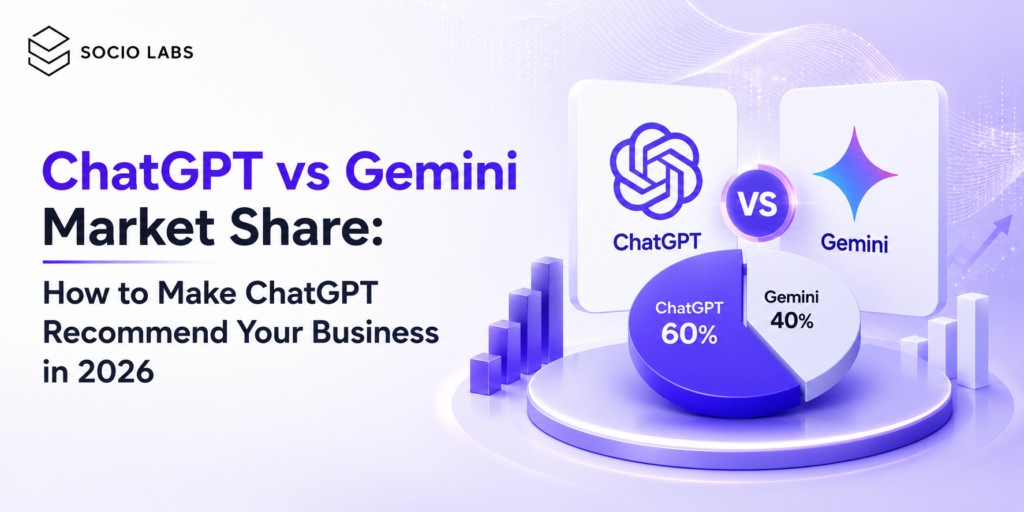
ChatGPT vs Gemini market share is no longer a curiosity for AI enthusiasts it’s a business-critical metric. As of mid-2026, ChatGPT holds roughly 54–68% of standalone chatbot web traffic depending on the tracker, while Gemini has climbed from under 6% to nearly 20–28% in just over a year, according to Similarweb and First Page Sage data. That shift changes where your customers are asking, “who should I buy from?”and whether your brand shows up in the answer. At Sociolabs, we track this landscape daily for clients across India and beyond, and this guide breaks down the real numbers, what they mean for your visibility, and exactly how to make ChatGPT recommend your business in 2026.
What Is ChatGPT vs Gemini Market Share?
Direct answer: ChatGPT vs Gemini market share refers to the relative percentage of AI chatbot traffic, active users, or query volume each platform captures and in 2026, ChatGPT still leads but Gemini is closing the gap fast.
Multiple trackers tell a consistent story with different absolute numbers. Similarweb’s May 2026 data put worldwide web-visit share at roughly ChatGPT 54%, Gemini 28%, and Claude 9% across the seven major assistants, while First Page Sage’s April 2026 panel measured ChatGPT at 60.4% and Gemini at 15.2%. The gap between trackers comes down to methodology some count only standalone chatbot domains, others fold in embedded experiences like Google’s AI Overviews, which alone reach over 2 billion monthly users through Search.
Example: A Sociolabs client in the industrial manufacturing space assumed ChatGPT visibility was “enough.” Once we mapped their citation footprint, we found zero presence in Gemini’s AI Overview responses a gap costing them visibility across Google’s much larger search funnel.
Takeaway: Track both platforms separately. A single “AI SEO” strategy aimed only at ChatGPT leaves the fastest-growing distribution channel untouched.
Why ChatGPT vs Gemini Market Share Matters for Businesses
Direct answer: Market share shifts determine where your marketing budget for AI Search Optimization should go, because each platform has different discovery mechanics and audiences.
ChatGPT’s 900 million weekly active users represent conscious adoption people who chose to open the app. Gemini’s growth, by contrast, is distribution-driven: it’s embedded in Android, Google Search, and Workspace, so users encounter it without seeking it out. Google’s Q4 2025 earnings call confirmed Gemini-powered AI Overviews now reach more than 2 billion people monthly a scale ChatGPT’s standalone product can’t match through organic adoption alone.
Example: Sociolabs worked with a D2C skincare brand whose organic traffic barely register in ChatGPT citations but who saw meaningful referral traffic once we optimized for AI Overview inclusion a Gemini-powered surface most competitors ignored.
Takeaway: Don’t chase whichever platform is “winning” build presence across both, since they reach different segments of your buyer journey.
How ChatGPT Recommends Businesses
Direct answer: ChatGPT recommends businesses by pulling from its training knowledge plus live web browsing, favoring sources with clear entity signals, consistent citations, and structured, quotable content.
When ChatGPT answers a “best X near me” or “which brand should I use” query, it typically browses in real time and prioritizes pages that directly answer the question in the first few sentences, carry credible third-party mentions, and use clean semantic structure (headers, lists, schema). It rarely recommends brands with thin, generic content or no external validation the model needs consistent signals across multiple sources to trust an entity.
Example: In a Sociolabs GEO case study for a flameproof/hazardous-area equipment manufacturer, restructuring 29 product pages around direct-answer formatting led to measurable AI search visibility gains within a single campaign cycle.
Takeaway: Write for extraction the first sentence under every heading should be a self-contained, quotable answer.
How to Make ChatGPT Recommend Your Business in 2026
Direct answer: To make ChatGPT recommend your business in 2026, combine structured content, consistent entity mentions, third-party citations, and technical schema so the model can confidently identify and trust your brand.
Follow this step-by-step framework:
- Define your core entity — Ensure your business name, category, and location are consistent everywhere (website, directories, socials, PR).
- Publish direct-answer content — Every page should answer a specific customer question in the opening lines.
- Earn third-party citations — Reviews, press mentions, and industry directories signal trustworthiness to LLMs.
- Implement structured data — Use Organization, Product, FAQ, and Review schema so machines can parse your offering.
- Build topical depth — Cover your niche comprehensively, not just a handful of keyword pages.
- Monitor AI citations — Regularly prompt ChatGPT with buyer-intent queries to check if and how you’re mentioned.
- Refresh content regularly — Outdated pages lose citation priority as models re-crawl for current information.
Statistic: Enterprises using integrated, structured content strategies see notably higher engagement and conversion outcomes than single-channel approaches, per industry benchmarks Sociolabs applies across client campaigns.
Example: For an e-commerce client, Sociolabs paired schema implementation with a citation-building push across review platforms; within three months the client began appearing in category-level ChatGPT recommendations they’d never previously secured.
Takeaway: Making ChatGPT recommend your business in 2026 isn’t a one-time fix it’s an ongoing entity-building process, not a keyword campaign.
How Gemini Chooses Business Recommendations
Direct answer: Gemini leans heavily on Google’s existing knowledge graph, structured data, and real-time Search index, making technical SEO and schema markup more directly influential than with ChatGPT.
Because Gemini is deeply integrated with Google Search and the Knowledge Graph, businesses with strong local SEO, verified Google Business Profiles, and clean structured data have a distinct advantage. Gemini’s referral traffic to external websites grew roughly 388% year-over-year, according to industry analysis a sign it actively surfaces external sources rather than just summarizing.
Example: Sociolabs helped a home-services client strengthen Google Business Profile signals and local schema; that entity strength carried directly into how Gemini surfaced them for “near me” style queries.
Takeaway: If your Google Business Profile and local SEO are weak, your Gemini visibility will suffer regardless of your content quality elsewhere.
Traditional SEO vs Generative Engine Optimization
Direct answer: Traditional SEO optimizes for rankings and clicks; Generative Engine Optimization (GEO) optimizes for being cited, quoted, or recommended directly inside an AI-generated answer.
| Factor | Traditional SEO | Generative Engine Optimization (GEO) |
|---|---|---|
| Primary Goal | Rank on page 1 | Get cited inside AI answers |
| Success Metric | Clicks, rankings | Citations, brand mentions, AI visibility |
| Content Style | Keyword-optimized | Direct-answer, entity-rich |
| Key Signals | Backlinks, keywords | Schema, structured data, third-party mentions |
| User Behavior | Click-through to site | Zero-click, answer consumed in-platform |
Takeaway: GEO doesn’t replace SEO — it extends it. Sociolabs builds campaigns that satisfy both simultaneously rather than treating them as separate budgets.
How to Build AI Authority
Direct answer: AI authority is built through consistent entity signals across the web your own site, third-party citations, reviews, and structured data all reinforcing the same facts about your brand.
LLMs cross-reference multiple sources before recommending a business. A single well-written page isn’t enough; the model needs corroboration. Sociolabs recommends building a “citation map” a list of directories, review platforms, and press mentions that consistently describe your brand the same way.
Example: A wholesale FMCG client saw organic growth to nearly 5,000 clicks and over 200,000 impressions within three months after Sociolabs aligned their citation footprint across directories and their own site content.
Takeaway: Authority is cumulative start building citations now, because AI models weight consistency over time.
Create an AI-Friendly Website
Direct answer: An AI-friendly website uses clear semantic HTML, fast load times, crawlable content (no JavaScript-locked text), and direct-answer formatting that both search engines and LLM crawlers can parse easily.
Avoid heavy client-side rendering that hides content from AI crawlers like GPTBot and Google-Extended. Use descriptive headers, concise paragraphs, and bullet points for scannability.
Example: Sociolabs rebuilt a service-marketplace website with server-rendered content and semantic markup, resulting in a high-trust, lead-driven structure that’s easier for both users and AI crawlers to navigate.
Takeaway: If an AI crawler can’t read your content, it can’t recommend you technical accessibility is non-negotiable.
Schema Markup That Helps AI Understand Your Brand
Direct answer: Organization, Product, FAQ, Review, and HowTo schema markup give AI models explicit, structured facts about your brand instead of forcing them to infer meaning from prose.
Structured data reduces ambiguity. Schema markup tells a model exactly what your business does, where it operates, and what customers say about it critical for AI Overviews and Knowledge Graph inclusion.
Takeaway: Treat schema as a translation layer between your website and the AI models reading it.
How Reviews, Citations, and Brand Mentions Influence AI
Direct answer: Reviews, citations, and brand mentions act as trust signals that AI models use to validate a business before recommending it, similar to how backlinks function in traditional SEO.
Statistic: Businesses active and consistently mentioned across social and review platforms generate roughly twice the brand awareness of inactive competitors, per digital marketing benchmarks.
Example: Sociolabs’ review-and-citation push for a wellness clinic client contributed to a marked drop in cost-per-lead alongside improved organic visibility.
Takeaway: Actively solicit reviews and pursue press mentions passive brands get passed over in AI recommendations.
Common GEO Mistakes Businesses Make
Direct answer: The most common GEO mistake is treating AI search optimization as a copy of traditional SEO instead of building distinct entity, citation, and structured-data signals.
Other frequent errors: ignoring Gemini in favor of ChatGPT only, publishing content without direct-answer structure, neglecting schema markup, and failing to monitor how AI platforms currently describe the brand.
Takeaway: Audit your AI presence quarterly Sociolabs recommends prompting multiple LLMs with your core buyer queries to catch gaps early.
Future of AI Search Beyond Google
Direct answer: AI search will keep fragmenting beyond Google and OpenAI, with Claude, Perplexity, and regional players like DeepSeek capturing specialized, high-engagement niches even as ChatGPT and Gemini dominate overall volume.
Claude’s user engagement time around 34.7 minutes per daily session is the highest of any major platform, suggesting sustained, serious use cases even at smaller scale. Enterprises are increasingly running multiple AI platforms concurrently rather than betting on one.
Takeaway: Build a multi-platform AI visibility strategy now Sociolabs sees single-platform dependency as the top emerging GEO risk for 2026 and beyond.
Conclusion
The ChatGPT vs Gemini market share battle isn’t a story of one platform replacing the other it’s a story of a rapidly fragmenting AI search landscape where visibility now depends on more than traditional rankings. Gemini’s ecosystem-driven growth and ChatGPT’s engaged user base both represent real opportunities, and businesses that build structured, citation-rich, entity-consistent content will be positioned to win across both. At Sociolabs, our team has seen firsthand how a combined SEO and GEO strategy converts AI search from a blind spot into a growth channel and that’s exactly what businesses need to prioritize heading further into 2026.
Ready to make ChatGPT and Gemini recommend your business? Book a consultation with Sociolabs and get a custom AI Search Optimization roadmap built for your brand.
FAQ
ChatGPT currently holds the larger share of standalone AI chatbot web traffic, estimated between 54% and 68% depending on the tracker, while Gemini has grown to roughly 15–28% over the past year. Gemini's growth rate outpaces ChatGPT's due to its integration across Android, Search, and Workspace, even though ChatGPT still leads in absolute weekly active users.
Yes. Gemini's market share has grown several-fold since early 2025, driven by distribution through Google's ecosystem rather than model quality alone. While ChatGPT remains the market leader, the gap is narrowing across most trackers, and Gemini has surpassed 2 billion monthly website visits.
Focus on structured, direct-answer content, consistent entity signals across the web, third-party citations and reviews, and proper schema markup. ChatGPT favors brands it can confidently verify across multiple credible sources rather than a single well-written page.
GEO is the practice of optimizing content so it gets cited, quoted, or recommended inside AI-generated answers from platforms like ChatGPT, Gemini, and Perplexity. It extends traditional SEO with entity building, structured data, and citation strategies.
Yes. Traditional SEO builds the technical foundation and search visibility that AI models often draw from, especially for Gemini through Google's index. GEO builds on top of SEO rather than replacing it.