
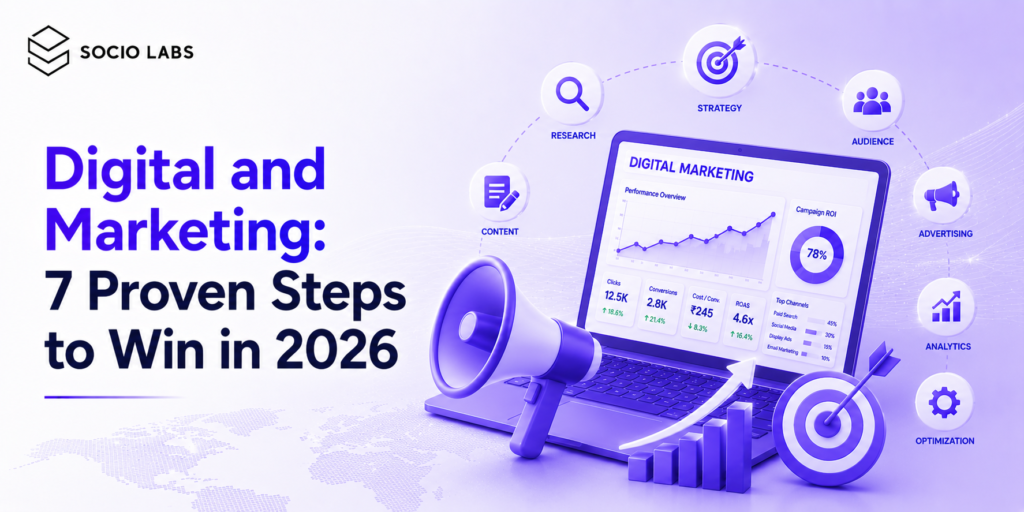
Digital and marketing decisions rarely fail because of bad ideas they fail because strategy and execution get built by different people, at different times, with no shared plan connecting them. Digital Marketing Services A founder nails the positioning in a pitch deck, then hands campaign execution to a freelancer who’s never seen that deck. An agency runs technically clean ads that don’t match the brand’s actual promise. After auditing accounts across dozens of industries, the pattern holds up every time: businesses that treat digital and marketing as one connected system consistently outperform those running strategy and execution as separate efforts. This guide lays out seven concrete steps to close that gap in 2026.
What Is Digital and Marketing Strategy?
Digital and marketing strategy is the combined process of defining who you’re targeting and why they should choose you, then delivering that message through digital channels like search, social, email, and paid ads. It’s one continuous discipline, not two separate jobs handed to two separate teams.
Positioning defines the “who” and “why.” Digital execution defines the “how” through:
- Search Engine Optimization (SEO)
- Pay-Per-Click Advertising (PPC)
- Social Media Marketing
- Content Marketing
- Email Marketing
A business with strong positioning but weak execution reaches too few people. A business with strong execution but weak positioning reaches plenty of people with the wrong message. Google’s guidance on helpful content reinforces this directly — clarity and coherence across a brand’s presence outrank raw channel volume.
Step 1–3: Building Your Digital and Marketing Foundation
The first three steps of any digital and marketing plan happen before a single ad goes live or a single blog post gets published skip them, and every later step becomes guesswork.
Define Positioning and Goals
Write down, in one sentence, what makes your offer different and for whom. Attach a specific, numeric goal to it leads, sales, or awareness, with a target number and timeframe. Vague goals like “grow the business” produce vague campaigns; specific goals produce specific, testable plans.
Identify Your Audience and Channels
Define your audience by more than demographics include intent signals and where they actually spend time online. Then select two or three primary channels matched to that audience, rather than spreading thin across every platform available. Our team has repeatedly seen five-channel launches with a one-channel budget quietly fail simply from dilution, not from bad execution.
Set Budget and Install Tracking
Tie your budget to a realistic cost-per-lead figure for your industry, not a comfortable round number. Then install Google Analytics 4 and Google Tag Manager before launch, not after retroactive tracking setup means losing the early performance data that’s often the most valuable data you’ll ever collect.
Digital and Marketing Channels That Matter Most
Digital and marketing channels fall into three categories, and relying on just one leaves a business exposed to algorithm shifts or rising ad costs it can’t control.
Organic Channel
SEO and content marketing build compounding, long-term visibility without ongoing per-click cost, though results typically take three to six months to show meaningful traction.
Paid Channels
PPC, paid social, and display advertising deliver immediate visibility and precise targeting the right choice when speed matters more than achieving the lowest possible cost per click.
Owned Channels
Email marketing and your website remain algorithm-independent, giving you direct access to your audience regardless of what a platform changes tomorrow.
| Channel Type | Speed to Results | Cost Structure | Best For |
|---|---|---|---|
| Organic (SEO, Content) | Slow (3–6 months) | Time investment, lower ongoing cost | Long-term compounding visibility |
| Paid (PPC, Social Ads) | Fast (days–weeks) | Ongoing spend per click/impression | Quick visibility, testing offers |
| Owned (Email, Website) | Immediate for existing audience | Low, mostly tool cost | Retention, direct communication |
Step 4–5: Execution and Testing
With foundation and channels set, step four is launching narrow: fewer keywords, fewer audiences, fewer ad variants than you’re tempted to try, so early data is clean enough to act on. Step five is testing one variable at a time ad copy, then landing page, then bidding strategy rather than changing everything at once and losing the ability to tell what actually worked. Most accounts that stall out at this stage aren’t underperforming because of bad creative; they’re underperforming because too many variables changed simultaneously for anyone to learn from the results.
Tools Every Digital and Marketing Team Should Use
The right toolkit turns a good plan into a repeatable, measurable process instead of a one-off campaign nobody can properly evaluate afterward.
- Google Ads & Meta Ads — the two largest paid platforms for most businesses.
- Google Analytics 4 (GA4) — tracks traffic and conversion behavior across channels.
- Google Search Console — monitors organic performance and indexing issues.
- Google Tag Manager — manages tracking without constant developer dependency.
- Looker Studio — unifies reporting into a single dashboard.
- SEMrush or Ahrefs — keyword research and competitor analysis.
- Google Keyword Planner & Google Trends — search volume and seasonal interest.
- Microsoft Ads — often overlooked, but can offer lower CPCs in less competitive niches.
Expert tip: connect ad platforms and GA4 before launch, not after the same rule as tracking setup, because early data is irreplaceable.
How to Measure Digital and Marketing ROI
Measuring ROI means comparing revenue generated against total cost, tracked separately by channel rather than blended into one overall number that can hide exactly where a problem sits.
ROI = (Revenue – Cost) / Cost × 100
- ROAS — revenue generated per unit of ad spend.
- Cost Per Lead (CPL) — total spend divided by leads generated.
- Conversion Rate — percentage of visitors completing a desired action.
Businesses that track ROI by channel identify underperforming spend significantly faster than those relying on one blended metric, since a strong channel can otherwise mask a weak one sitting in the same report.
Common Digital and Marketing Mistakes to Avoid
- No conversion tracking — turns every decision into a guess instead of a data-backed choice.
- Channel overload — running SEO, PPC, social, and email at once without enough budget for any of them to work well.
- Premature judgment — pausing campaigns within days rather than allowing algorithms time to learn.
- Disconnected messaging — ads that don’t match the positioning used elsewhere on the site.
- Ignoring landing page experience — sending traffic to a page that doesn’t match the ad’s promise.
Three underfunded channels almost always underperform one or two well-funded ones a pattern that shows up in nearly every underperforming account we’ve audited.
Step 6–7: Scaling and Choosing the Right Support
Step six is scaling gradually typically 15–20% budget increases at a time once a channel shows consistent, positive ROI, rather than doubling spend the moment results look promising. Step seven is recognizing when internal bandwidth is the limiting factor, not strategy: once monthly ad spend or channel count exceeds what your team can realistically monitor weekly, an experienced agency or specialist typically pays for itself in avoided mistakes alone. Look for verifiable case studies with real metrics, full ownership of your ad accounts and analytics, and a track record in the specific channels your plan actually needs — not just the lowest quote.
Conclusion
Digital and marketing succeed together when foundation, channel selection, execution, and measurement are treated as one connected process rather than isolated tasks handled by different people at different times. The seven steps in this guide from defining positioning to scaling gradually apply whether you’re managing campaigns yourself or evaluating outside help. At Sociolabs, we’ve consistently seen that businesses who follow this sequence, in order, avoid the most expensive and most common mistakes.
If you’re ready to bring digital and marketing together into one coordinated plan, the team at Sociolabs can help you audit your current channels and build a strategy around measurable results.Reach out to Sociolabs for a strategy session focused on where your digital and marketing efforts stand today — and where they could be performing better.
FAQs
Marketing is the broader discipline covering positioning, messaging, and audience strategy the "who" and "why" behind a business's approach. Digital marketing is the execution layer, delivering that strategy through online channels like search, social media, email, and paid advertising. Neither works well without the other.
Budgets vary by industry and goals, but small businesses typically start with a modest monthly spend focused on one or two channels, scaling only once early data shows a positive return. Underfunding too many channels at once usually performs worse than fully funding fewer channels.
The main channels fall into three categories: organic (SEO, content marketing), paid (PPC, paid social, display advertising), and owned (email marketing, your website). A resilient strategy typically draws from all three rather than relying on just one.
Paid channels can show early signals within weeks, while organic channels like SEO typically take three to six months for meaningful traction. Judging performance too early is one of the most common reasons businesses abandon strategies just as they're starting to work.
Small budgets and simpler goals can often be managed in-house with the right tools and time investment. As spend, channel count, and complexity grow, an experienced agency typically accelerates results and reduces costly trial-and-error.