
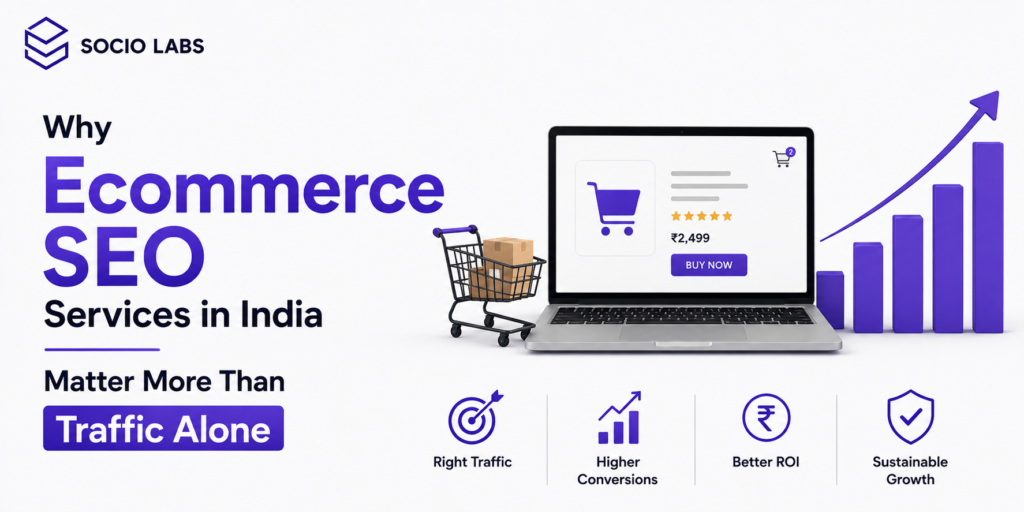
A product page ranking on page one for the wrong keyword is a common problem most Indian online stores don’t notice until conversions stay flat despite steady traffic. ecommerce seo services in india exist specifically to fix this gap connecting technical health, product content, and search intent so traffic actually turns into revenue.
Businesses looking to strengthen this alongside broader visibility can also explore SEO Services from SocioLabs. This guide breaks down what a real ecommerce SEO strategy includes, how it plays out for Shopify, WooCommerce, and marketplace sellers in India specifically, and what to look for before hiring a partner.
What Are Ecommerce SEO Services and Why Do Online Stores Need Them?
Ecommerce SEO services help online stores increase organic visibility for product, category, and commercial-intent searches without depending entirely on paid traffic. Unlike general SEO, the work centers on catalog structure, product data, and conversion-focused optimization rather than blog content alone.
Online stores need this because paid ads stop delivering the moment budget stops, while organic rankings continue driving traffic month after month once established. For growing D2C brands, this compounding effect often becomes the difference between sustainable margins and a business permanently dependent on rising ad costs.
The scope is broader than most business owners expect. It spans technical SEO (site speed, crawlability), product and category page optimization, structured data, and content strategy all working together rather than as isolated tasks handled separately.
What Does an Ecommerce SEO Strategy Include?
A complete ecommerce SEO strategy includes keyword research, product and category page optimization, technical SEO, internal linking, structured data, and ongoing competitor analysis treated as one connected system rather than separate checklist items.
Keyword research for an online store looks different from a typical blog it’s less about broad topics and more about matching exact product and category search intent, distinguishing “buy running shoes online” from informational queries that won’t convert.
Product page SEO focuses on unique, SEO-friendly product descriptions, clear titles, and structured data, while category page SEO ensures broader collection pages rank for higher-volume commercial terms without competing against the store’s own product pages.
- Keyword research mapped to product and category intent
- Product page SEO (unique descriptions, structured data, schema)
- Category page SEO for broader commercial-intent terms
- Technical SEO (Core Web Vitals, crawlability, indexing health)
- Internal linking connecting categories, products, and content
- Competitor analysis to identify gaps in ranking coverage
Mobile SEO deserves specific attention here too, since the majority of Indian ecommerce traffic now arrives on mobile devices, making page speed and mobile usability a ranking factor that directly affects conversion as well.
How Ecommerce SEO Works for Indian Online Stores
Ecommerce SEO in India works by aligning product visibility with how Indian shoppers actually search often price-conscious, comparison-heavy, and split between branded searches and generic category terms across both Google and marketplace platforms.
Shopify and WooCommerce stores face different technical realities than marketplace sellers. A Shopify store controls its own site architecture and page speed directly, while a seller also listed on Amazon or Flipkart needs to think about how organic search and marketplace visibility work together rather than competing for the same customer.
Consider a Mumbai-based D2C skincare brand selling both on its own Shopify store and through marketplaces. Organic search on the brand’s own site typically drives higher-margin, direct sales, while marketplace visibility captures a different, often price-sensitive segment both matter, but the SEO approach for each differs meaningfully.
National search visibility matters more than local SEO for most ecommerce brands, since customers can be anywhere in India, though category competitiveness varies significantly fashion and electronics face far more organic competition than niche, specialized product categories.
What Ecommerce SEO Services Should a Business Invest In?
The ecommerce SEO services worth investing in first are a technical SEO audit, product and category page optimization, and structured data implementation these typically deliver the fastest, most measurable impact before broader content or link-building work.
A technical audit through Google Search Console often reveals indexing issues duplicate product variants, blocked category pages that silently cap rankings regardless of how good the content is. Fixing these usually shows results faster than any content investment.
| Service | What It Improves | Why It Matters | Best For |
|---|---|---|---|
| Technical SEO audit | Crawlability, indexing, site speed | Fixes issues that block rankings entirely | All ecommerce sites, especially larger catalogs |
| Product page optimization | Individual product visibility | Directly drives conversion-ready traffic | Stores with unique, differentiated products |
| Category page optimization | Broader commercial-intent rankings | Captures higher-volume search terms | Multi-product, multi-category stores |
| Structured data / schema | Rich results, AI/search understanding | Improves click-through and AI citation | All product-based ecommerce sites |
| Content & keyword strategy | Long-term organic growth | Builds authority beyond product pages alone | Brands investing in sustained SEO growth |
SocioLabs typically recommends sequencing these technical fixes first, then product and category optimization, then broader content rather than starting with content while technical issues remain unresolved underneath.
How to Choose the Right Ecommerce SEO Partner in India
Choosing the right ecommerce SEO partner means verifying genuine ecommerce-specific experience, confirming they audit technical issues (not just content), and checking their reporting connects to actual revenue, not just ranking positions.
Ask specifically about their experience with your platform Shopify, WooCommerce, or a custom build since technical implementation differs meaningfully between them, and generic SEO experience doesn’t always translate to ecommerce-specific problems like duplicate product variants or faceted navigation.
A useful evaluation checklist:
- Ask for examples of ecommerce-specific technical fixes they’ve handled
- Confirm their process covers both product and category page optimization
- Check whether reporting ties to revenue and conversion data, not just rankings
- Ask how they handle structured data and schema for products
- Request a realistic timeline rather than guaranteed ranking promises
Businesses can also explore AI SEO Services from SocioLabs to understand how structured data and entity signals now affect visibility inside AI-powered search results, not just traditional rankings.
Common Ecommerce SEO Mistakes That Hurt Rankings
The most common ecommerce SEO mistakes are duplicate product content, thin product pages, poor category structure, and missing schema issues that quietly cap visibility even when a store publishes new content regularly.
Duplicate content is especially common in ecommerce, where product variants (different colors or sizes) often generate near-identical pages without proper canonical tags, confusing search engines about which version to rank.
Thin product pages a title, price, and one-line description rarely rank well against competitors offering genuinely useful product information. Keyword cannibalization is another frequent issue, where multiple pages unintentionally compete for the same search term instead of each targeting distinct intent.
- Duplicate product content across variants without canonical tags
- Thin product pages lacking genuine, useful descriptions
- Poor category structure making navigation and crawling difficult
- Missing or incorrect product schema markup
- Slow page speed and poor mobile experience
- Broken internal links between products, categories, and content
- Keyword cannibalization across similar product or category pages
How Long Does Ecommerce SEO Take to Show Results?
Ecommerce SEO typically shows early signal within 60–90 days for technical fixes, with more substantial ranking and traffic improvement generally visible after 4–6 months, though timelines vary based on competition, domain age, and existing site authority.
A newer store in a highly competitive category like fashion will generally take longer to see meaningful movement than an established store in a less contested niche, regardless of how well the SEO work is executed.
Technical fixes tend to show the fastest results, since resolving indexing or crawlability issues can unlock visibility for pages that were previously invisible to search engines. Content and authority-building work compounds more gradually, typically over several months rather than weeks.
No agency can guarantee specific rankings or timelines, since search competition and algorithm behavior aren’t fully controllable realistic expectations, set upfront, prevent most of the frustration businesses experience with SEO partnerships.
CONCLUSION
Getting real value from ecommerce seo services in india means treating SEO as connected system work technical health, product content, and structured data rather than a checklist of isolated tasks. Stores that fix technical issues first, then optimize product and category pages deliberately, consistently see more sustainable organic growth than those chasing content volume alone. Businesses ready to build this alongside broader growth can also explore Performance Marketing Services from SocioLabs to combine organic and paid strategy under one roof.
Want to know where your ecommerce store is actually losing organic visibility? Get a practical audit from SocioLabs and build an SEO strategy focused on sustainable, revenue-connected growth rather than rankings alone.