
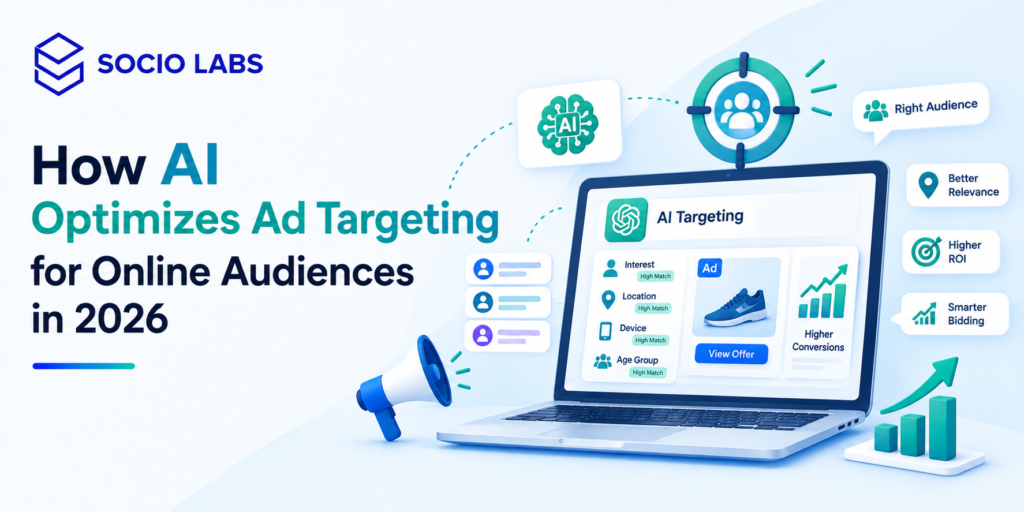
Most marketers running Google or Meta campaigns today aren’t manually building audience segments the way they were five years ago the algorithm is doing most of that work now, often without anyone fully explaining how. Understanding how AI optimize ad targeting actually happens under the hood matters more than ever, because “just trust the algorithm” isn’t a strategy, it’s an excuse for not knowing what’s happening with your budget.
Our team at SocioLabs works with campaigns where AI-driven targeting is doing the heavy lifting daily, and this guide breaks down exactly what that means in practice how AI identifies audiences, personalizes creative, and adjusts bidding in real time, plus where it genuinely falls short and still needs human oversight
What Is AI-Powered Ad Targeting?
AI-powered ad targeting uses machine learning models to analyze user signals, predict conversion likelihood, and automatically adjust who sees an ad, when, and at what bid replacing manual audience-building with continuous, data-driven decisions made in real time.
How AI Changes Traditional Audience Targeting
Traditional targeting relied on marketers manually selecting age, location, or interest categories based on assumptions; AI-driven targeting instead analyzes actual behavioral and conversion signals across millions of data points to find patterns no human would spot manually.
AI vs Manual Ad Targeting
The practical difference shows up in speed and scale a human adjusting bids weekly can’t compete with a system re-evaluating every auction in milliseconds based on fresh signals.
| Traditional Targeting | AI-Powered Targeting |
|---|---|
| Manual audience setup | Automated audience discovery |
| Historical assumptions | Predictive signals |
| Manual optimization | Continuous optimization |
| Fixed targeting rules | Dynamic targeting |
| Slower adjustments | Real-time adjustments |
How Does AI Optimize Ad Targeting for Online Audiences?
AI optimizes ad targeting by continuously analyzing audience signals, predicting which users are most likely to convert, and automatically adjusting bids, placements, and creative delivery toward those users a process that repeats constantly rather than on a fixed schedule.
Audience Segmentation
Instead of static demographic buckets, AI systems build dynamic segments based on behavior patterns browsing history, past purchases, engagement signals that shift as new data comes in.
Predicting User Intent
Machine learning models estimate the probability a specific user will take a desired action, using signals like search behavior, site engagement, and similarity to past converters, rather than relying on a single demographic proxy.
Real-Time Campaign Optimization
Bids and placements adjust within each individual ad auction based on that specific user’s predicted value, not a fixed bid applied uniformly across an entire audience segment.
How AI Identifies the Right Audience
AI identifies the right audience by combining behavioral signals, contextual data, and similarity modeling to find users who resemble your best existing customers, rather than relying on marketer-defined demographic assumptions alone.
Behavioral Signals
Browsing patterns, time spent on specific content, and past interactions with your brand all feed into how AI systems score a user’s likelihood to convert.
Demographic and Contextual Signals
Traditional signals like location and device type still matter, but AI weighs them alongside behavioral data rather than treating them as the primary targeting criteria the way manual setups often did.
Lookalike and Similar Audiences
By analyzing patterns among your existing converters, AI can identify new users who share similar characteristics a capability that scales far beyond what manual audience research could realistically achieve.
How AI Personalizes Ads for Different Users
AI personalizes ads by dynamically selecting which creative elements headlines, images, copy to show each individual user based on what’s predicted to resonate most, rather than serving identical creative to an entire audience segment.
Dynamic Creative Optimization
Platforms can automatically test and serve different combinations of headlines, images, and calls-to-action, learning which combinations perform best for specific audience segments in real time.
Personalized Messaging
Messaging can shift based on where a user is in their journey a first-time visitor might see broader brand messaging, while someone who abandoned a cart sees a more direct, conversion-focused message.
Cross-Platform Audience Signals
Increasingly, signals from one platform inform targeting on another when first-party data is properly connected, giving AI a more complete picture of a user’s intent across their broader online behavior.
How AI Optimizes Bidding, Budget and Conversions
AI optimizes bidding by calculating a predicted value for each auction in real time and adjusting bids accordingly, allocating budget toward the users and moments most likely to produce a conversion rather than spreading spend evenly.
Smart Bidding
Systems like Google’s Smart Bidding use machine learning to set bids based on the likelihood of conversion for each specific auction, factoring in signals a manual bidding strategy couldn’t realistically process at that speed.
Budget Allocation
Rather than a fixed daily split across campaigns, AI-driven systems can shift budget toward better-performing segments dynamically as performance data accumulates throughout a campaign’s lifecycle.
Conversion Prediction
Machine learning models estimate the probability of conversion before it happens, allowing budget to be prioritized toward higher-probability opportunities rather than reacting only after conversions are already recorded.
AI Ad Targeting Across Major Advertising Platforms
Most major advertising platforms now build AI-driven targeting and bidding directly into their core products, though the specific mechanics and level of advertiser control vary meaningfully between them.
| Platform | How AI Is Used |
|---|---|
| Google Ads | Smart Bidding, Performance Max automated targeting across Search, Display, YouTube |
| Meta Ads | Advantage+ automated targeting and creative optimization |
| Microsoft Advertising | AI-assisted bidding and audience expansion |
| YouTube Ads | AI-driven placement and audience targeting within Google’s ecosystem |
| Performance Max | Fully automated cross-channel targeting with limited manual segment control |
Businesses already working with structured PPC advertising services typically get more value from these AI systems, since clean conversion tracking and quality first-party data directly determine how well the underlying models can actually perform
Benefits of AI-Powered Ad Targeting for Businesses
AI-powered ad targeting benefits businesses primarily through better audience matching, faster optimization, and more efficient budget allocation than manual management can realistically achieve at scale.
- Better audience matching based on real behavioral signals, not assumptions
- Improved personalization across creative and messaging
- Faster optimization cycles than manual bid and audience adjustments
- More efficient budget allocation toward higher-probability conversions
- Better conversion potential through continuous, real-time refinement
- Reduced manual workload for campaign management teams
- Scalable campaign management across larger, more complex account structures
Limitations and Risks of AI Ad Targeting
The main limitations of AI ad targeting are dependence on data quality, reduced transparency into why specific decisions get made, and genuine attribution challenges as targeting becomes more automated and less directly controllable.
Poor data quality inconsistent tracking, incomplete conversion signals directly undermines AI performance, since these systems can only optimize toward what they can actually measure. Privacy changes across platforms have also made third-party data less reliable, pushing more weight onto first-party data quality.
- Data quality directly limits how well AI systems can actually perform
- Privacy regulations and signal loss reduce available targeting data
- Attribution becomes harder to interpret as automation increases
- Limited transparency into why the algorithm made specific decisions
- Risk of over-automation without sufficient human strategic oversight
- Algorithmic bias can emerge from patterns in historical training data
Marketers manage these risks by maintaining clean first-party data, setting clear conversion goals before automating, and reviewing AI-driven decisions periodically rather than assuming the system is always right.
How Indian Businesses Can Use AI for Ad Targeting
Indian businesses across startups, SMEs, e-commerce, and enterprise segments can use AI ad targeting most effectively by first ensuring clean conversion tracking, then gradually adopting automated bidding as enough conversion data accumulates to make the models genuinely reliable.
A D2C brand with limited historical data, for example, should start with broader automated targeting to let the system learn before narrowing scope, while an enterprise with years of conversion history can move to more aggressive automation immediately since the underlying data is already strong.
- Startups: Focus on clean tracking setup before scaling automated bidding
- SMEs: Start with Smart Bidding on well-defined conversion goals
- E-commerce/D2C: Use dynamic product ads and Performance Max for catalog-wide reach
- Service businesses: Prioritize lead-quality signals, not just lead volume, in conversion tracking
- Enterprises: Leverage first-party data integration across CRM and ad platforms for deeper personalization
How AI Will Change Ad Targeting in 2026
AI ad targeting in 2026 is shifting toward deeper first-party data integration, more automated cross-channel campaign management, and growing convergence between AI search behavior and advertising targeting itself.
As third-party signals continue weakening, first-party data quality is becoming the clearest differentiator between businesses getting strong AI-driven results and those getting mediocre ones. Creative automation is also expanding generating and testing more variations faster than manual production ever could.
- Deeper reliance on first-party data as third-party signals weaken further
- Predictive targeting expanding beyond conversion likelihood to lifetime value
- Creative automation producing and testing more variations at greater speed
- Privacy-aware targeting becoming a baseline expectation, not a differentiator
- Growing convergence between AI-powered search behavior and advertising targeting
Conclusion
AI optimize ad targeting isn’t a black box businesses should blindly trust it’s a system that performs only as well as the data and strategic direction behind it. AI handles audience discovery, personalization, and real-time bidding at a scale no manual process can match, but conversion tracking quality and clear campaign goals still determine whether that automation actually works in your favor. At SocioLabs, this is exactly the balance every performance marketing strategy is built around genuine automation, backed by human judgment on what actually matters.
FAQs
AI optimizes ad targeting by analyzing behavioral and conversion signals continuously, predicting which users are most likely to convert, and automatically adjusting bids, placements, and creative in real time.
Yes AI-driven bidding and audience discovery typically improve conversion efficiency by identifying and prioritizing higher-probability users faster than manual campaign management can achieve.
Google Ads, Meta Ads, Microsoft Advertising, and YouTube Ads all build AI-driven targeting and bidding into their core products, though the specific mechanics and advertiser control vary by platform.
Key risks include dependence on data quality, reduced transparency into algorithmic decisions, attribution challenges, and the possibility of over-automation without sufficient human oversight.
Start by ensuring clean, accurate conversion tracking, then gradually adopt automated bidding strategies as enough conversion data accumulates to make the underlying models genuinely reliable.