
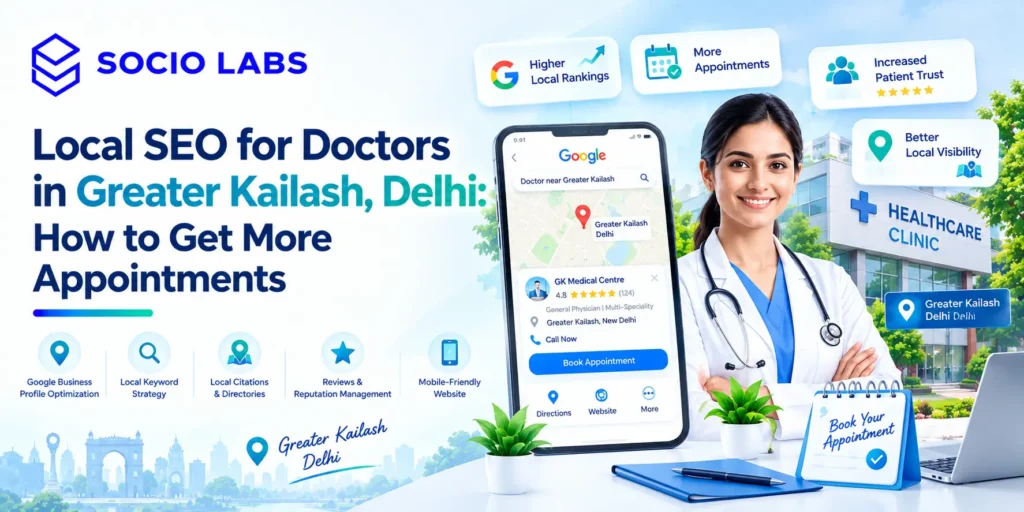
A patient in Greater Kailash searching “pediatrician near me” or “best dermatologist in GK 2” isn’t browsing they’re usually ready to book within the next few days. Whether your clinic shows up in that search, with accurate details and genuine credibility, often decides who gets that appointment. Local SEO is how a doctor or clinic in Greater Kailash wins that moment of search intent not through paid promotion tactics, but through accurate, well-structured visibility exactly where and when patients are looking. This guide walks through exactly how to build that visibility, step by step, specifically for a Greater Kailash practice. Along the way, we’ll reference how an agency such as SocioLabs approaches local SEO for healthcare practices across South Delhi.
What Is Local SEO for Doctors, and Why Does It Matter in Greater Kailash
Local SEO for doctors is the practice of optimizing a clinic’s online presence Google Business Profile, website, citations, and location-specific content so the practice appears prominently when nearby patients search for relevant care, specialty, or symptoms.
Greater Kailash specifically has a dense mix of clinics, specialist practices, and diagnostic centers across GK 1, GK 2, and the surrounding M-block and N-block markets, meaning patients often have several comparable options within a short radius. In that environment, a practice’s visibility in Google’s local map pack and organic results directly influences which clinic actually gets the call or booking making local SEO less about general brand awareness and more about capturing specific, nearby, ready-to-book search intent.
How Do You Set Up a Google Business Profile for a GK Clinic?
Setting up a Google Business Profile properly means claiming and verifying the listing, completing every relevant field accurately, selecting precise specialty categories, and keeping hours, services, and contact details current.
Practical setup steps include claiming the profile if it hasn’t been already (or correcting it if it was auto-generated inaccurately), selecting the most specific primary category available (e.g., “Dermatologist” rather than generic “Doctor”), adding accurate business hours, including any variation for specific days, listing services and specialties clearly so Google can match relevant searches, adding real photos of the clinic exterior, interior, and signage to help patients recognize the location, and setting the exact service area or pinning the precise address so the clinic shows correctly in nearby map searches.
A fully completed, accurate profile consistently outperforms a partially filled one in local search visibility this is one of the highest-leverage, lowest-cost steps a GK practice can take.
What Local Keywords Should a Greater Kailash Practice Target?
A Greater Kailash practice should target specialty-plus-location keywords combining the specific medical specialty with the specific neighborhood or sub-area rather than broad, generic terms that face far more competition and weaker purchase intent.
Useful keyword patterns include specialty plus neighborhood (“gynecologist in Greater Kailash,” “orthopedic clinic GK 1”), specialty plus nearby landmark or sub-market where relevant (“dentist near M-block market”), symptom-plus-location combinations for conditions patients commonly search before diagnosis (“skin allergy treatment Greater Kailash”), and service-specific terms for distinct offerings (e.g., “vaccination clinic GK 2” rather than just “clinic GK 2”). Because GK 1 and GK 2 function as somewhat distinct sub-markets with their own local search behavior, being specific about which part of Greater Kailash your practice serves rather than using “Greater Kailash” as one broad catch-all tends to perform better for genuinely local intent.
How Should Your Website Be Structured for Local Search?
A clinic website should be structured with a clear homepage establishing location and specialty, dedicated pages for each service or specialty, and consistent, accurate contact and location information repeated across every page rather than one generic page trying to cover everything.
Practical structure includes a homepage that states the practice’s specialty and Greater Kailash location clearly within the first screen a visitor sees, individual pages for each distinct service or specialty (not combined into one “services” page), an easily findable contact page with embedded Google Maps location, phone number, and hours, fast mobile load speed, since most local health searches happen on mobile devices, and schema markup (LocalBusiness and MedicalBusiness schema types) to help search engines clearly understand the practice’s location and specialty.
This structure doesn’t just help search engines it also helps patients land directly on the specific page relevant to their need rather than having to search through a generic page for the information they came for.
How Do Citations and Directory Listings Help Local Rankings?
Citations mentions of your practice’s name, address, and phone number across directories, medical platforms, and local business listings help local rankings by reinforcing consistency and legitimacy signals that search engines use to confirm a business’s location and credibility.
Practical steps include ensuring your practice’s name, address, and phone number (NAP) are identical across every listing inconsistent formatting or outdated addresses can quietly undermine local ranking signals, claiming and completing listings on major directories and medical platforms where relevant, correcting any outdated or duplicate listings from previous addresses or practice names, and prioritizing quality, accurate citations over volume a handful of correct, authoritative listings matters more than dozens of low-quality, inconsistent ones.
This is also an area where any paid, manufactured, or ranking-boosted placement on healthcare directories should be avoided entirely recent regulatory guidance for doctors and hospitals in India specifically restricts paid ranking placements on healthcare platforms, so citation-building here should stay limited to accurate, organic directory presence.
How Should You Handle Patient Reviews Compliantly?
Patient reviews should be handled by encouraging genuine, unprompted feedback through normal, non-incentivized means, and responding professionally to reviews received without soliciting testimonials for promotional use, offering incentives for reviews, or using paid or manufactured review activity.
This is an area where recent national guidelines for doctors and hospitals in India have tightened considerably testimonials, paid reviews, and promotional use of patient experiences are now explicitly restricted for medical practitioners, a shift covered in more depth in our broader guide to digital marketing compliance for South Delhi healthcare practices. A practical, compliant approach is simply making it easy for patients to leave a review if they choose to (a visible Google review link, for instance), responding thoughtfully and professionally to reviews that come in naturally, and never offering incentives, scripting specific wording, or using testimonial content in active marketing materials.
What On-Page Content Drives Local Appointment Bookings?
The on-page content that drives local appointment bookings is clear, factual information about services, conditions treated, and what a patient can expect paired with an obvious, low-friction way to book an appointment, rather than content built around promotional claims or outcome promises.
Useful content types include condition and treatment explainer pages written factually and accessibly, a clear “what to expect at your first visit” page that reduces uncertainty for new patients, an FAQ page addressing common questions specific to the practice’s specialties, and a visible, simple appointment booking process whether a booking widget, a clear phone number, or a straightforward contact form placed prominently rather than buried. Content that answers a patient’s actual pre-visit questions tends to build more genuine trust and conversion than generic promotional copy, and it keeps the practice clearly within the more conservative, factual framing that current healthcare advertising guidelines call for.
How Do You Track Whether Local SEO Is Actually Working?
Local SEO performance should be tracked through Google Business Profile insights (views, searches, direction requests, calls), organic search visibility for local keyword terms, and most directly appointment inquiries or bookings traceable back to online visibility.
Practical tracking includes reviewing Google Business Profile insights monthly for trends in how patients found and interacted with the listing, monitoring rankings for your core specialty-plus-location keywords over time, tracking phone calls and form submissions with a method that distinguishes online-driven inquiries from walk-ins or referrals, and reviewing which specific pages on the website are generating the most appointment-related activity. Because local SEO builds gradually, reviewing trends monthly rather than reacting to short-term fluctuations gives a more accurate picture of whether visibility is genuinely improving.
Conclusion
Local SEO for doctors in Greater Kailash comes down to being accurately, specifically, and consistently visible exactly where and when nearby patients are searching a complete Google Business Profile, specialty-plus-location keyword targeting, and a well-structured, factual website. Within the current compliance environment, the safest and most durable approach leans on genuine accuracy and educational content rather than promotional claims or testimonials, which also happens to be what tends to build real, lasting patient trust.
Want a local SEO strategy built specifically for your Greater Kailash practice, within current healthcare marketing compliance requirements? Explore SEO services from SocioLabs and see how a location-specific, compliance-aware approach could work for your clinic.
FAQs
Start with a fully completed, accurate Google Business Profile, target specialty-plus-location keywords specific to GK 1 or GK 2, build dedicated pages for each service, and maintain consistent business information across all listings.
Google Business Profile often has the most direct impact on whether your practice appears in local map pack results, which is typically where ready-to-book patients look first.
No current national guidelines for doctors and hospitals in India specifically restrict promotional use of patient testimonials and reviews, so trust should be built through factual, educational content instead.
Quite specific targeting “GK 1” or “GK 2” and nearby markets or landmarks, combined with your exact specialty, tends to perform better than broad “Greater Kailash” or generic specialty terms alone.
Most practices see meaningful improvement over a few months of consistent effort, since Google needs time to crawl, index, and build trust signals around updated or new content and listings.