
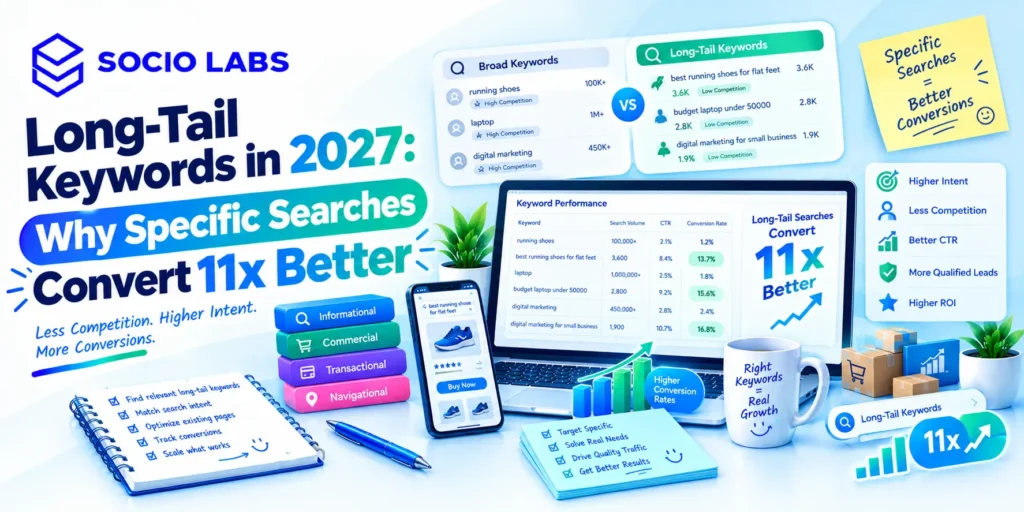
The most profitable searches in your market are probably the ones your keyword tool tells you to ignore. In a paid search study of 40 companies, six-word searches converted at 1.94%, while one-word searches converted at just 0.17%. That is an 11x gap.
Most businesses still chase the biggest keywords: “shoes,” “CRM,” “accounting.” On paper the logic holds, since more searches should mean more traffic and more customers. In practice, those broad searches are typed by people who are still browsing, and Google increasingly answers them directly with AI-generated summaries.
In this guide, you will learn:
- Why long-tail keywords convert so much better than short, high-volume terms
- What the latest data says about query length and revenue
- How search is changing heading into 2027, from AI Overviews to conversational queries
- A step-by-step method to find your own high-intent, low-competition searches
- How to build pages that win both Google rankings and AI search citations
Whether you are a beginner learning keyword basics or a marketing lead defending a budget, this playbook from Sociolabs is written to be applied this week.
Why Big Keywords Rarely Bring Your Best Customers
Broad keywords are built for browsers, not buyers. Someone typing a single word is usually early in the process, with many tabs open and no clear idea of what they need yet.
The conversion problem
With branded searches excluded, one-word searches converted at 0.17%, which is fewer than one visitor in 500. You pay the most to reach the visitor who is least ready to act.
The AI Overviews problem
Google now answers many broad, informational searches itself. Industry data shows click-through rates for pages below an AI Overview drop by roughly 61% on those searches. Fighting hardest for the least valuable visitor, while clicks shrink, is a poor trade.
Why your keyword tool misleads you
Keyword tools estimate volume from samples, and they often round rare searches down or drop them. A long, specific query may show 10 searches a month, or just a dash. But dozens of phrasings of the same specific problem add up to a real market.
- The tool is doing its job: estimating popularity
- It was not built to find buyers
- Low reported volume is not the same as low value
The 61% figure now has no named source. Before publishing, add a link to the original industry study, because an unsourced statistic weakens the post’s credibility.
The Data: Longer Searches Convert and Drive More Revenue
Conversion rises sharply once a search reaches four words, then holds steady. The figures below come from search ad campaigns across 40 companies (branded searches excluded).
Query length | Conversion rate | What it signals |
|---|---|---|
1 word | 0.17% | Early browsing, no defined need |
2 words | Barely higher than 1 word | Still exploratory |
3 words | Starts to climb | Intent forming |
4 words | About 1.6% | A different kind of searcher |
6 words | 1.94% | Specific need, ready to choose |
7+ words | 1.83% | Highly specific, stays high |
The revenue picture points the same way. A four-year analysis of more than 1 million leads tracked which searches produced revenue in 2025:
Query length | Share of 2025 revenue |
|---|---|
7+ words | 51% |
1 to 2 words | Under 4% |
In 2022, searches of seven or more words drove 31% of revenue. The share dipped slightly from 2024 to 2025, but the four-year direction is clear.
Caveat: these conversion rates come from paid search campaigns, and organic conversion rates can differ. The underlying intent is the same whether someone clicks your ad or your organic listing, and intent is what you are targeting. Treat these figures as the study’s findings, and validate them against your own analytics.
Search Trends Shaping 2027
Trend | What it means for your keyword strategy |
|---|---|
Conversational queries | Users describe their full situation, so pages must name situations, not just products |
AI Overviews on broad searches | Informational head terms lose clicks; specific, decision-stage queries are harder for AI summaries to satisfy |
AI search assistants (ChatGPT, AI Mode) | Content that clearly answers one specific scenario is easier to cite |
Smaller traffic, higher value | Report on leads and revenue, not sessions |
What this means in practice
- Optimize for situations, not just terms. A query like “CRM for a 12-location dental group switching off Dentrix” contains a situation, a constraint and a buying intent.
- Measure differently. Specific pages often show smaller traffic numbers but stronger revenue. Expect internal pushback and plan to explain it.
- Expect the trend to continue. Long searches rose from 31% of revenue in 2022 to about half by 2025 in a four-year analysis of more than 1 million leads.
Why Specific Searches Win: The Starving Crowd and Edge Cases
Long searches convert because the searcher has already defined the problem and ruled out the generic answers. They are looking for one company that clearly understands their situation.
The starving crowd principle
Legendary direct-response copywriter Gary Halbert used to ask students which single advantage they would want when opening a hamburger stand. Better meat, location or price were common answers. His pick was a starving crowd: give him hungry people and the burger almost doesn’t matter.
For most of marketing history you could not see that crowd. Search is the exception, because people type what they want, in their own words, at the moment they want it.
Anatomy of a high-intent search
Take “CRM for a 12-location dental group switching off Dentrix.” It packs in three signals:
- A situation: 12 locations
- A constraint: switching off a specific system
- Intent: they are choosing a tool, not learning what a CRM is
Length alone is not the signal. “How do I fix a leaky faucet under my kitchen sink?” is long, but the searcher wants a free answer. Look for queries that are specific and show the person is choosing.
Edge cases bring bigger clients
In software, an edge case is where the normal answer breaks and someone must handle it specifically. A weird niche search often means the opposite of a small customer:
- Multiple locations, regulated industries and legacy systems all signal complexity
- Complexity usually comes with budget
- Fewer competitors bid on these queries, and few have a page written for them, so you can often rank faster and pay less per click
For example, an accountant struggles to win “accounting services,” but can win “accountant for a restaurant with tipped employees in Texas.” A software firm may lose on “project management tool” but win on “project management for construction subcontractors with change orders.”
The self-reference effect
Psychologists call it the self-reference effect: people pay more attention to, and remember more of, information that is clearly about them. A page headed “For multi-location dental groups” makes that visitor lean in before they have seen a single credential.
Real-world example: One digital marketing agency rewrote its homepage for its ideal customer, leading with how customers get found “from Google to ChatGPT” and listing AI SEO first. It reported about 30% more leads afterward, and those leads were bigger and closed faster. These are the agency’s own reported results, not an independent study.
Step-by-Step: How to Find Your Own Edge-Case Keywords
The best long-tail keywords rarely appear at the top of a volume report. Skip the keyword tool at first and mine four sources you already own.
Step 1: Sales calls
Listen for the first question a prospect asks after “What do you do?” For example: “Does this work if we’re in three states?” or “Can it handle our old inventory system?” Write these down word for word, because the way people say it is usually the way they search it.
Step 2: Support tickets
Sort tickets by time to resolve. A long ticket usually means the default answer did not cover the case, and someone else is probably searching for that same problem right now.
Step 3: The final objection
Ask your sales team what a customer needed to hear just before buying. Phrase that last objection as a search query, and you have a page.
Step 4: Google Search Console
Open the Performance report’s query view. Use a custom filter to show only the longest queries and sort by impressions. These are real people describing their situation and landing near you, often on a page not written for them.
Step 5: Validate with question research
A tool such as Answer the Public shows the questions people ask around a topic, including long phrasings that keyword tools bury.
Quick tip: do not dismiss a query because the tool shows “0” or “-” for volume. Judge it by the buyer it implies.
Step-by-Step: Turn Each Situation Into a Page That Converts
Build one page per distinct problem, and name the situation in the very first line.
- Write the opening line as the situation. “CRM software” will not land a buyer. “CRM for multi-location dental groups moving off Dentrix” will. If visitors must scroll to learn whether the page is about them, many will leave.
- Answer the specific situation clearly. Address the constraint directly rather than describing your product in general terms.
- Add one example of a similar customer. A short case study that mirrors the visitor’s context works best.
- Add checkable proof. Use a number, a screenshot or a named client.
- Start with five pages, not fifty. Choose the five problems that recur across all four sources above.
- Judge by leads, not traffic. A page with 40 visitors and three new clients a month outperforms a post with 4,000 visitors and none.
Page element | Why it matters |
|---|---|
Situation-specific H1 | Triggers the self-reference effect and matches the query |
Direct answer near the top | Helps users and AI systems extract the answer |
Customer example | Shows real-world experience |
Verifiable proof | Builds trust and credibility |
Optimizing for AI Search and E-E-A-T
Pages written for one specific situation are well suited to AI search, because they give an assistant a clear, self-contained answer to cite. Combine that with strong trust signals.
AI search optimization checklist
- Put the direct answer in the first 2 to 3 sentences under each heading
- Use question-style subheadings that mirror how people phrase queries
- Keep paragraphs short and use tables and lists for comparisons
- Name the audience, situation and constraint explicitly
- Add FAQ sections with concise, factual answers
- Use structured data (such as FAQ and Article schema) where it applies
- Track brand mentions and citations in AI assistants alongside rankings
E-E-A-T checklist
Signal | How to demonstrate it on a long-tail page |
|---|---|
Experience | Include a real customer example and what actually happened |
Expertise | Show author credentials and explain the edge case in practitioner detail |
Authoritativeness | Cite reputable sources and earn links from industry sites |
Trustworthiness | Provide checkable proof, clear contact details, dates and honest limitations |
Common Mistakes, FAQs and References
Mistakes to avoid
- Equating long with high-intent: look for specific searches that show the person is choosing
- Judging pages by traffic instead of leads and revenue
- Starting with 50 thin pages instead of five strong ones
- Handing every page to AI to write without adding real examples and proof
- Ignoring the language customers actually use on sales calls
Conclusion
SocioLabs focuses on high-intent, long-tail keywords that reflect what customers are actively searching for, helping businesses attract relevant traffic, generate quality leads, and improve conversions through targeted SEO strategies.
Frequently asked questions
Long-tail keywords are longer, more specific search phrases, usually four words or more, that describe a particular situation or need. They have lower volume but typically higher intent.
In NP Digital's study of 40 companies' paid search data, six-word searches converted at 1.94% versus 0.17% for one-word searches. Organic rates may differ, so test against your own data.
Five. Pick the problems that recur across sales calls, support tickets, final objections and Search Console, and judge them by leads.
Yes. Specific, situation-based pages give AI assistants a clear answer to cite, and conversational queries are becoming more common.