
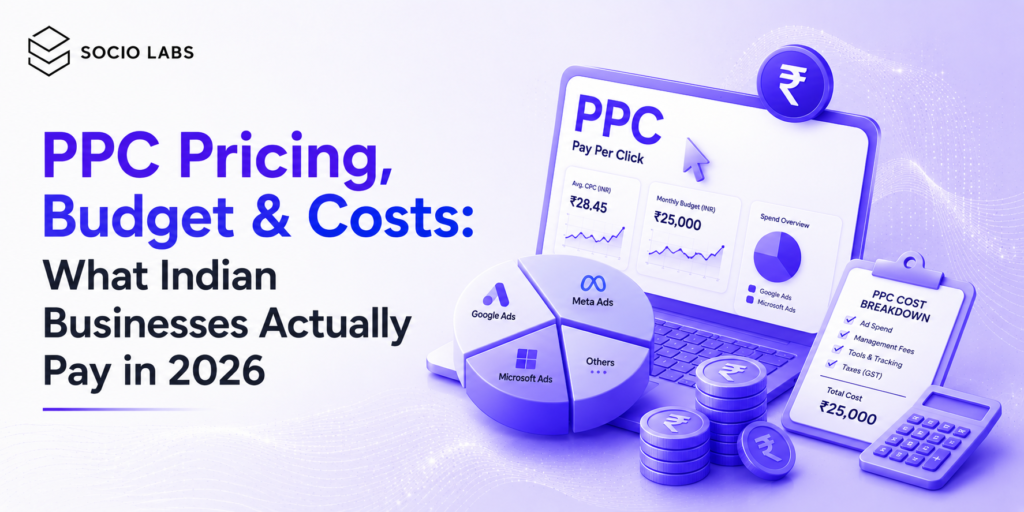
PPC pricing, budget & costs are usually the first thing business owners ask about, and the last thing most agencies explain clearly. Google Ads Management Vague quotes and “it depends” answers leave founders guessing whether ₹20,000 or ₹2,00,000 a month is the right number for their business. At Sociolabs, one recurring conversation with new clients is that they’ve been quoted wildly different prices for what sounds like the same service. This guide breaks down real pricing ranges, budget planning logic, and the hidden costs most proposals leave out so you can plan a Google Ads budget with actual confidence instead of guesswork.
What Does PPC Management Cost for Small Businesses?
PPC management cost for small businesses in India typically ranges from ₹15,000 to ₹60,000 per month for a boutique agency managing a single platform like Google Ads. Costs rise with campaign complexity, the number of platforms managed, and the level of hands-on optimization required.
Several factors shape this number:
- Monthly retainers — Most agencies charge a flat monthly fee that covers strategy, setup, optimization, and reporting, separate from your actual ad spend.
- Freelancer vs agency — Freelancers often charge ₹8,000–₹25,000/month but typically offer less structured reporting and limited bandwidth for testing.
- Industry differences — Regulated or high-competition sectors like finance, real estate, or legal usually cost more to manage due to stricter compliance and higher CPCs.
- Campaign complexity — A single search campaign costs far less to manage than a multi-platform setup spanning Search, Shopping, Display, and remarketing.
- Typical Indian pricing — Small local businesses often fall in the ₹15,000–₹30,000/month band, while growth-stage ecommerce or D2C brands often move into the ₹40,000–₹1,00,000+ range.
After auditing hundreds of Google Ads accounts, our team at Sociolabs has found that businesses paying unusually low management fees often end up with generic, template-based campaigns rather than accounts built around their specific goals.
How Much Should You Spend on Google Ads Each Month?
Your Google Ads budget should typically be based on your target number of conversions, average cost per click in your industry, and expected conversion rate not an arbitrary round number. Most small businesses start with a monthly ad spend of ₹20,000–₹50,000 and scale based on early performance data.
Budget needs vary significantly by business type:
| Business Type | Typical Monthly Ad Spend (₹) | Notes |
|---|---|---|
| Local service business | 15,000–40,000 | Lower CPCs, geo-targeted campaigns |
| Ecommerce (small-mid) | 40,000–1,50,000 | Higher spend needed for Shopping + remarketing |
| B2B / SaaS | 50,000–2,00,000+ | Longer sales cycles, higher CPCs, lead nurturing needed |
| Enterprise / national brand | 3,00,000+ | Multi-platform, multi-market campaigns |
Local businesses generally need less budget because their audience pool is naturally smaller and CPCs are lower. Ecommerce brands need enough budget to gather conversion data quickly, since Google’s algorithms require volume to optimize effectively. B2B companies should budget for a longer runway, since lead-to-customer cycles can take weeks or months.
One recommendation our PPC experts at Sociolabs consistently make is to hold back 10–15% of the monthly budget specifically for testing new keywords, audiences, or ad formats, rather than spending the entire budget on existing campaigns.
What's the Average Cost of PPC Services in India?
The average cost of PPC services in India ranges from ₹10,000/month for freelancers to ₹3,00,000+/month for enterprise-level agencies, depending on scope, team seniority, and reporting depth. Pricing tiers generally correlate with the level of strategic input and account access you receive.
| Provider Type | Typical Monthly Fee (₹) | What You Usually Get |
|---|---|---|
| Freelancer | 8,000–25,000 | Basic setup, limited reporting, part-time attention |
| Boutique agency | 20,000–75,000 | Dedicated strategist, regular reporting, moderate testing |
| Premium agency | 75,000–2,50,000 | Senior strategist, multi-platform management, deep reporting |
| Enterprise agency | 2,50,000+ | Full team, custom dashboards, dedicated account ownership |
| One-time setup fee | 10,000–50,000 | Initial account structure, conversion tracking, audits |
(Source: Statista industry estimates on digital advertising service pricing figures above are general market ranges; verify current benchmarks before publishing.
Freelancers can work well for very small budgets, but bandwidth is often the constraint one person can only actively manage so many accounts well. Boutique agencies like Sociolabs typically sit in a sweet spot for SMBs: senior-enough strategy without enterprise-level overhead. Enterprise agencies make sense once ad spend and organizational complexity justify a full dedicated team.
How Much Budget Do You Need to Start a PPC Campaign?
A realistic minimum viable Google Ads budget for testing is around ₹15,000–₹25,000 per month, enough to gather meaningful click and conversion data without running out of budget mid-test. Anything significantly lower makes it difficult for Google’s algorithms to optimize effectively.
Think of your budget in phases:
- Testing phase (Months 1–2): Focus on gathering data across a narrow set of keywords or audiences rather than spreading budget too thin.
- Optimization phase (Months 2–4): Reallocate budget toward what’s converting, pause what isn’t, and refine targeting based on real performance.
- Scaling phase (Month 4+): Increase budget gradually — typically 15–20% at a time — to avoid destabilizing the algorithm’s learning phase.
Industry examples help illustrate this: a local clinic might start meaningfully with ₹15,000/month, while an ecommerce brand selling a ₹3,000 product often needs ₹40,000+ just to generate enough conversion volume for the algorithm to optimize toward.
Our PPC specialists frequently recommend that new advertisers resist the urge to launch with too many campaigns at once a narrower, well-funded test almost always outperforms a broad, underfunded one.
Is It Cheaper to Hire PPC Services Offshore?
Hiring PPC services offshore, such as agencies in India, is generally cheaper than hiring US, UK, or Australian agencies for comparable work, but “cheaper” doesn’t always mean better value once time zones, communication, and quality control are factored in. The right choice depends on your budget, industry, and how much oversight you can provide.
| Region | Typical Monthly Agency Cost (USD equivalent) | Key Consideration |
|---|---|---|
| India | $200–$1,500 | Strong value, English-fluent teams, time zone gap for US/UK clients |
| United States | $1,500–$10,000+ | Higher cost, easier same-timezone communication |
| United Kingdom | £1,200–£8,000+ | Premium pricing, strong compliance familiarity |
| Australia | AUD 2,000–12,000+ | Higher cost, smaller agency pool |
Benefits of offshore hiring include significant cost savings and access to skilled Google Ads talent. Risks include communication gaps, time zone friction, and inconsistent quality among lower-cost providers. Hidden costs can include extra project management time needed to bridge communication gaps, or rework costs if the offshore team misunderstands your market context.
At Sociolabs, we’ve worked with international clients who initially hired based purely on hourly rate, then switched agencies after realizing that unclear communication was costing them more in wasted ad spend than they were saving on fees.
What Are the Hidden Costs of PPC Advertising?
The hidden costs of PPC advertising often exceed the visible management fee, including landing page development, tracking setup, creative design, and software subscriptions. Businesses that budget only for ad spend and management fees are frequently surprised by these additional line items.
Common hidden costs include:
- Landing pages — Custom, conversion-optimized pages often cost extra if not included in your retainer.
- Conversion tracking setup — Proper GA4 and Google Tag Manager configuration takes real technical time.
- Call tracking — Tools like CallRail add a monthly subscription cost for phone-based lead attribution.
- Creative design — Ad creatives, especially for Display and social, often require a designer’s time.
- Software and tools — Subscriptions to platforms like Semrush, Ahrefs, or Hotjar for research and behavior analysis.
- Agency setup fees — A one-time onboarding or account audit fee that some agencies charge upfront.
- Click fraud — Invalid clicks from bots or competitors can quietly erode budget without proper monitoring.
- Ongoing optimization time — A/B testing ad copy, landing pages, and bidding strategies takes recurring hours beyond initial setup.
One mistake we repeatedly observe at Sociolabs is businesses budgeting only for media spend and management fees, then being caught off guard when landing page or tracking costs appear mid-project.
How to Negotiate Better Rates With a PPC Agency
You can negotiate better PPC agency rates by understanding their pricing model, asking for scope clarity, and tying part of the fee to performance rather than accepting a flat rate at face value. Agencies are often more flexible than their first quote suggests, especially for longer engagements.
Follow these steps:
- Ask which pricing model they use — flat fee, percentage of spend, or hybrid — and request a breakdown of what’s included.
- Clarify deliverables upfront — get specifics on reporting frequency, number of campaigns, and included creative work.
- Request a trial period — propose a 60–90 day engagement before committing to a longer contract.
- Negotiate setup fees — many agencies will waive or reduce onboarding fees for longer commitments.
- Tie a portion to KPIs — ask if part of the fee can be linked to agreed performance benchmarks.
- Compare like-for-like proposals — make sure you’re comparing similar scope, not just the bottom-line number.
- Ask about contract flexibility — favor month-to-month or quarterly terms over long annual lock-ins early in the relationship.
Our PPC specialists frequently recommend treating the first negotiation as scope-setting rather than price-cutting a well-defined, slightly higher-priced scope usually delivers better ROI than a discounted, vague one.
Conclusion
Understanding PPC pricing, budget & costs upfront prevents two common mistakes: underfunding campaigns so they never gather enough data, and overpaying for services that don’t match your actual needs. Whether you’re a small local business testing your first ₹15,000 budget or an ecommerce brand scaling toward ₹1,00,000+ per month, the right approach is matching your budget and agency choice to clear, measurable goals. At Sociolabs, we’ve found that businesses who plan their PPC budget with this level of clarity consistently avoid the mid-campaign surprises that derail less-prepared advertisers.
If you’re planning your Google Ads investment and want transparent pricing backed by measurable results, the PPC specialists at Sociolabs can help you create a budget that maximizes ROI without overspending.
FAQs
Beginners should generally start with ₹15,000–₹25,000 per month, enough to gather meaningful data without exhausting budget too quickly. Starting narrower fewer keywords, one campaign type often produces better early results than spreading a small budget too thin.
Yes, when budgeted and targeted correctly. PPC offers immediate visibility and measurable results, unlike organic strategies that take months to show impact, making it especially useful for small businesses needing faster lead generation.
It's possible for hyper-local businesses with low competition and low CPCs, but data will be limited, making optimization slower. Most advertisers get better results starting closer to ₹15,000–₹20,000/month if the industry allows it.
Many do, typically 10–20% of monthly ad spend, though flat-fee and hybrid models are also common. The right model depends on your budget size — percentage-based fees can become expensive at higher spend levels.
Pricing differences reflect team seniority, reporting depth, platform coverage, and account ownership terms. A lower price often means less strategic input or shared account management, while higher prices typically include dedicated senior attention.