
Before learning SEO tips, it helps to know what you’re actually optimizing for and most newbies go straight to “tips” without ever learning how a search engine decides what to show. Search engine basics are not complicated when broken down. Every search engine relies on three core processes: crawling, indexing, and ranking. Almost every SEO decision comes back to one of these three. This guide explains how search engines actually work, in plain terms, so the SEO advice you follow later makes a lot more sense. We will also see how an agency like SocioLabs incorporates these basic concepts into their SEO services for businesses across India.
What is search engine and how it works?
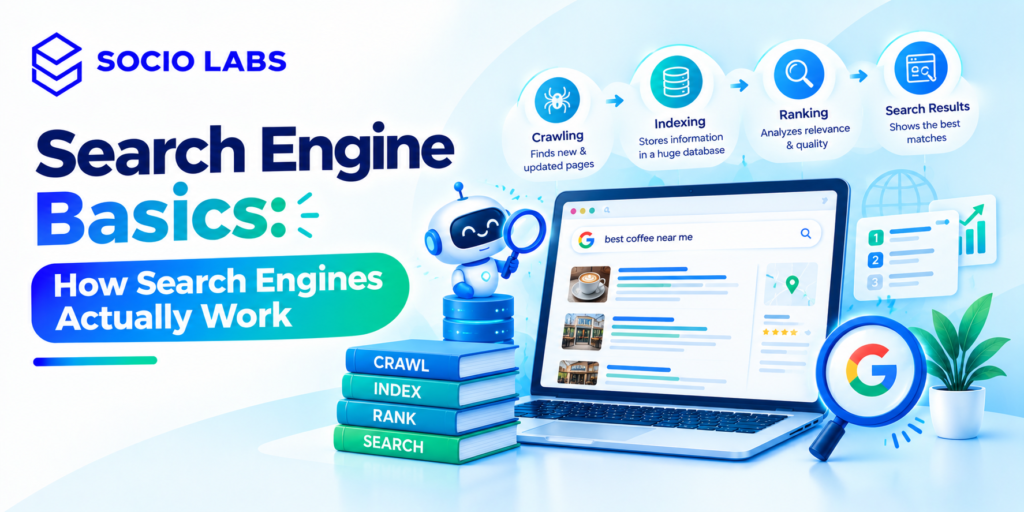
A software system that retrieves, organizes and ranks web content so that it can return most relevant results for a user’s query is called a search engine. This is done through three sequential processes: crawling, indexing and ranking.
Crawling This is how a search engine finds pages across the web. Indexing This is how a search engine stores that information and organizes it. Ranking This is how a search engine determines which of the stored pages best answer a given search query, and in what order to show them. A page has to pass through all three stages crawled, indexed, and ranked to be eligible to appear in search results. That’s why even the best content can fail to rank if it’s held up by technical issues that prevent crawling or indexing.
This sequence is the basis for just about every SEO decision, as different problems (a page that doesn’t show up at all vs. a page that ranks badly) often mean a failure at a different step in this process.
What is web crawling?
Search engines use automated programs called bots or spiders (for example, Googlebot) to find web pages by following links from one page to another throughout the internet, a process known as crawling.
Crawlers begin at known pages and follow both internal and external links to discover new or updated content. They examine the content, code and structure of each page. What determines if and how often a page is crawled? There are a few factors that play into this: Internal linking (orphan pages that have no links pointing to them are harder to discover). An XML sitemap submitted through Google Search Console, which tells Google exactly which pages exist. A robots.txt file, which can intentionally allow or block crawlers from certain pages. Overall site structure and crawl budget, which is more important for very large websites with thousands of pages.
Pages that are never crawled can’t be indexed or ranked so technical issues such as broken internal links or robots.txt blocks that were put there by accident are often the first thing you should look at when a page is mysteriously absent from search results.
What is an index?
Indexing is the process in which a search engine processes the contents of a crawled page and saves some relevant information about that page in a huge database (the index) to make that page eligible to appear in search results for relevant queries.
When indexing, search engines try to figure out what a page is really about by looking at the text, headings, images and structured data, whether the content is unique or duplicates something they’ve already indexed, and whether the page passes basic quality thresholds. You can crawl a page successfully, but not index it, for reasons like thin or duplicate content, forgetting to add a “noindex” tag to the page, or quality issues which cause the search engine to deprioritize it.
The URL Inspection tool in Google Search Console allows site owners to see if a given page is indexed, and if not, why that might be the case. This is typically the first step in diagnosing a page that isn’t showing up in search at all.
What is the Ranking and What Affects It?
Ranking is the method by which a search engine orders indexed pages by relevance and quality for a specific search query, using hundreds of signals combined through complex algorithms that are not fully public.
While the exact ranking algorithm is not public, some of the known influencing factors include: Content relevance and quality how well a page actually answers the query Backlinks and site authority trust signals from other reputable sites linking in Page experience load speed, mobile-friendliness and usability Keyword and topical relevance how closely a page’s content matches search intent Freshness matters more for some query types (news, trending topics) than others (evergreen reference content)
That’s why sustainable SEO is about improving multiple factors over time, not chasing a single lever. No single tactic (adding a keyword, building one backlink) reliably moves rankings in isolation because ranking involves so many combined factors.
What Are SERPs? What Do They Contain?
A SERP (search engine results page) is the page a user sees after searching, and by 2026 it will typically contain far more than a simple list of ten blue links featured snippets, local map packs, image and video results, People Also Ask boxes, and increasingly, AI-generated summaries.
Other common SERP features besides the usual organic listings are featured snippets (an answer extracted from one of the ranking pages that appears at the top of the results), the local map pack (showing relevant local businesses with map pins for location-related queries), People Also Ask boxes (expandable related questions), image and video carousels (for visually relevant queries), and AI-generated overviews (which provide a summary of information from multiple sources right on the results page).
Understanding SERP features is important for novices because it’s no longer the case that the only goal for visibility is to get ranked “number one” in traditional organic listings sometimes appearing in a featured snippet or AI overview can generate more visibility than a regular top organic position.
How Search Engines Understand What Users Want
Search engines look at query phrasing, past search behavior, and contextual clues to understand what the user wants. Is the searcher looking for information? A specific website? To buy something? Search engines work to rank results that best match that intent.
Search intent is typically categorized into four types: informational (seeking an answer or explanation), navigational (desiring to access a particular website or brand), commercial investigation (exploring options before making a choice), and transactional (prepared to purchase or perform a specific action). A search engine will return very different results for “what is SEO” (informational, likely showing explainer content) versus “best SEO agency near me” (commercial/local, showing business listings and local pack results) even when both queries are on the same broad subject.
Which is why search intent matters more than keyword volume for content planning content that doesn’t match the intent behind a keyword rarely ranks well, regardless of how well it’s otherwise optimized.
The main types of search engines are:
General Web Search Engines: Google and Bing index the web and help users find information through search results.
Vertical Search Engines: These focus on specific types of content or products, such as YouTube for videos and Amazon for products.
AI-Powered Answer Engines: Tools such as Google AI Overviews, Perplexity, and ChatGPT Search generate conversational answers by synthesizing information from multiple sources.
How AI Changed the Fundamentals of Search Engines in 2026?
AI has revolutionized the fundamentals of search engines, with AI-generated summaries in search results (for example, Google’s AI Overviews) and new AI-native search tools (such as Perplexity and ChatGPT search) that compile answers from different sources instead of just a list of links.
This has made having structured, clearly-answered content more important than ever. Artificial intelligence systems tend to pull answers from content that directly and concisely answers a specific question, often favoring pages with clear headings, direct-answer paragraphs, and structured data like FAQ schema. It hasn’t replaced the basics of traditional SEOcrawling, indexing, and content quality still matterbut it has added a parallel consideration: writing content that’s easily extractable by AI summarization, not just readable by a human scrolling a results page.
Because AI search features are still changing quickly, you might want to treat the specifics of how each platform behaves (what it cites, how often, in what format) as something to watch and verify directly, rather than assume based on older SEO knowledge.
What mistakes do beginners make misunderstanding search engines
Assuming a page will rank immediately after it’s published, minus the time crawling and indexing take. Confusing “not ranking well” with “not indexed at all” – different problems with different solutions. That there is one known ranking algorithm to reverse engineer, not hundreds of combined and evolving signals. Disregarding technical blockers such as robots.txt or noindex tags that completely prevent indexing. Not distinguishing between search intent and writing commercial content for informational queries or vice versa. Not counting SERP features like featured snippets and AI overviews as winnable visibility opportunities in their own right. Assuming traditional SEO is obsolete because of AI search, rather than another, overlapping layer.
Conclusion
Understanding search engine basics crawling, indexing, ranking, and how intent and AI now shape results gives every other SEO decision more context and makes troubleshooting far more straightforward. Before chasing tactics, confirm the fundamentals: that your site can actually be crawled, indexed, and understood by both traditional and AI-powered search systems.
Want a technical and content foundation that’s actually built around how search engines work? Explore SEO services from SocioLabs and see how a fundamentals-first approach could apply to your website.
FAQs
Crawling (discovering pages), indexing (storing and organizing page information), and ranking (ordering pages by relevance for a specific query) are the three core processes nearly every search engine relies on.
It’s usually either a crawling issue (the page wasn’t discovered), an indexing issue (it was crawled but not stored, often due to a noindex tag or quality concerns), or simply hasn’t been processed yet due to normal delays.
Crawling is how a search engine discovers a page by following links; indexing is how it analyzes and stores that page’s content in its database, making it eligible to appear in search results.
No ranking involves hundreds of combined signals evaluated together, including content relevance, backlinks, page experience, and more, rather than one isolated, fully disclosed formula.
Search intent is the underlying goal behind a search query informational, navigational, commercial, or transactional. Content needs to match the intent behind a keyword, not just the keyword itself, to rank well.