
A Delhi-based business owner recently described a familiar problem: the website looked fine, the service was solid, but almost no one found it through Google. Three different freelancers had already “done SEO” on the site, yet nothing had changed. This is the situation that pushes most companies toward hiring an SEO consultant in Delhi not because SEO sounds impressive, but because visibility has a direct effect on revenue.
Choosing the right person for the job is harder than comparing quotes. SEO touches strategy, technical website health, content, authority building, and ongoing measurement, and a consultant who is strong in one area may be weak in another. This article walks through what an SEO consultant in Delhi actually does, how to evaluate one, what questions to ask, and how to avoid the mistakes that waste both time and budget.
What Does an SEO Consultant Do?
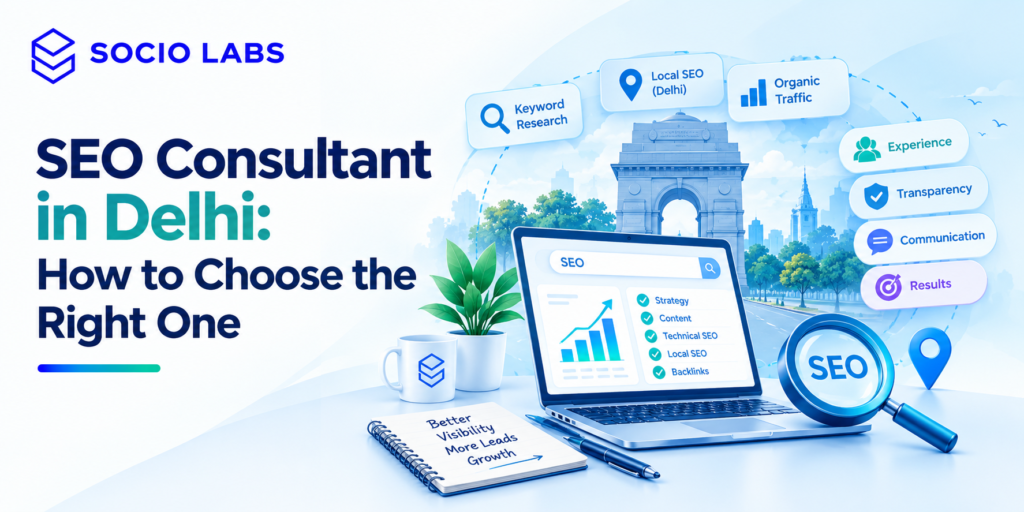
An SEO consultant in Delhi helps a business improve its visibility in organic (non-paid) search results by combining strategy, technical fixes, content guidance, and performance tracking.
Depending on the engagement, a consultant may:
- Build an overall SEO strategy aligned with business goals
- Run a website audit to find technical and content gaps
- Conduct keyword research based on real search intent
- Review on-page SEO elements like titles, headings, and internal links
- Identify and fix technical SEO issues affecting crawling and indexing
- Guide content strategy so pages match what searchers actually want
- Advise on off-page SEO, including ethical link building
- Manage local SEO, especially Google Business Profile optimization
- Set up SEO reporting so progress can be tracked honestly
Some consultants only advise, leaving execution to an in-house team. Others manage the entire process end to end. It is worth clarifying this upfront, since “consultant” can mean different things depending on how the engagement is structured
Why Should Delhi Businesses Hire an SEO Consultant?
Delhi NCR is one of the most competitive digital markets in India. Local businesses, e-commerce brands, service providers, and B2B companies are all competing for the same searchers, often in the same categories, which makes generic SEO advice less useful than a plan built around how the business actually earns customers.
A few reasons Delhi businesses look for an SEO consultant in Delhi specifically:
- Local customer discovery: Many searches carry local intent (for example, “near me” or neighbourhood-specific queries), which affects how visibility is built.
- Dense competition: Gurugram, Noida, and South and West Delhi markets often have multiple established players targeting identical keywords.
- Industry-specific needs: A healthcare clinic, a real estate developer, and a SaaS startup each need very different SEO priorities, even if they’re all technically “doing SEO.”
- Long-term visibility: Paid ads stop generating traffic the moment spend stops; organic visibility, once built responsibly, tends to compound.
SEO requirements genuinely differ by business model an e-commerce site needs category and product-page optimization, a B2B company needs authority and lead-focused content, and a multi-location business needs a local SEO structure that doesn’t rely on thin, duplicate pages.
What SEO Services Does a Consultant in Delhi Provide?
A qualified SEO consultant in Delhi typically offers a mix of the following, though the exact scope should always be defined in a proposal:
- SEO audit – a diagnostic review of technical health, content quality, and backlink profile
- Keyword research – identifying terms with genuine business relevance, not just search volume
- Competitor analysis – understanding what’s already ranking and why
- Search-intent mapping – matching page content to what the searcher is actually trying to do
- On-page SEO – optimizing titles, meta descriptions, headings, and content structure
- Technical SEO – addressing site speed, crawlability, indexing, mobile usability, and Core Web Vitals
- Content strategy – planning pages and articles that satisfy intent and build topical authority
- Internal linking – connecting related pages to spread authority and help users navigate
- Local SEO – Google Business Profile optimization, location pages, and local relevance signals
- Link building – earning or acquiring links through ethical, sustainable methods
- E-commerce SEO – category structure, product-page optimization, and technical issues unique to online stores
- Conversion optimization – making sure traffic translates into enquiries or sales
- SEO reporting – transparent updates on what was done and what changed
- AI search optimization – structuring content so it can be understood and cited by AI-powered search experiences
The value isn’t in the list itself it’s in how these pieces are sequenced and prioritized for a specific business.
How Does an SEO Consultant Improve Website Visibility?
A sound SEO process generally follows this sequence:
- Business and market discovery – understanding goals, audience, and competitive landscape
- Website audit – identifying what’s currently helping or hurting visibility
- Keyword research – building a realistic, intent-based keyword map
- Search-intent analysis – matching content types to what searchers expect
- Competitor research – learning from what’s already working in the space
- Technical SEO improvements – fixing crawl, indexing, speed, and structure issues
- On-page optimization – refining titles, content, and internal structure
- Content improvements – filling gaps and improving existing pages
- Internal linking – strengthening site architecture
- Authority development – building credibility through ethical outreach and mentions
- Local SEO – aligning with the locations the business actually serves
- Performance measurement – tracking impressions, clicks, and conversions over time
No responsible consultant will promise guaranteed rankings, since Google’s systems account for hundreds of factors, many of which change over time.
SEO Consultant vs SEO Agency: Which Should You Choose?
Both models can work well the right choice depends on budget, scope, and how hands-on you want to be.
Factor | SEO Consultant | SEO Agency |
Personal attention | High usually one point of contact | Varies often a managed account team |
Team size | Small or solo | Larger, with specialists per function |
Specialist access | Limited to the consultant’s skill set | Broader access to technical, content, and outreach specialists |
Service range | Often focused or customizable | Typically full-service |
Communication | Direct and consistent | Structured, sometimes through account managers |
Scalability | Limited by one person’s time | Easier to scale with more resources |
Cost structure | Often lower overhead | Generally higher due to team size |
Best suited for | Startups, SMEs, focused projects | Larger businesses needing full-scale execution |
Neither option is universally better. A startup needing hands-on strategic guidance may prefer an independent consultant, while a multi-location enterprise may need an agency’s broader bandwidth.
Freelance SEO Expert vs SEO Consultant
The terms are often used loosely, but there are practical differences worth understanding:
- Freelancer: Usually project-based, often strong in execution (writing, technical fixes, link outreach), but may offer limited strategic planning.
- Independent consultant: Typically focuses more on strategy, audits, and guidance, sometimes coordinating with your in-house team or other freelancers for execution.
- SEO agency: Offers a full team and broader resources, useful when the scope is large or multi-faceted.
- In-house SEO professional: Fully dedicated to one business, with deep internal context but limited exposure to other industries.
Comparing them on strategy, execution ability, communication, availability, and accountability rather than assuming one category is automatically “better” leads to a more realistic hiring decision.
How to Choose the Right SEO Consultant in Delhi
A practical evaluation framework should cover:
- Relevant experience in your industry or a comparable one
- Methodology can they explain their process clearly, step by step?
- Technical SEO capability do they understand crawling, indexing, and site performance?
- Local SEO knowledge critical if you serve Delhi NCR customers directly
- Content strategy approach is it intent-driven or just keyword-driven?
- Link-building approach ethical and sustainable, not spam-based
- Reporting style clear, honest, and tied to real business metrics
- Communication responsive and willing to explain decisions
- Transparency upfront about limitations and timelines
- Case studies or references, where available, without expecting fabricated guarantees
- Measurement framework clear KPIs agreed in advance
- Contract terms defined deliverables, timelines, and exit terms
A good SEO proposal should clearly state the scope of work, expected deliverables, reporting frequency, and realistic timelines not vague promises of “top rankings.”
What Should You Ask an SEO Consultant Before Hiring?
These questions help surface how a consultant actually thinks and works:
- What does your SEO process look like from start to finish? reveals whether they have a structured methodology.
- How will you audit our website? shows depth of technical understanding.
- How do you choose keywords to target? indicates whether they prioritize intent over volume.
- How do you factor in search intent for content? separates strategic thinkers from keyword-stuffers.
- What technical SEO issues do you typically look for first? tests real technical knowledge.
- How do you approach content creation or improvement? clarifies whether content is treated as a priority.
- What is your link-building approach? critical for spotting risky tactics early.
- How often will we receive reports, and what will they include? sets expectations for transparency.
- What KPIs will we track together? ensures success isn’t measured by rankings alone.
- What is a realistic timeline for this type of project? filters out unrealistic promises.
- Can you walk me through a past project’s approach (without exact figures)? tests real-world experience.
- Do you offer any ranking guarantees? a “yes” here is a warning sign, not reassurance.
Each answer tells you more about working style and ethics than any sales pitch can.
How Much Does an SEO Consultant in Delhi Cost?
SEO pricing varies widely because every project is different. Cost is typically influenced by:
- Website size and number of pages
- Industry competition level
- Technical complexity of the site
- Target locations and keyword difficulty
- Content requirements (volume and depth)
- Link-building scope
- Consultant experience level
- Overall scope of work
Common pricing structures include:
- Monthly retainer – ongoing SEO management
- One-time SEO audit – a diagnostic project with recommendations
- Project-based SEO – a defined scope with a start and end date
- Hourly consultation – ad hoc strategic advice
- Custom SEO strategy – a tailored roadmap without execution
- Monthly SEO management – execution plus reporting over time
Because pricing depends heavily on project specifics, it’s best discussed directly with the consultant rather than assumed from generic numbers online. The cheapest proposal is rarely the best value a very low quote often signals limited scope, shortcuts, or both.
How Long Does SEO Take to Show Results?
SEO is a cumulative process rather than an instant switch. A realistic timeline generally includes:
- Early stage – technical improvements and indexing/crawling changes start taking effect
- Mid stage – initial visibility improvements become noticeable as content and technical fixes compound
- Later stage – authority and content depth continue building, supporting more sustained organic growth
No ethical consultant can guarantee page-one placement, a specific ranking position, exact traffic numbers, or a fixed timeline, because results depend on competition level, the website’s starting condition, existing authority, content quality, technical health, and overall search demand for your category.
How Can You Measure an SEO Consultant's Performance?
Rankings alone are a weak and incomplete signal. More meaningful KPIs include:
- Organic impressions and clicks (from Google Search Console)
- Relevant keyword visibility, not just vanity keywords
- Qualified organic traffic visitors likely to convert
- Leads and conversions generated from organic channels
- Revenue, where it can be reliably attributed
- Landing-page performance bounce rate, engagement, conversion rate
- Local visibility Google Business Profile views, calls, and direction requests
A consultant who reports only on rankings, without connecting work to business outcomes, is giving you an incomplete picture.
What Are the Red Flags When Hiring an SEO Consultant?
Watch for these warning signs:
- Guaranteed #1 rankings or guaranteed traffic
- Claims of “secret” Google techniques
- Spam backlinks or Private Blog Networks (PBNs) presented as safe
- No access to your own Search Console or Analytics data
- Vague deliverables with no defined scope
- Extremely cheap pricing with no clear justification
- No technical audit before work begins
- A keyword-only approach with no content or technical plan
- No conversion or business-outcome tracking
- Long lock-in contracts with unclear exit terms
- Unverifiable case studies or suspicious reviews
Any one of these alone may not be disqualifying, but several together usually indicate a risky engagement.
Local SEO for Delhi Businesses
Local SEO is especially relevant for businesses serving customers within Delhi NCR directly. Core elements include:
- Google Business Profile optimization accurate categories, services, and regular updates
- NAP consistency Name, Address, and Phone number matching across the web
- Local landing pages built only for locations genuinely served, not created purely for keyword coverage
- Reviews encouraging genuine customer feedback over time
- Google Maps visibility supporting discovery for “near me” and location-based searches
- Service-area optimization relevant for businesses that travel to customers rather than operating from a storefront
- Multi-location SEO structured pages for each genuine location, avoiding thin duplicate content
The guiding principle is relevance: local SEO should map to where the business actually operates, not to every neighbourhood that might contain a search volume.
AI Search and Modern SEO
Search is expanding beyond the traditional list of blue links. Features like Google’s AI Overviews and AI Mode, along with AI assistants such as ChatGPT, Gemini, and Perplexity, increasingly generate direct answers rather than just linking out. Through 2026, Google has continued merging AI Overviews and AI Mode into a more unified experience, and ranking well in traditional search no longer automatically guarantees inclusion in an AI-generated answer.
This has given rise to related concepts like Answer Engine Optimization (AEO) and Generative Engine Optimization (GEO) essentially, structuring content so it can be understood, trusted, and cited by AI systems, not just crawled by traditional search bots.
No consultant can promise inclusion in a specific AI answer, since these systems select sources using complex and evolving criteria. What does remain reliable is the same foundation good SEO has always rested on:
- Genuinely helpful, first-hand content
- Clear, well-structured information
- Technical accessibility (fast, crawlable, mobile-friendly pages)
- Strong entity and brand signals
- Credible, consistent business information across the web
- Content that fully satisfies search intent
Businesses that build on these fundamentals tend to be better positioned for both traditional and AI-driven search, even as specific features continue to change.
Illustrative Example
Illustrative Example (hypothetical, not a real case study):
A Delhi-based service business has a well-regarded offering but receives very little organic traffic.
- Business Problem: Strong reputation offline, minimal visibility in Google search.
- Audit: The consultant reviews technical health, content quality, and current keyword visibility, discovering slow page speed, thin service pages, and no structured local presence.
- Strategy: Priorities are set fix core technical issues first, then rebuild service pages around actual customer search intent, and establish a proper Google Business Profile presence.
- Implementation: Keywords are mapped to relevant pages, content is rewritten to directly answer customer questions, technical fixes are deployed, and local listings are corrected and optimized.
- Measurement: Search Console data, organic traffic trends, and enquiry volume are tracked over subsequent months.
- Optimization: Based on what the data shows, further content and technical refinements continue in later phases.
No specific traffic figures, rankings, or revenue outcomes are implied here the example illustrates process, not promised results.
Common SEO Hiring Mistakes
- Choosing only based on price the cheapest option often means a narrower scope or weaker methodology.
- Hiring without defining goals without clear objectives, progress can’t be measured meaningfully.
- Selecting keywords without search-intent research ranking for the wrong keywords wastes effort.
- Accepting ranking guarantees no one can ethically guarantee specific Google rankings.
- Buying low-quality backlinks these risk penalties and long-term damage.
- Ignoring technical SEO content improvements won’t matter if the site can’t be crawled or loads too slowly.
- Focusing only on traffic traffic without relevance or conversions doesn’t help the business.
- Ignoring conversions visibility is only useful if it leads to enquiries or sales.
- Not reviewing reports regular review keeps the engagement accountable.
- Giving no access to Search Console or Analytics this data should always remain in the business owner’s control.
- Expecting instant results SEO is a cumulative, not immediate, process.
- Hiring based only on online claims ask direct questions rather than relying solely on marketing copy.
Conclusion
Hiring the right SEO consultant in Delhi comes down to evaluating expertise, transparency, and fit for your specific business not just comparing price tags. A good consultant explains their process clearly, sets realistic expectations, ties their work to measurable business outcomes, and keeps you in control of your own data. SEO is a long-term investment in visibility, and the quality of the person or team managing it has a direct impact on how that investment performs over time.
If your business isn’t getting the organic visibility it should, start by reviewing your current SEO performance and identifying where the gaps are. A clear-eyed audit and a well-defined strategy are a far better starting point than a rushed hiring decision.