
Most beginners start SEO by googling “SEO tips” and ending up with fifty scattered suggestions some outdated, some contradictory, none telling them what to actually do first. SEO for beginners doesn’t need to be complicated, but it does need to be sequenced correctly: understanding how search engines evaluate a page, fixing the basics before chasing advanced tactics, and building habits that compound over months rather than expecting results in weeks. This guide lays out exactly where to start, in the order that actually matters, so early effort goes toward what moves the needle instead of what sounds impressive. Along the way, we’ll reference how an agency such as SocioLabs typically approaches SEO fundamentals for businesses just getting started in India.
What Is SEO,and Why Does It Matter for Beginners?
SEO (search engine optimization) is the practice of improving a website so it ranks higher in organic (unpaid) search results, and it matters for beginners because it’s one of the few marketing channels that keeps generating traffic without ongoing ad spend once it starts working.
Search engines like Google rank pages based on relevance to a search query, content quality, technical accessibility (can the page be crawled and understood), and trust signals like backlinks and site reputation. For beginners, understanding this helps reframe SEO correctly: it’s not a single setting to switch on, but an ongoing combination of what you write, how your site is built, and how trustworthy it appears to search engines over time.
Getting the basics right early avoids a common beginner trap chasing advanced tactics (schema markup, link-building outreach, technical tweaks) before the fundamentals like relevant content and a crawlable site are actually in place.
Where Should Beginners Start With SEO?
Beginners should start with keyword research and basic on-page SEO before anything else understanding what your audience actually searches for, and making sure your existing pages are structured to answer those queries clearly.
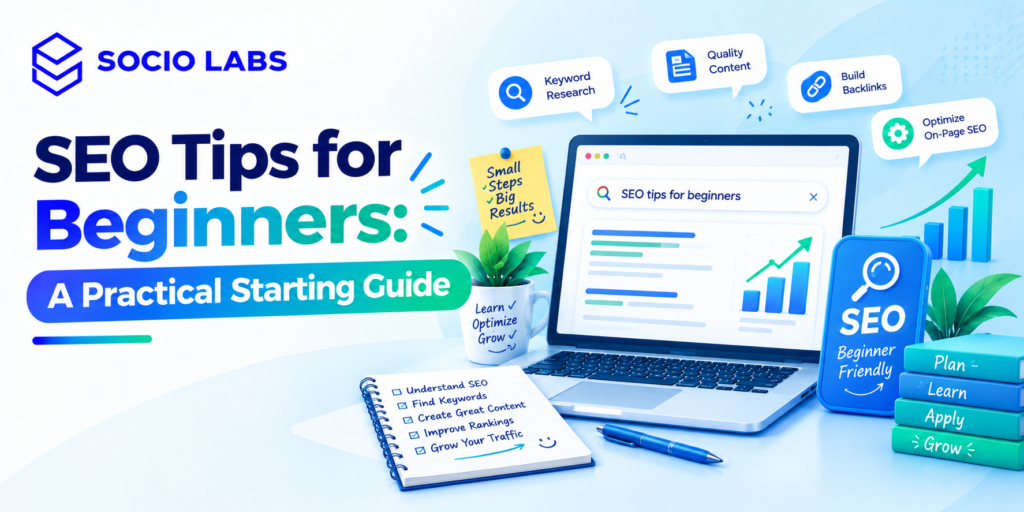
A sensible starting sequence looks like this: confirm the website is indexed and crawlable by search engines, identify a small set of realistic, relevant keywords to target first, optimize existing core pages (homepage, key service or product pages) around those keywords, and only then expand into new content, technical improvements, and backlink building. Trying to do everything simultaneously in week one usually means nothing gets done properly.
This sequencing matters more than any individual tactic a beginner who nails keyword research and on-page basics will typically outperform one who jumps straight to advanced technical SEO without a clear content foundation.
What Is Keyword Research, and How Do Beginners Do It?
Keyword research is the process of identifying the specific words and phrases your target audience types or speaks into search engines, so your content can be built around what people are actually searching for rather than guesswork.
For beginners, a practical approach includes starting with free tools like Google Keyword Planner or Google Search Console (if the site has any existing traffic) to see real search terms, thinking from the customer’s perspective what problem are they trying to solve, not just what your product is called, prioritizing long-tail keywords (longer, more specific phrases) early on since they’re typically easier to rank for than broad, highly competitive single-word terms, and checking what’s already ranking for a keyword to gauge whether it’s realistic to compete for as a new or smaller website.
Example (hypothetical): A new bakery website targeting just “cakes” faces enormous competition from established national brands. Targeting “custom birthday cakes in [city name]” is a far more realistic starting keyword for a beginner site with limited authority.
What On-Page SEO Basics Should Beginners Learn?
On-page SEO basics include writing clear, keyword-relevant title tags and meta descriptions, using one well-structured H1 per page, organizing content with logical headings, and naturally including target keywords in the content itself not just stuffing them in mechanically.
Essential on-page elements for beginners to check include a unique, descriptive title tag for every page (ideally under 60 characters), a meta description that accurately summarizes the page and encourages clicks, one H1 per page that clearly states the page’s topic, descriptive URL slugs rather than long strings of numbers or parameters, and alt text on images that describes what the image shows, which also supports accessibility.
These elements are foundational, low-effort, high-impact fixes correcting them across a small website’s key pages is often one of the fastest ways a beginner can see measurable improvement.
What Technical SEO Basics Should Beginners Check?
Technical SEO basics for beginners include confirming the site loads quickly, works properly on mobile devices, uses HTTPS, and doesn’t have major crawl errors blocking search engines from indexing pages.
Beginner-friendly technical checks include testing page load speed, since slow pages hurt both rankings and user experience, confirming the site displays and functions correctly on mobile (Google primarily uses mobile-first indexing), checking that the site uses HTTPS rather than HTTP for security, using Google Search Console to check for crawl errors or pages that aren’t getting indexed, and making sure there’s a simple XML sitemap submitted to Search Console.
Technical SEO can get highly advanced, but beginners don’t need to master all of it immediately these core checks cover the issues most likely to actively block a small or new website from ranking at all.
How Important Is Content Quality for Beginners?
Content quality is arguably the most important factor for beginners, because even perfect technical SEO and keyword targeting won’t rank a page that doesn’t genuinely answer the reader’s question better than competing pages already ranking.
Beginners should focus on writing content that directly and clearly answers the specific query behind a keyword, covering the topic thoroughly enough to be genuinely useful rather than thin or repetitive, structuring it with clear headings and short paragraphs for readability, and updating older content periodically rather than only ever publishing new pages. This overlaps closely with broader content marketing principles SEO and content quality aren’t separate disciplines, they reinforce each other directly.
A beginner mistake here is writing content for search engines first and readers second modern search algorithms are built to reward genuinely helpful content, not keyword density or mechanical optimization.
What Role Do Backlinks Play for Beginners?
Backlinks links from other websites pointing to yours act as a trust signal to search engines, and while they matter for long-term authority, beginners shouldn’t prioritize aggressive link-building before their on-page and content foundations are solid.
For beginners, realistic early approaches include getting listed in relevant, legitimate business directories (especially local ones, paired with a complete Google Business Profile), earning natural links through genuinely useful content other sites want to reference, and building relationships within your industry rather than purchasing links or using manipulative schemes, which carry real risk of search engine penalties. Backlink building is typically a slower-paying, longer-term effort beginners get a better early return from fixing on-page basics and publishing strong content first.
It’s worth being cautious here: buying links or using link schemes to shortcut this process is explicitly against Google’s guidelines and can result in search penalties that hurt rankings significantly more than the lack of links would have.
How Long Does SEO Take to Show Results?
SEO typically takes several months to show meaningful results for a new or small website, since search engines need time to crawl, index, and build trust signals around a site before ranking it competitively there’s no verified way to guarantee a specific timeline.
Beginners should expect an initial period where changes don’t immediately translate into visible ranking movement, gradual improvement as content accumulates and technical issues get resolved, and faster results for less competitive, long-tail keywords compared to broad, highly contested terms. Setting expectations accurately early on prevents the common beginner frustration of abandoning SEO efforts after just a few weeks because “nothing happened yet.”
This is also why SEO tends to work best as part of a broader strategy combined with faster channels like performance marketing for near-term results while the organic foundation builds in parallel.
What Mistakes Do SEO Beginners Make?
Keyword stuffing repeating a keyword unnaturally instead of writing for readers first. Ignoring mobile experience, despite most search traffic now coming from mobile devices. Publishing thin, low-value content just to hit a word count or publishing schedule. Expecting results within days or weeks instead of the realistic months-long timeline. Skipping Google Search Console, missing clear signals about indexing issues or search performance. Copying competitor content instead of creating genuinely original, more useful material. Chasing backlinks aggressively before fixing on-page and content fundamentals. Never tracking rankings or organic traffic, making it impossible to know what’s actually working.
Conclusion
SEO for beginners doesn’t require mastering every tactic at once it requires starting in the right order: realistic keyword research, solid on-page basics, a technically sound site, and genuinely useful content, with backlinks and advanced tactics layered in over time. Progress will feel slow at first, but the fundamentals covered here compound steadily with consistent effort.
Want help building SEO fundamentals the right way from the start? Explore SEO services from SocioLabs and see how a structured, beginner-friendly approach could apply to your website.
FAQs
Start with basic keyword research to understand what your audience searches for, then optimize your site’s existing core pages around those terms before expanding further.
Most new or small websites take several months to show meaningful ranking improvements, since search engines need time to crawl, index, and build trust around the site.
Many fundamentals (keyword research, on-page basics, technical checks) can be learned and applied by beginners directly; more advanced strategy and scaled link-building often benefit from professional support.
On-page SEO refers to content and page elements like title tags and headings; technical SEO refers to site infrastructure like page speed, mobile-friendliness, and crawlability.
Yes, backlinks remain a meaningful trust signal, but beginners should prioritize on-page and content fundamentals first, since aggressive early link-building without those basics tends to underperform.