
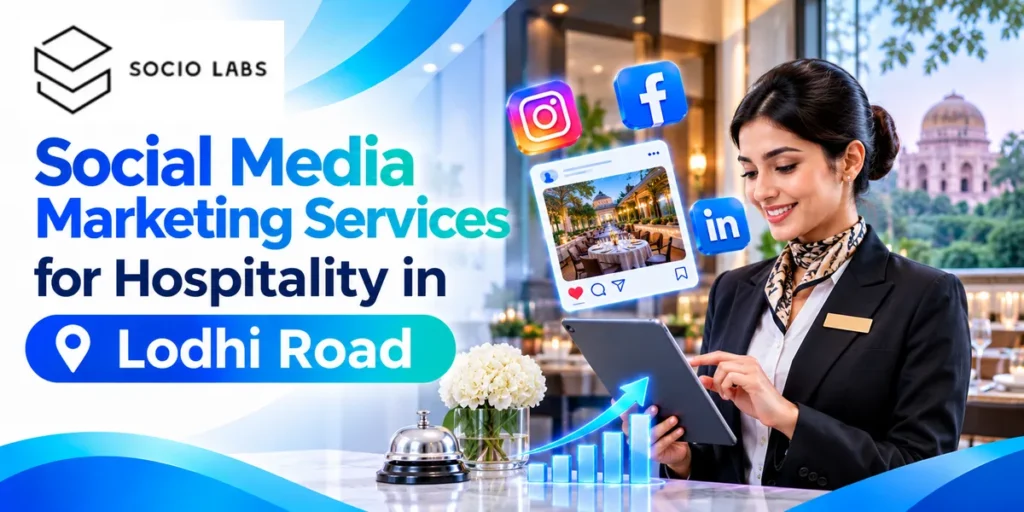
A beautiful Instagram feed doesn’t automatically fill tables or rooms. For hospitality venues around Lodhi Road, the gap between “people like our posts” and “people actually book” is where most social media effort gets wasted. This article traces that journey step by step, showing what social media marketing services for hospitality in Lodhi Road should actually be doing at each stage.
The Short Answer
Hospitality social media works in four stages: a guest discovers the venue, develops enough interest to consider it seriously, needs a final nudge of trust or urgency, and then has to book with minimal friction. Most venues invest heavily in the first stage striking visuals and underinvest in the last two, which is usually where bookings are actually lost. The rest of this guide walks through each stage and what belongs there.
Why Lodhi Road Is a Distinct Hospitality Market
Lodhi Road sits near Lodhi Gardens and some of Delhi’s more upscale dining and boutique-stay destinations, drawing a mix of local Delhi diners looking for a special occasion, out-of-town visitors, and international guests researching before they arrive. That’s a wider and more varied audience than a typical neighbourhood restaurant serves.
This means hospitality social media marketing here can’t assume everyone is a local repeat customer. Content needs to work for someone who’s never been to Delhi as well as someone who drives past Lodhi Road every week.
Stage 1: Discovery
This is the first moment someone sees the venue a reel on the explore page, a friend’s tagged post, a hashtag search for “restaurants near Lodhi Garden.”
What should happen here:
- Strong, consistent visual identity lighting, plating, interiors shot to a professional standard
- Short-form video (reels) showing atmosphere, not just food close-ups
- Location tags and hashtags that match how people actually search this area
Hospitality lives or dies on this first visual impression more than almost any other category but discovery alone rarely converts without the stages that follow.
Stage 2: Consideration
The guest is now interested but not committed. They’re checking reviews, comparing a couple of options, and deciding whether this venue fits the occasion.
What should happen here:
- A highlights section or pinned content showing menu range, ambience and past events
- Genuine guest content (with permission) real diners, real reactions, not just staged shots
- Clear practical information: cuisine, price range, dress code or occasion fit, visible without digging
A venue that looks good but gives no sense of what an evening there actually involves often loses the consideration stage to a competitor who answers that question clearly.
Stage 3: Trust and Urgency
At this point, the guest is close to deciding. Small signals tip the decision one way or another.
What should happen here:
- Recent activity posts from the last few weeks, not months, signalling the venue is active and current
- Limited-time content (a seasonal menu, a special event) that gives a reason to book now rather than “someday”
- Fast replies to DMs asking about availability, timing or group bookings
A social media marketing agency for hospitality often earns its value most clearly here sustaining fresh, timely content and fast responses is hard to do consistently without dedicated attention.
Stage 4: Booking
The guest is ready, but friction at this final step can still lose them.
What should happen here:
- A clear, single path to book link in bio, WhatsApp, direct reservation system, or phone number, not buried
- A prompt reply if someone messages asking to book, ideally within the hour during service hours
- Confirmation details that are simple and reassuring, not an endless back-and-forth
Core Elements of Hospitality Social Media Marketing
Across all four stages, a working approach generally includes:
- Consistent visual quality — the baseline expectation for any hospitality venue
- A content mix beyond food shots — atmosphere, staff, events, behind-the-scenes
- Guest-generated and consented content used alongside the venue’s own photography
- Fast, reliable response handling, since hospitality decisions are often made quickly
Choosing a Social Media Marketing Agency for Hospitality
Not every venue needs outside help, especially smaller, single-location spots with someone handling content personally. But as covers or bookings grow, consistency often slips.
When evaluating a social media marketing agency for hospitality, ask about:
- Experience producing or directing high-quality visual content for restaurants, cafes or boutique stays
- How they handle guest-generated content and permissions
- Their approach to fast response times during service hours
- Whether reporting tracks actual bookings or covers, not just engagement
- Familiarity with the Lodhi Road area and its mixed local/visitor audience
Common Mistakes Hospitality Venues Make
Stopping at discovery. Beautiful content with no clear next step leaves interested guests with nowhere to go.
Stale feeds. Guests checking before a visit notice when the last post is weeks or months old, which quietly signals the venue might not be reliably open or active.
Slow or missed booking replies. A guest asking about a table for tonight who doesn’t get a quick answer will likely book elsewhere within minutes, not days.
Measuring What’s Working
Track outcomes at each stage, not just overall follower growth:
- Profile visits and reach, as a discovery signal
- Saves and shares on menu or event content, as a consideration signal
- DM response time and conversation-to-booking ratio, as a trust signal
- Bookings or covers traced directly back to social media
Conclusion
The venues around Lodhi Road that convert social media into actual bookings aren’t necessarily the ones with the best photography they’re the ones that guide a guest all the way from a striking first impression to a simple, fast way to book. Visuals open the door, but trust and ease of booking are what get someone through it. Whether managed in-house or with a partner like Socio Labs, strong social media marketing services for hospitality in Lodhi Road should be judged on bookings and covers, not likes.
FAQs
It helps significantly, since hospitality is a highly visual category, but consistency matters as much as production value. Well-lit, regular smartphone content can outperform occasional professional shoots.
Three to five times a week is a reasonable baseline, with short-form video included regularly, since reels tend to drive the strongest discovery for this category.
Yes, with permission. Genuine guest content often builds more trust at the consideration stage than polished venue photography alone.
Slow response time to DM or message enquiries is one of the most frequent and fixable issues guests deciding where to go often won’t wait long for a reply.
Discovery-stage engagement can build within a few weeks, but a steady, measurable increase in bookings usually takes around two to three months of consistent content and fast response handling.