
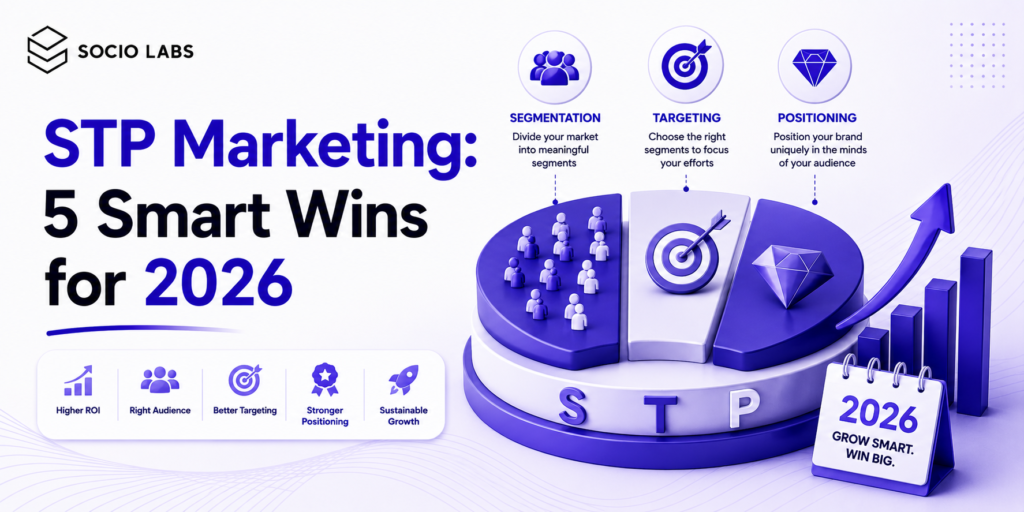
stp marketing is the reason two businesses can spend the exact same ad budget and get completely different results one speaks to a specific, well-defined audience, and the other tries to speak to everyone and ends up resonating with almost no one. It’s the strategic layer most founders skip when they’re eager to launch campaigns.
That shortcut is expensive. Broad, undifferentiated targeting inflates cost-per-click, weakens ad relevance scores on Google Ads and Meta Ads, and produces creative that sounds like it could belong to any competitor. STP fixes this at the root, before a single rupee gets spent on media.
This guide breaks down every layer of the framework segmentation, targeting, positioning, and how each applies differently for startups versus e-commerce brands with real examples throughout. Our team at Socio labs applies this framework at the start of every client strategy, so what follows reflects applied practice, not just theory.
What Is STP Marketing (and Why It Matters)?
stp marketing is a three-stage strategic framework Segmentation, Targeting, and Positioning used to divide a broad market into distinct customer groups, choose which group(s) to focus on, and define how a brand should be perceived by that chosen audience. It’s meant to happen before any campaign, creative, or channel decision is made.
The framework matters because it directly solves the most expensive mistake in marketing: trying to appeal to everyone at once. A business targeting “anyone who might need this product” consistently sees higher acquisition costs than one targeting a clearly defined segment with tailored messaging.
For Indian businesses specifically, where customer behavior varies significantly by region, income level, and language, an STP marketing framework prevents wasted spend on audiences unlikely to convert in the first place.
Expert Tip: If you can’t name your single most valuable customer segment in one sentence, that’s usually the clearest sign your STP marketing framework hasn’t been built out deliberately yet.
What Is Market Segmentation? Types With Real Examples
Market segmentation is the process of dividing a broad customer base into smaller, more defined groups based on shared characteristics commonly demographic, geographic, psychographic, or behavioral traits. It’s the foundational first step of any STP marketing strategy, since targeting and positioning both depend on segments being accurately defined.
Most businesses start with demographic segmentation because it’s easiest to pull from tools like Google Analytics 4 and CRM platforms, but it’s also the weakest predictor of actual purchase behavior on its own.
Demographic and Geographic Segmentation
Demographic segmentation groups customers by measurable traits — age, income, occupation — while geographic segmentation accounts for regional differences, such as different creative and offers for metro versus Tier-2 city audiences.
Psychographic and Behavioral Segmentation
Psychographic segmentation groups customers by values and lifestyle (budget-conscious, eco-aware, luxury-seeking), while behavioral segmentation groups them by actual purchase patterns tracked through Meta Pixel and GA4, like repeat buyers versus cart abandoners.
| Segmentation Type | Based On | Real Example |
|---|---|---|
| Demographic | Age, income, occupation | Skincare brand targeting women 25–40 |
| Geographic | City, region, climate | Different creative for coastal vs hill-station audiences |
| Psychographic | Values, lifestyle | “Sustainability-first” customer segment |
| Behavioral | Purchase habits, loyalty | Retargeting customers who abandoned checkout |
Based on campaigns managed by Socio labs, brands that combine behavioral data with at least one other segmentation type consistently see more efficient ad spend than those relying on demographics alone.
What Is Targeting in Marketing? Strategies Explained
Targeting in marketing is the decision of which customer segment(s) identified during segmentation a business will actually focus its marketing resources on and it typically follows one of four strategies: undifferentiated, differentiated, concentrated, or micromarketing. The right choice depends heavily on budget size and competitive intensity.
Concentrated targeting focusing entirely on one well-defined segment tends to outperform broader approaches for startups and smaller SMEs with limited ad budgets.
Differentiated and Concentrated Targeting
Differentiated targeting tailors separate messaging to multiple segments and suits businesses with multiple product lines, while concentrated targeting focuses all resources on one niche segment for deeper resonance and typically lower acquisition costs.
Micromarketing and Personalized Targeting
Micromarketing uses AI analytics tools and first-party customer data to personalize offers down to individual or hyper-local behavior patterns, such as location-specific promotions or browsing-triggered email flows.
- Undifferentiated: one broad message, works only for true mass-market staples
- Differentiated: tailored messaging per segment, needs bigger budgets
- Concentrated: one niche segment, strong ROI for startups
- Micromarketing: hyper-personalized, needs strong CDP/CRM data infrastructure
Expert Tip: Most early-stage brands underperform when attempting differentiated targeting too soon concentrated targeting on one strong segment usually proves the model faster and cheaper.
What Is Positioning in Marketing? Building a Strong Brand Positioning Strategy
Positioning in marketing is the deliberate effort to define how your target audience perceives your brand relative to competitors the specific mental “space” you want to own, such as “the fastest option” or “the premium, design-led choice.” A strong brand positioning strategy makes every downstream decision, from pricing to ad tone, easier and more consistent.
Most brand positioning strategies start with a clear internal positioning statement, even if it never appears word-for-word in customer-facing marketing.
Writing a Positioning Statement
A practical format: “For [target audience], [brand] is the [category] that [key differentiator], unlike [main alternative].” This structure forces specificity that vague brand messaging usually lacks.
Making Positioning Consistent Across Channels
Positioning only works if pricing, product design, and promotional tone all reinforce the same perception a premium positioning strategy undermined by constant discount promotions confuses customers rather than building trust.
Expert Tip: Test your positioning statement by imagining a competitor using it if it could apply to them just as easily, it isn’t differentiated enough yet.
Segmentation vs Targeting vs Positioning vs the Marketing Mix (4Ps)
Segmentation identifies distinct customer groups, targeting selects which group(s) to pursue, and positioning defines how the brand should be perceived by that chosen group the three work in strict sequence, each narrowing focus before the next. The Marketing Mix (Product, Price, Place, Promotion) is a separate, tactical framework that comes after an STP marketing strategy is finalized, translating positioning into execution.
A frequent point of confusion is treating STP and the 4Ps as competing frameworks, when in practice STP defines who and how you’re perceived, while the 4Ps define what you actually do to deliver on that.
| Framework Step | Question It Answers | Sequence |
|---|---|---|
| Segmentation | Who are the distinct customer groups? | 1st |
| Targeting | Which group(s) should we focus on? | 2nd |
| Positioning | How should we be perceived by them? | 3rd |
| Marketing Mix (4Ps) | How do we execute that positioning? | After STP |
Socio Labs recommends finalizing positioning before locking pricing or promotional strategy reversing this sequence is one of the more common structural mistakes we see during new client audits.
STP Marketing Examples:
Well-known brands make an STP marketing framework visible in practice: Apple targets design-conscious, premium-willing consumers and positions around simplicity and status; Nike targets performance-driven and aspirational consumers and positions around achievement; Amazon targets broad, convenience-seeking consumers and positions around selection and speed; Zomato targets urban, time-pressed consumers and positions around everyday convenience.
What’s consistent across all four is discipline pricing, product design, and messaging all reinforce a single position instead of pulling in different directions.
The Real Lesson for Smaller Businesses
The takeaway isn’t to copy these brands’ specific positioning, but to copy their consistency — every decision, from packaging to ad tone, should reinforce one clear position rather than trying to appeal broadly to everyone.
This same consistency principle is exactly what smaller brands working with Socio labs are guided toward, regardless of budget size a narrower, consistent position reliably outperforms a broader, diluted one.
How Startups and E-commerce Brands Use STP Marketing
Startups typically apply an STP marketing strategy by starting with concentrated targeting on one clearly defined segment, since limited budgets can’t yet support differentiated messaging across multiple audiences. E-commerce brands, by contrast, often layer behavioral data — browsing and cart activity — on top of demographic segments to personalize both ads and on-site experience.
For a startup, this usually starts with product-market fit signals: identifying which segment is already buying repeatedly, even in small numbers, before scaling paid acquisition.
Practical STP Marketing for Early-Stage Startups
Startups benefit from choosing one segment, running a small test campaign, and refining positioning based on real customer response, rather than finalizing a full strategy before any market feedback exists.
STP Marketing for Scaling E-commerce Brands
Scaling e-commerce brands typically pull Shopify or WooCommerce order data alongside GA4 to segment by purchase frequency and average order value, feeding these segments directly into Meta Ads custom audiences.
Businesses working with Socio labs that segment by purchase behavior, not demographics alone, consistently see stronger retargeting performance than those relying on broad interest-based targeting.
Common STP Marketing Mistakes and AI/Customer Data Trends (2026)
The most common mistake businesses make with an STP marketing strategy is skipping straight to targeting and ad creative without doing the segmentation and positioning work first, producing campaigns that reach people efficiently but say nothing distinctive to them. A close second is treating STP as a one-time exercise instead of revisiting it as customer data accumulates.
Heading into 2026, AI analytics tools and customer data platforms (CDPs) are shifting segmentation from static, quarterly-updated groups toward dynamic micro-segments built on real-time behavioral signals.
- Targeting “everyone interested in [category]” instead of a defined segment
- Writing positioning statements no one on the team can actually recite
- Never revisiting segments as customer data grows richer
- Letting pricing or promotions contradict the intended brand positioning
Best Practices for Implementing STP Marketing
Implementing STP marketing effectively means following the three stages in strict sequence segment first using real data, target deliberately based on budget and opportunity size, then position clearly before any creative or campaign work begins. Reordering or skipping steps is the root cause of most underperforming campaigns.
A practical implementation checklist:
- Pull real customer data before assuming segments (GA4, CRM, Shopify/WooCommerce)
- Choose concentrated targeting first if budget or team bandwidth is limited
- Write a one-sentence positioning statement the entire team can repeat
- Align pricing and promotions to reinforce, not contradict, positioning
- Revisit segments and positioning quarterly as customer data matures
- Test positioning language in a small campaign before full rollout
How STP Marketing Strengthens Your SEO, Social and Digital Strategy
STP marketing isn’t limited to paid ad targeting it should also shape keyword strategy, social content themes, and overall digital positioning, since a defined segment and clear positioning make every channel’s messaging sharper and more consistent. Businesses that apply STP only to paid media often end up with disjointed organic and paid messaging.
Keyword research through tools like Semrush or Ahrefs becomes far more focused once a target segment is clearly defined, since it narrows which search intent actually matters for that audience.
Applying STP to Organic and Social Channels
A defined positioning statement should directly inform content themes on social platforms and the tone used across an AI SEO Services strategy inconsistent tone between paid ads and organic content confuses the exact audience STP was meant to clarify.
Bringing Channels Together Under One Positioning
Working with a connected Social Media Marketing Company in India and paid media team under one shared STP framework typically produces more consistent brand perception than managing channels in silos.
SocioLabs recommends briefing every channel team paid, organic, and social on the same segmentation and positioning document, rather than letting each channel define its own version of “the target audience.”
Conclusion
stp marketing isn’t a theoretical exercise it’s the strategic groundwork that determines whether every rupee spent on ads, content, or creative actually lands with the right audience. Getting the sequence right segment, target, then position before jumping into campaigns is what separates brands with consistent, efficient growth from those constantly tweaking creative without knowing why performance stays flat. At Socio labs, this framework is applied at the start of every client strategy, precisely because skipping it tends to cost more in wasted spend later than doing it properly upfront.
Not sure if your current campaigns are built on solid STP foundations? Socio labs offers a free positioning and audience review to identify quick wins before your next campaign. Explore our Performance Marketing Agency services or strengthen your organic presence with our Digital Marketing Agency team.