
SMMA gets thrown around online as if it’s a secret formula for fast income course sellers promise easy clients and recurring revenue from a laptop. The reality is simpler and less dramatic: SMMA is just an agency business model, built on the same fundamentals as any service business real deliverables, real client relationships, and real work to retain clients month over month. This guide explains exactly what SMMA means, how the business model actually works, what it costs to run, and whether it’s still a viable path in 2026. Along the way, we’ll reference how an agency such as SocioLabs approaches the social media and performance marketing services that sit at the core of this model.
What Does SMMA Stand For?
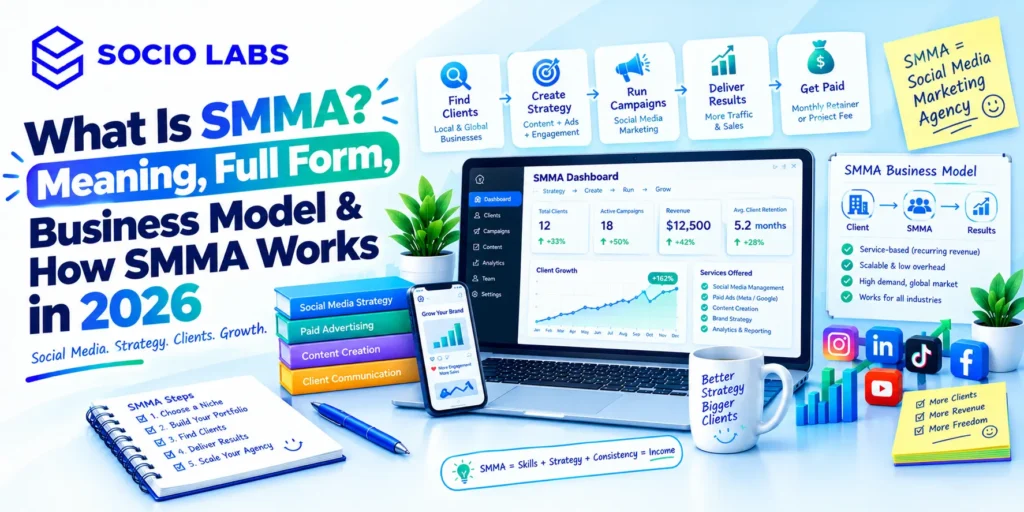
SMMA stands for Social Media Marketing Agency a service business that manages some or all of another company’s social media presence, including content, posting, community management, and often paid advertising, in exchange for a recurring fee.
The term is used specifically to describe the agency business model itself, not a particular tool, platform, or trading indicator the acronym might otherwise be confused with. Within digital marketing circles, “SMMA” has become shorthand not just for the service category, but for a specific way of running that service as a standalone business typically lean, often remote, and usually built around monthly client retainers rather than one-off projec
What Is an SMMA, Explained Simply?
An SMMA is a company or individual that manages and grows a brand’s social media presence covering strategy, content creation, posting, engagement, and usually advertising to help that brand reach specific business goals rather than simply “being active” on social platforms.
In practice, this means an SMMA takes over tasks a business either doesn’t have time for or doesn’t have the specific expertise to do well: planning a content calendar, writing captions, producing or sourcing visuals, responding to comments and messages, running and optimizing paid social campaigns, and reporting back on what’s actually working. The distinction between a casual “I’ll post for you” freelancer and a genuine SMMA usually comes down to structure a defined process, consistent reporting, and services built around measurable business outcomes rather than just posting volume.
How Does the SMMA Business Model Work?
The SMMA business model works by signing clients onto recurring monthly service agreements most commonly a flat retainer in exchange for ongoing social media management, with the agency’s profitability depending on how efficiently it can deliver consistent results across multiple clients at once.
The core mechanics include acquiring clients through outreach, referrals, or inbound marketing, delivering a defined scope of services (content, posting, ads, reporting) for an agreed monthly fee, managing margins by balancing team or contractor costs, tools, and ad platform fees against that retainer income, and retaining clients long enough to make the acquisition cost worthwhile, since client churn is one of the biggest threats to profitability in this model.
Because revenue is recurring rather than project-based, a well-run SMMA can build predictable monthly income but that same recurring structure means client retention, not just client acquisition, determines whether the business is actually sustainable.
What Services Does an SMMA Typically Offer?
An SMMA typically offers content strategy and creation, social media posting and scheduling, community management, and paid social advertising though the exact mix varies by agency and by what a given client actually needs.
Common service components include a content calendar and strategy tailored to the client’s goals and audience, graphic design, video editing, or caption writing depending on the agency’s specific strengths, engagement and community management replying to comments and messages on the client’s behalf, paid advertising management across platforms like Meta Ads or LinkedIn Ads, and regular performance reporting showing what the investment is actually producing.
Some SMMAs specialize narrowly (organic content only, or paid ads only), while others offer a fuller bundle the right scope depends on the agency’s team capacity and the specific niche or client type it’s built around.
How Do SMMAs Make Money?
SMMAs primarily make money through monthly retainers charged to clients for ongoing social media management, with some agencies supplementing this with performance-based pricing or a management fee calculated as a percentage of the client’s ad spend.
Retainer amounts vary significantly based on scope, client industry, and agency experience a small business paying for basic content and posting sits at a very different price point than a larger company paying for full content production plus managed paid advertising. Beyond the core retainer, some agencies add setup or onboarding fees for new clients, and others structure part of their pricing around ad spend management, where the fee scales with how much the client is investing in paid campaigns.
Because exact pricing varies so widely by market, niche, and scope, it’s worth researching current local pricing benchmarks directly rather than assuming a single standard rate applies across the industry.
What Does It Cost to Start and Run an SMMA?
Starting an SMMA typically requires a relatively low upfront investment compared to many other business models the core costs are tools and software, time (either your own or hired team/contractor time), and client acquisition efforts, rather than large physical infrastructure.
Ongoing cost areas include scheduling and management software (for content planning and posting), design or editing tools if content production is handled in-house, any contractor or employee costs as the agency scales beyond what one person can manage, and marketing or outreach costs for acquiring new clients. Because much of the work can be done remotely with a laptop and the right software, SMMA has become one of the more accessible agency models to start though “low cost to start” doesn’t mean “low effort to run profitably,” since client delivery and retention still require consistent, real work.
Is SMMA Still Worth It in 2026?
SMMA remains a viable business model in 2026, but the “easy money” version promoted by many online courses has become less realistic genuine client results, clear reporting, and real retention now matter more than they did when social media management was a newer, less competitive service.
What’s gotten harder includes increased competition as more people have entered the space following years of course-driven promotion, rising client expectations around measurable ROI rather than just posting activity, and more businesses bringing basic social media management in-house or using AI tools for simpler content tasks. What hasn’t changed is that businesses genuinely needing strategic, consistent social media management especially paired with paid advertising expertise still represent real, ongoing demand; the model still works, but it increasingly rewards agencies that function as competent, outcome-focused marketing partners rather than ones simply reselling basic posting services.
SMMA vs Freelancer vs Full-Service Digital Agency
Factor | SMMA | Freelancer | Full-Service Digital Agency |
|---|---|---|---|
Service scope | Focused on social media management and paid social | Often narrower, individual-skill based (e.g., just content) | Broad — SEO, PPC, social, content, web, and more |
Team structure | Solo founder or small team, sometimes with contractors | Typically a single individual | Larger, often specialized departments |
Client relationship | Recurring retainer, ongoing management | Can be project-based or recurring | Usually recurring, often higher-touch |
Startup cost | Low to moderate | Very low | High |
Best suited for | Clients needing dedicated social media focus | Clients with one specific, narrow need | Clients wanting one partner across multiple channels |
An SMMA generally sits between a solo freelancer and a full-service agency more structured and scalable than individual freelance work, but narrower in scope than an agency handling a client’s entire digital marketing mix.
Who Should Consider Starting an SMMA?
SMMA tends to suit people with existing social media or digital marketing skills, a willingness to handle both service delivery and client acquisition, and realistic expectations about the consistent work required to retain clients month over month.
Good candidates typically include freelancers already doing social media or content work who want to formalize and scale it, social media managers with in-house experience looking to work independently across multiple clients, and content creators with a demonstrable skill (design, video, copywriting) who can package that skill into a recurring service. It suits people comfortable with sales and client communication just as much as the creative or technical work itself, since acquiring and retaining clients is as central to the model as the service delivery.
Common Mistakes New SMMAs Make
Underpricing services to win clients quickly, making the business unsustainable once real delivery costs are factored in. Overpromising specific results (guaranteed leads, guaranteed follower growth) before understanding a client’s actual market and starting point. Taking on too many clients too quickly without the capacity to deliver consistent quality. Ignoring reporting and communication, leaving clients unsure what they’re actually paying for. Treating client acquisition as a one-time task instead of an ongoing, necessary part of running the business. Not specializing or niching down, making it harder to stand out in an increasingly competitive space. Relying entirely on one acquisition channel (like cold DMs) instead of building multiple, more durable lead sources over time.
Conclusion
Social Media Marketing Agency is a straightforward service business model built on managing social media and often paid advertising for clients in exchange for a recurring fee. It remains a viable path in 2026, but succeeding in it now depends more on genuine client results, clear reporting, and retention than on simply entering the market early. Whether you’re building one or hiring one, understanding the real mechanics behind the model not just the course-sold version of it makes for better decisions either way.
Looking for social media and paid marketing support built around real, measurable outcomes? Explore social media marketing services from SocioLabs and see how a results-focused approach to this model works in practice.
FAQs
SMMA stands for Social Media Marketing Agency a service business that manages social media content, engagement, and often paid advertising for client businesses.
It’s a recurring-revenue service model where agencies charge clients a monthly retainer (or ad-spend-based fee) in exchange for ongoing social media management and strategy.
It remains viable, particularly for agencies that deliver genuine, measurable results and specialize in a niche, though the market has become more competitive than in earlier years.
Startup costs are relatively low compared to many businesses mainly tools, software, and time making it one of the more accessible agency models to begin, though profitability still depends on consistent client delivery.
Most charge a flat monthly retainer, though some use ad-spend percentage pricing or a hybrid model combining a base fee with performance-based elements.