
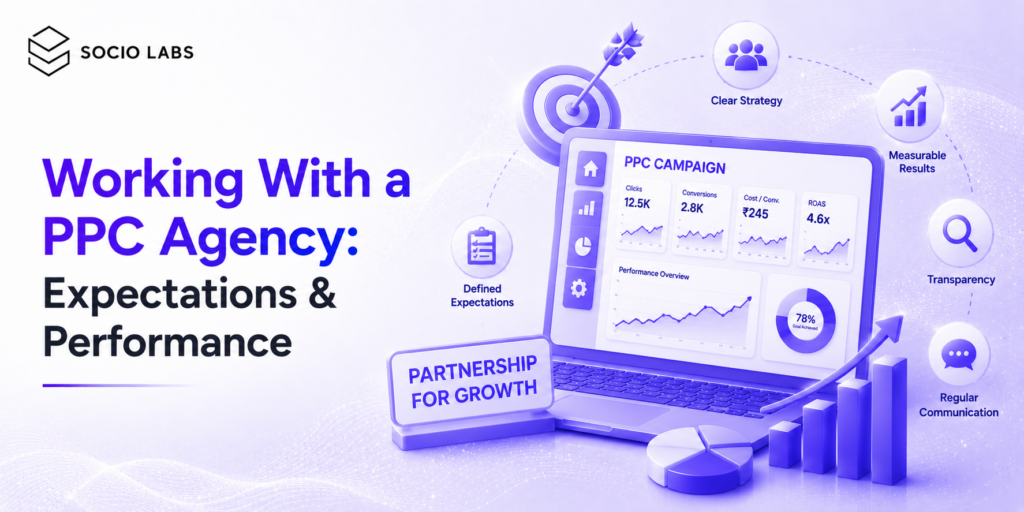
Working with a PPC agency for the first time comes with a mix of excitement and uncertainty you’re handing over real budget and expecting real results, often without knowing exactly what “good” looks like. Google Ads Management Services Some businesses expect overnight leads; others aren’t sure what a monthly report should even contain. At Sociolabs, one recurring challenge we encounter is clients who’ve never had clear visibility into PPC agency performance from a previous provider, which makes it hard for them to know if things are actually going well. This guide sets realistic expectations for PPC management packages, timelines, reporting, and how to judge whether your agency is genuinely delivering.
PPC Management Packages: What's Included?
PPC management packages typically range from basic campaign setup and monitoring to full-service strategy, testing, and reporting, with pricing and scope scaling accordingly. Most agencies structure packages into tiers so businesses can choose based on budget and complexity needs.
| Feature | Basic Package | Standard Package | Premium Package |
|---|---|---|---|
| Campaign Setup | ✔ | ✔ | ✔ |
| Keyword Research | Basic | Advanced | Advanced + competitor-based |
| Competitor Analysis | ✘ | Limited | Full ongoing analysis |
| Ad Copy Creation | Template-based | Custom | Custom + continuous testing |
| Landing Page Recommendations | ✘ | Basic suggestions | Detailed optimization guidance |
| Conversion Tracking | GA4 basic setup | GA4 + Tag Manager | Full-funnel tracking, call tracking |
| Monthly Optimization | Limited | Regular | Continuous |
| Performance Reporting | Monthly summary | Monthly + dashboard | Weekly + monthly + quarterly review |
| A/B Testing | ✘ | Ad copy only | Ads, landing pages, bidding strategies |
| Strategy Reviews | ✘ | Quarterly | Monthly |
Our PPC specialists frequently observe that businesses choosing Basic packages purely on price often underestimate how much manual monitoring they’ll still need to do themselves. Standard packages tend to suit most growing SMBs, while Premium packages make sense once ad spend is large enough to justify continuous testing and full-funnel tracking. At Sociolabs, we always walk clients through which package tier actually matches their spend level, since an overbuilt package on a small budget rarely pays for itself.
How to Know If Your PPC Agency Is Doing a Good Job
You can evaluate PPC agency performance by tracking core KPIs ROAS, conversion rate, cost per lead, CTR, and Quality Score alongside the transparency and quality of their reporting. Strong performance shows up in both the numbers and how clearly the agency explains them.
Use this checklist to assess your agency:
- ☐ Are ROAS and conversion rate trending in the right direction month over month?
- ☐ Is cost per lead stable or improving relative to your goals?
- ☐ Is CTR competitive for your industry benchmarks?
- ☐ Is Quality Score improving as campaigns mature?
- ☐ Does the agency explain why metrics changed, not just report the numbers?
- ☐ Do you have full access to your Google Ads and GA4 accounts?
- ☐ Does the agency proactively suggest strategic changes, rather than waiting to be asked?
- ☐ Are reports specific and data-backed, rather than vague summaries?
After auditing hundreds of Google Ads accounts, we’ve found that the biggest performance gaps aren’t usually about spend level they’re about whether the agency is actively testing and adjusting versus letting campaigns run on autopilot. A PPC agency performing well should be able to clearly explain a metric shift within the same conversation, not need a week to “look into it.”
How Long Does It Take to See Results?
Most PPC campaigns show early signals within the first two to four weeks, but meaningful, stable results typically take 60–90 days as the algorithm gathers enough conversion data to optimize effectively. Timeline expectations should be set upfront to avoid premature judgments.
| Timeframe | What to Expect |
|---|---|
| Week 1 | Campaigns launch; initial impressions, clicks, and early Quality Score signals appear |
| First Month | Data starts accumulating; expect some inefficiency as the algorithm learns |
| Months 2–3 | Performance typically stabilizes; cost per lead and ROAS trends become clearer |
| Long-term (3+ months) | Continuous optimization compounds; scaling budget becomes more predictable |
Industry and budget both affect this timeline. High-competition industries with expensive clicks, or accounts with low monthly budgets, generally take longer to gather enough data for reliable optimization (Source: Think with Google). We’ve consistently found that clients who judge performance too early within the first two to three weeks often make premature decisions to pause or drastically change campaigns just as they were beginning to stabilize.
Can a PPC Agency Guarantee Results?
No ethical PPC agency can guarantee specific rankings, conversions, or lead volume, because Google’s ad auction and audience behavior involve variables no agency fully controls. What a reputable agency can guarantee is transparent reporting, consistent optimization effort, and realistic goal-setting based on your budget and market.
What agencies should never promise:
- Guaranteed #1 ad position
- A fixed number of leads or sales regardless of budget or market conditions
- Guaranteed ROAS within a specific short timeframe
What they can reasonably commit to:
- Transparent, regular reporting on agreed KPIs
- Ongoing optimization based on real performance data
- Realistic goal-setting tied to your specific budget and industry
- Clear communication when performance underperforms expectations, along with a plan to address it
For example, a Sociolabs client in a competitive ecommerce category once asked for a guaranteed ROAS figure before launch; instead of promising a number, our team set a realistic performance range based on similar accounts and industry benchmarks, then worked to beat it through ongoing testing. That approach honest expectation-setting over guarantees is generally a much stronger signal of a trustworthy agency than any promised number.
How Often Should Your PPC Agency Report Performance?
Your PPC agency should typically provide weekly performance snapshots, detailed monthly reports, and quarterly strategy reviews, supported by an accessible dashboard rather than reporting only when asked. Reporting frequency should match how quickly your budget and goals require decision-making.
A solid reporting cadence typically includes:
- Weekly updates — Brief snapshots of spend pacing, key metric shifts, and any urgent issues.
- Monthly reports — Full breakdowns of ROAS, conversion rate, cost per lead, CTR, and Quality Score trends, along with narrative context.
- Quarterly strategy reviews — A step back to reassess overall strategy, budget allocation, and longer-term goals.
- Live dashboards — Tools like Looker Studio connected to GA4 and Google Ads Reports give real-time visibility rather than waiting for a static document.
Every report should include performance against agreed KPIs, a plain-language explanation of what changed and why, and specific next steps or tests planned for the coming period. One of the most common questions our PPC specialists at Sociolabs receive is how frequently agencies should report and our answer is always that reporting frequency should be driven by decision-making needs, not a fixed calendar default that ignores what’s actually happening in the account.
What to Expect in Your First Month With a PPC Agency
Your first month with a PPC agency typically involves discovery and research in week one, campaign build-out in week two, testing in week three, and initial optimization with reporting in week four. Understanding this timeline helps set realistic expectations from day one.
- Week 1 — Discovery & Research: Goal-setting conversations, competitor analysis, keyword research, and conversion tracking setup in GA4 and Google Tag Manager.
- Week 2 — Campaign Creation: Building campaign structure, writing ad copy, setting up audiences, and configuring budgets and bidding strategies.
- Week 3 — Testing: Campaigns go live; the agency monitors early signals, checks tracking accuracy, and begins gathering initial performance data.
- Week 4 — Optimization & Reporting: First real optimizations based on early data, along with your first formal performance report and a discussion of next steps.
At Sociolabs, we’ve found that businesses often expect immediate results without allowing enough time for campaign optimization, which is why we walk every new client through this exact timeline before launch. Setting this expectation upfront consistently reduces frustration and premature second-guessing during those crucial first few weeks.
Conclusion
Working with a PPC agency becomes far less stressful once you know what to expect around packages, timelines, reporting, and how to judge PPC agency performance objectively. Rather than chasing guaranteed results that no ethical agency can promise, focus on transparency, consistent optimization, and KPI trends over time. At Sociolabs, we’ve seen that clients who understand this process from day one build stronger, longer-lasting partnerships and typically get better results because expectations and reality are aligned from the start.
If you’re looking for transparent reporting, experienced PPC specialists, and performance-driven campaign management, the team at Sociolabs can help you build a strategy focused on measurable business growth.
FAQs
Track trends in ROAS, conversion rate, cost per lead, and CTR over time, and evaluate whether your agency explains changes clearly rather than just reporting numbers. Consistent optimization effort and full account access are also strong indicators of good performance.
Wait at least 60–90 days before making major judgments, since Google's algorithms need sufficient conversion data to optimize effectively. Early weeks often show inconsistent performance simply because the system is still learning your audience.
No ethical agency can guarantee a specific number of leads, since auction dynamics and market conditions vary. Reputable agencies instead commit to transparent reporting, ongoing optimization, and realistic performance ranges based on your budget and industry.
A good report includes performance against agreed KPIs like ROAS, conversion rate, and cost per lead, plain-language explanations of key changes, and specific next steps or tests planned. Reports should never be just raw numbers without context.
Most clients benefit from brief weekly check-ins, detailed monthly reports, and quarterly strategy reviews. Communication frequency should scale with your ad spend and how quickly you need to make budget or strategy decisions.