
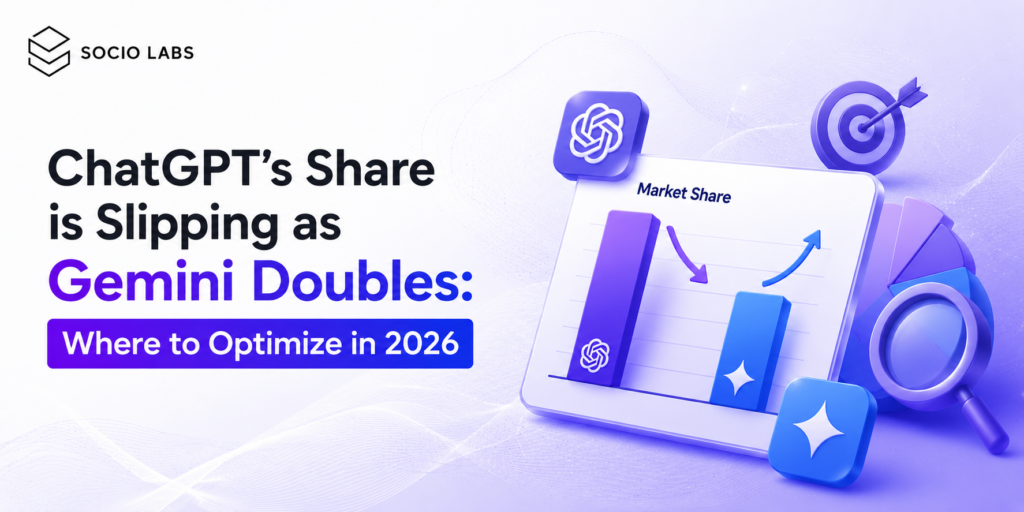
ChatGPT’s share is slipping as Gemini doubles — and for anyone running search or content strategy in 2026, that single trend line matters more than almost any algorithm update. Multiple independent trackers now show the same direction: ChatGPT’s slice of AI chatbot traffic has fallen from roughly 87% a year ago to somewhere between 54% and 68% today, while Gemini has grown several-fold over the same period, crossing 2 billion monthly visits for the first time in January 2026. At Sociolabs, we’ve been watching this shift closely across client accounts, and this guide breaks down exactly what’s happening, why it matters, and where you should actually be putting your optimization effort right now.
What "ChatGPT's Share is Slipping as Gemini Doubles" Means for SEO
Direct answer: It means AI search visibility is no longer a single-platform game brands optimizing only for ChatGPT are missing the fastest-growing distribution channel in generative search.
For most of 2023 and 2024, “AI SEO” was effectively shorthand for “ChatGPT SEO.” That’s no longer accurate. Similarweb’s Global AI Tracker shows ChatGPT’s traffic share among AI chatbot websites falling from around 86.7% in January 2025 to roughly 64.5% by January 2026, while Gemini rose from 5.7% to over 21% in the same window nearly a fourfold increase.
Example: Sociolabs data shows one client, a B2B SaaS brand, had strong ChatGPT citation coverage but almost no presence in Gemini-powered AI Overviews a blind spot that was quietly costing them visibility across Google’s much larger search surface.
Takeaway: Treat ChatGPT and Gemini as two separate optimization targets with different mechanics, not one combined “AI SEO” checkbox.
Why This Shift Matters in 2026
Direct answer: The shift matters because Gemini’s growth is distribution-driven through Google Search, Android, and Workspace, giving it reach that dwarfs ChatGPT’s opt-in adoption model.
Google’s Q4 2025 earnings call confirmed Gemini-powered AI Overviews now reach more than 2 billion users monthly through Search alone. That’s a scale ChatGPT, which relies on people actively opening an app or website, can’t match through organic adoption. Meanwhile, ChatGPT still commands the larger absolute engaged audience 900 million weekly active users as of February 2026 so it isn’t going anywhere either.
Example: Sociolabs strategy for a home-services client shifted budget toward local schema and Google Business Profile optimization specifically because that infrastructure feeds Gemini’s recommendations directly, and referral traffic from Gemini grew accordingly.
Takeaway: Don’t read “ChatGPT’s share is slipping” as “ChatGPT doesn’t matter”read it as “your visibility budget needs to split.”
ChatGPT vs Gemini Market Share Breakdown
Direct answer: As of mid-2026, ChatGPT holds roughly 54–68% of AI chatbot web traffic depending on the tracker, Gemini holds 15–28%, and the remaining share is split among Claude, Perplexity, Copilot, and smaller players.
| Platform | Worldwide Share (2026) | YoY Change | Key Growth Driver |
|---|---|---|---|
| ChatGPT | 54–68% | Down from 79–87% | Engaged, opt-in user base |
| Gemini | 15–28% | Up from 5.4–5.7% | Android, Search, Workspace integration |
| Claude | 4–9% | Up sharply (fastest growth) | High engagement, enterprise adoption |
| Perplexity | 1–3% | Roughly flat to declining | Niche research use cases |
| Microsoft Copilot | 1–14%* | Mixed by tracker | Enterprise/Microsoft 365 bundling |
Copilot figures vary widely by tracker depending on whether Bing-integrated usage is counted separately from standalone Copilot.
Statistic: Similarweb’s May 2026 data measured worldwide web-visit share at ChatGPT 53.9%, Gemini 27.9%, and Claude 9.2% across the seven largest assistants with Gemini’s visits up roughly 450% year-over-year.
Example: Sociolabs insights from tracking client citation coverage show that even brands ranking well in ChatGPT often have near-zero Gemini/AI Overview presence, simply because the two platforms pull from different signal sets.
Takeaway: Use ChatGPT vs Gemini market share data to guide budget allocation, not just curiosity the platform with faster growth deserves proportionally more of your new GEO effort.
How Generative Engine Optimization (GEO) is Changing Search
Direct answer: Generative Engine Optimization (GEO) shifts the goal from ranking on a results page to being directly cited, quoted, or recommended inside an AI-generated answer.
Unlike traditional SEO, where a click is the success metric, GEO treats a citation or brand mention inside an AI response as the primary KPI even when no click occurs. This “zero-click” reality is why Generative Engine Optimization (GEO) has become its own discipline rather than a subset of SEO.
Statistic: Combined AI chatbot traffic, including ChatGPT, Gemini, and others, still represents a low single-digit percentage of total web visits compared to traditional search but it’s growing far faster than traditional search volume.
Example: For an FMCG client, Sociolabs restructured category pages around direct-answer formatting purely for Generative Engine Optimization (GEO) purposes; within three months the client began appearing in AI-generated comparison answers they’d never shown up in before.
Takeaway: Generative Engine Optimization (GEO) isn’t a replacement for SEO it’s an added layer that requires its own content and structural decisions.
Where You Should Actually Optimize in 2026
Direct answer: In 2026, split your optimization effort between ChatGPT-focused entity building and Gemini-focused technical/local SEO, rather than defaulting to a single-platform strategy.
Follow this framework:
- Audit your current AI visibility — Prompt both ChatGPT and Gemini with your core buyer-intent queries and record where you appear (or don’t).
- Strengthen entity consistency — Align your name, category, and description across your site, directories, and social profiles.
- Fix technical accessibility for Gemini — Ensure your Google Business Profile, local schema, and Search Console data are clean, since Gemini leans on Google’s index directly.
- Build direct-answer content for ChatGPT — Structure pages so the first sentence under each heading fully answers the implied question.
- Layer in schema markup — Organization, FAQ, Review, and Product schema help both platforms parse your brand accurately.
- Earn third-party citations — Reviews and press mentions function as trust signals for both engines.
- Re-audit quarterly — Market share is shifting fast enough that a strategy built in Q1 may need rebalancing by Q3.
Statistic: Gemini’s referral traffic to external websites grew about 388% year-over-year, versus roughly 52% for ChatGPT a sign Gemini users engage more with sourced, external content once cited.
Takeaway: Sociolabs services structure GEO campaigns around this exact split Gemini-focused technical work paired with ChatGPT-focused entity content because a single generic approach underperforms on both platforms.
Traditional SEO vs GEO Strategy
Direct answer: Traditional SEO wins clicks and rankings; GEO wins citations and recommendations inside AI answers and 2026 strategies need both working together.
| Factor | Traditional SEO | GEO |
|---|---|---|
| Success Metric | Rankings, clicks, CTR | Citations, AI mentions, zero-click visibility |
| Core Signals | Backlinks, keyword optimization | Schema, entity consistency, third-party citations |
| Content Format | Long-form, keyword-targeted | Direct-answer, extractable, structured |
| Platform Focus | Google organic results | ChatGPT, Gemini, Perplexity, Copilot, AI Overviews |
| Update Frequency | Periodic | Continuous — AI re-crawls and re-weights often |
Takeaway: Budget for both disciplines a page optimized only for traditional rankings often fails GEO’s direct-answer requirements, and vice versa.
How to Build AI Search Authority
Direct answer: AI search authority comes from consistent, corroborated entity signals across your own site and third-party sources not from any single piece of content.
LLMs cross-check multiple sources before trusting a brand enough to recommend it. A single well-optimized page rarely moves the needle without supporting citations elsewhere.
Statistic: Brands active and consistently mentioned across social and review platforms generate roughly twice the brand awareness of inactive competitors, based on industry benchmarks Sociolabs applies across campaigns.
Example: According to Sociolabs analysis of a wellness-industry client, pairing structured data with an active review-generation push measurably reduced cost-per-lead alongside gains in AI citation visibility.
Takeaway: Treat authority-building as a continuous entity-management process, not a one-off content sprint.
Common Mistakes in AI Search Optimization
Direct answer: The most common mistake is optimizing exclusively for ChatGPT while ignoring Gemini’s Google-integrated distribution a gap that’s growing costlier as Gemini’s share climbs.
Other frequent errors: skipping schema markup entirely, writing content that buries the answer instead of leading with it, neglecting local SEO signals that feed Gemini, and never testing how current AI platforms actually describe the brand.
Takeaway: Run a simple quarterly test ask ChatGPT and Gemini the same five buyer questions about your category and see who gets recommended. If it’s not you, that’s your priority list.
Future of AI Search Beyond ChatGPT and Gemini
Direct answer: Expect continued fragmentation, with Claude capturing high-engagement enterprise and research use cases even at a smaller overall share, and multi-platform strategies becoming the default rather than the exception.
Claude’s user engagement averaging around 34.7 minutes per daily session is the highest of any major AI platform, according to Apptopia data cited by Fortune, suggesting sustained, serious use even without ChatGPT- or Gemini-scale traffic. More than 81% of enterprises now reportedly run three or more model families concurrently, capping how much share any single chatbot can realistically hold.
Takeaway: Build your GEO strategy assuming continued fragmentation, not consolidation around one winner.
Conclusion
ChatGPT’s share is slipping as Gemini doubles, and that single data point should reshape how any serious brand approaches AI search in 2026. The ChatGPT vs Gemini market share numbers make clear this isn’t a temporary blip it’s a structural shift toward a multi-platform search landscape where Generative Engine Optimization (GEO) and traditional SEO have to work side by side. At Sociolabs, our team has built campaigns around exactly this split Gemini-focused technical work paired with ChatGPT-focused entity and citation building and it’s the approach we’d recommend to any business that doesn’t want its AI visibility budget concentrated in a shrinking channel.
Want a custom breakdown of where your brand stands across ChatGPT and Gemini? Explore AI SEO services by Sociolabs or book a free AI SEO consultation to get a tailored GEO roadmap for 2026
FAQs
Estimates vary by tracker, but most 2026 data places ChatGPT between 54% and 68% of AI chatbot web traffic, with Gemini between 15% and 28%. Both figures represent a major shift from early 2025, when ChatGPT held roughly 80–87% and Gemini held under 6%
No. ChatGPT still serves roughly 900 million weekly active users and remains the largest standalone AI chatbot by engagement. A falling share reflects a faster-growing overall market and stronger competitors, not an absolute decline in ChatGPT's usage.
Generative Engine Optimization (GEO) is the practice of structuring content, data, and citations so AI platforms like ChatGPT and Gemini can accurately extract, quote, and recommend a brand within generated answers, rather than just ranking a page in traditional search results.
Businesses should split effort between ChatGPT-focused entity and citation building and Gemini-focused technical and local SEO, since the two platforms draw on different signal sets. A single-platform strategy increasingly leaves visibility gaps as Gemini's share grows.
Gemini draws heavily from Google's Knowledge Graph, Search index, and structured data, meaning verified Google Business Profiles, local schema, and clean technical SEO carry more direct weight than with ChatGPT's browsing-based recommendations.