
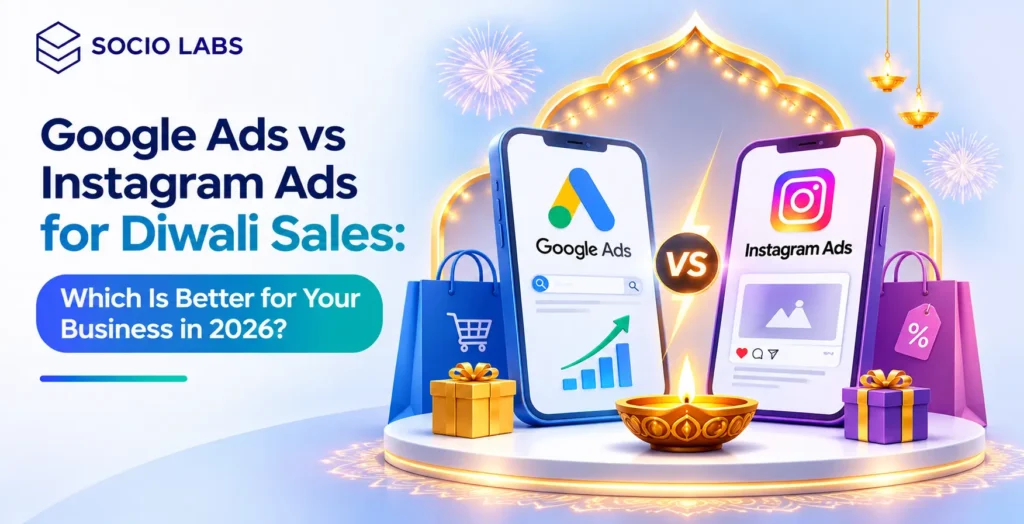
A business preparing festive offers faces a familiar choice: should it pay to appear when someone searches for a product, or show its products to people scrolling through Instagram? The question of Google Ads vs Instagram Ads for business matters because the two channels often reach customers at different moments.
A practical Diwali advertising strategy begins with the buying journey, not a universal claim that one platform is better. Google Search can reach people expressing a specific need; Instagram can make a product desirable through demonstrations, visuals and discovery. For many retailers, the answer is a measured combination. The right split depends on product demand, sales cycle, margins, creative quality and a reliable way to track purchases or qualified enquiries. Businesses looking to make informed advertising decisions can explore PPC advertising services.
Google Ads vs Instagram Ads for Business: The Decision in One Minute
Choose search-led campaigns when people already look for your product or service using clear buying phrases. Choose Instagram-led campaigns when seeing, comparing or demonstrating the product is an important part of demand creation. Use both when customers typically discover a product visually and later search or compare before purchasing.
For example, a shop selling a specific mixer-grinder model may benefit from capturing ready-to-buy searches. A handcrafted gifting brand may need a visual demonstration before customers know what to look for. Neither approach guarantees a sale, and the comparison should be tested with real account data.
How the Two Platforms Influence the Customer Journey
Google Ads: responding to expressed intent
On Search, advertisers can show relevant ads for queries tied to products, locations or problems. This makes Google Ads for retail business a useful option when shoppers already know the category or model they want. A strong campaign needs well-matched search terms, clear ad copy, helpful landing pages and control over irrelevant traffic.
Search demand has limits. If few people know a new product exists, there may not be many relevant queries. Popular terms can also be competitive, and an ad click still does not prove the visitor will buy.
Instagram Ads: creating interest through creative
Instagram placements are suited to product demonstrations, lifestyle context, collections and short-form visual storytelling. People may encounter an item before deciding to research it. Strong creatives show what the product actually does, who it suits and why its price or quality is justified.
But visual engagement does not equal purchase intent. A reel can be watched by curious people who never intended to buy. That is why useful product content and a simple purchase route matter more than an impressive view count.
Compare the Channels by Business Goal
Business situation | Google Ads: possible advantage | Instagram Ads: possible advantage |
Known product model | Captures specific queries | Shows product features visually |
New or unfamiliar gift product | Limited if search demand is low | Introduces the idea through demonstrations |
Local store with nearby buyers | Product-plus-location intent | Builds interest in a local collection |
Fashion or decor brand | Reaches people searching exact styles | Displays styling and use cases |
Quick, measurable web purchases | Purchase-intent traffic when available | Conversion opportunities from product-led creative |
This comparison is a planning aid, not a performance ranking. Costs, targeting options and conversion rates vary with audience, season, creative and account setup. A valid Google Ads vs Instagram Ads for business decision should be based on what customers do after the click or view.
Three Realistic Diwali Budget Scenarios
Scenario A: a local store with a narrow product range
Suppose a retailer sells several recognisable appliance models and already receives “near me” enquiries. It may begin with a search-heavy test around specific stocked products, while using a smaller creative budget to show available models to local shoppers. The store must answer calls, confirm prices and keep product pages current.
This is where Google Ads for retail business can connect local buying intent with real stock. It works only if ads lead to a dependable store experience.
Scenario B: a visual, gift-focused D2C brand
A gifting startup with unusual handmade products may need people to see the products before searching. Product-led reels, short demonstrations and authentic packaging videos may deserve the larger initial test. Search activity around product categories can still be useful, especially once the audience starts comparing options.
Your Diwali advertising strategy should not spend most of its money on search phrases that barely exist. First validate whether creative attention can turn into website actions and completed orders.
Scenario C: an established e-commerce shop with multiple categories
A store with both strong search demand and good visual assets can plan separate tests for product categories. Search can focus on active needs; Instagram can highlight gifting collections or complementary products. Keep reporting separated enough to identify each channel’s contribution and avoid counting the same order twice across dashboards.
Rather than a fixed 70/30 or 50/50 rule, choose a starting split you can afford to test, review results and adjust. No percentage is universally correct.
Build Measurement Before Increasing Spend
Decide which events matter: completed orders, qualified calls, appointment bookings or useful enquiries. Google Ads provides ways to track website conversions and phone calls, but settings and implementation must be checked. For a retail shop, compare ad data with actual sales records and ask customers where they heard of a promotion when appropriate.
A useful Diwali advertising strategy also watches gross profit after discounts and fulfilment. Imagine two hypothetical campaigns: one generates 100 inexpensive enquiries with five purchases; the other generates 30 enquiries with ten purchases. Even without a precise attribution model, the example shows why lead count alone can mislead.
Use consistent campaign naming, separate landing pages or tagged links where possible, and test that each tracked action fires at the right time. Do not treat page views or accidental button clicks as confirmed revenue.
Creative and Landing-Page Rules That Apply to Both
Make the offer legible in the first few seconds or lines. Show actual products, prices or price ranges when appropriate, delivery locations, return terms and one clear action. Match the ad to the destination page. If an ad promotes a festive collection, the link should open that collection.
Google Ads promotion assets can communicate eligible sale information in supported placements. Instagram creatives can demonstrate product context. In both cases, review advertising policies, claims and offer conditions before publishing. Never invent stock scarcity, a discount or delivery assurance to increase clicks.
When testing Google Ads for retail business, review search terms and geography. When testing Instagram, compare distinct creative concepts rather than changing six variables at once. Keep a simple log of what changed, the amount spent and the result.
The Most Common Platform-Selection Mistakes
One mistake is selecting channels because competitors appear to use them. Another is declaring success from vanity metrics: ad impressions, followers or views. A third is ignoring what happens after the ad, including slow pages, unreturned calls, payment failures and sold-out stock.
A final mistake is switching budgets after only a handful of observations. Festive windows are short, but a tiny sample still creates unreliable conclusions. Set review checkpoints, monitor obvious delivery problems immediately and avoid claiming statistical certainty from very small datasets.
Conclusion
The question of Google Ads vs Instagram Ads for business does not have a universal winner. Search is often a good match for existing purchase intent, while Instagram is useful for product discovery and storytelling. The stronger decision is to choose the channel that fits the customer journey, test it with a clear objective and use real orders or qualified enquiries to guide the next change. Google Ads for retail business should be judged by the same standards as every other channel.
Turn the Comparison Into a Measured Campaign
SocioLabs provides professional PPC and social media marketing services to help businesses reach the right audience and improve campaign performance. Get 26% OFF on all services and make your Diwali marketing budget go further. Explore our PPC advertising services and connect with the SocioLabs team for an independent review of your search demand, creative readiness, landing-page clarity and conversion tracking. Get a practical strategy that helps you decide what to test first, how to measure results and when to optimise your campaigns.
Frequently Asked Questions
Start with the most common way customers find your products. If buyers usually search for a named item plus a location, a small search test may be sensible. If shoppers need to see styles or demonstrations, try product-led social creatives. Keep enough budget to measure a meaningful result before expanding.
There is no fixed cost advantage. Advertiser competition, audience, placement, creative, product category and season can all influence price. Compare cost per qualified enquiry or completed order rather than only cost per click. A cheaper click that never becomes a sale is not necessarily the more economical option.
Yes, but splitting a very small budget too widely can make learning difficult. Choose one primary channel and a smaller secondary test, or run the tests sequentially. Keep the offer and conversion goal comparable. Review orders and lead quality before deciding whether to scale or pause a campaign
It may work for broader problem or category searches, but a completely unfamiliar product might have little direct demand by name. Visual storytelling and demonstrations can help explain why a customer should care. Test relevant search themes rather than assuming people will use your internal product name.
Bring your product catalogue, realistic margin range, current website or catalogue links, previous campaign results if available and a clear definition of a qualified enquiry. Explain your serviceable locations and available stock. This lets the agency discuss channel selection, tracking and conversion problems rather than simply promising more traffic.