
Imagine spending years optimizing your website for Google perfecting your meta tags, building backlinks, fine-tuning your page speed and then waking up to discover that a completely different type of search engine is now sending traffic to your competitors instead of you.
That’s not a hypothetical. It’s happening right now.
AI-powered search tools like ChatGPT, Perplexity, Google AI Overviews, and Gemini are fundamentally changing how people discover information online. These systems don’t just crawl and index pages the way traditional search engines do. They read, summarize, reason, and generate answers often without sending users to your website at all.
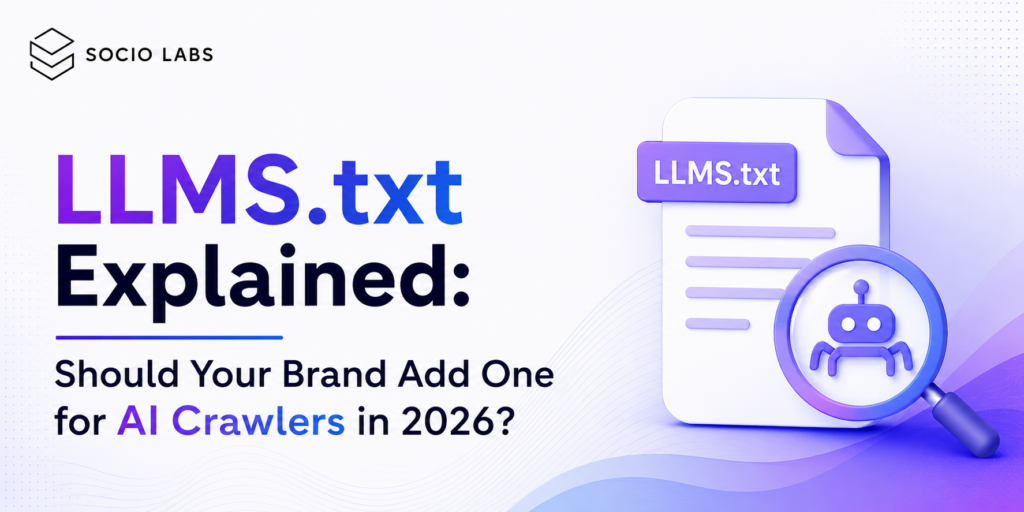
Into this new reality steps llms.txt a quietly proposed standard that’s sparked enormous debate in the SEO world. Is it the robots.txt of the AI era? A genuine opportunity for brands to communicate directly with AI crawlers? Or just another digital marketing trend that will quietly fade away?
In this guide, we’ll break down everything you need to know what the llms.txt file actually is, how AI crawlers work, which platforms support it, and whether your brand should add one in 2026. At SocioLabs, we work with businesses navigating exactly these kinds of emerging technical SEO decisions so the insights here are grounded in real strategic thinking, not hype.
What Is LLMS.txt?
llms.txt is a proposed plain-text file that website owners can place in the root directory of their domain similar to robots.txt to provide structured, curated information specifically intended for large language models (LLMs) and AI crawlers.
The concept was introduced by Jeremy Howard (of fast.ai) in September 2024 and has since gained attention across the SEO, developer, and AI research communities.
The basic idea: instead of leaving AI systems to figure out your website on their own scraping pages, interpreting navigation menus, and guessing at your brand’s core purpose you provide a clean, machine-readable summary. Think of it as a “briefing document” written specifically for AI.
A typical llms.txt file might include:
- A summary of what your website or business does
- Links to your most important pages (products, documentation, key articles)
- Notes on which content is intended for AI consumption vs. which should be excluded
- Contextual information that helps LLMs understand your domain
An extended version, llms-full.txt, can include the complete markdown versions of important pages essentially handing AI systems a pre-digested version of your content
Why Was LLMS.txt Created?
The origin of llms.txt comes from a practical frustration.
LLMs and AI crawlers are increasingly powerful but they’re not always smart about what content to prioritize on a complex website. A large documentation site, for example, might have thousands of pages. Without guidance, an AI system might index outdated pages, miss critical content, or misinterpret the site’s structure.
The llms.txt proposal essentially asks: why not give AI systems a better starting point?
For developers and technical documentation sites, this was an immediate, obvious win. Sites like Anthropic, Cloudflare, and several developer platforms quickly adopted the format. But the implications for broader website optimization for AI including e-commerce, publishing, and B2B brands are still being worked out.
The driving forces behind the llms.txt movement include:
- The rise of generative AI search — Users are increasingly asking AI systems direct questions rather than browsing search results. If your content isn’t accessible or understandable to AI, you risk being left out of AI-generated answers entirely.
- Context quality matters — AI systems that have clear, accurate context about your brand produce better (and fairer) summaries of your services.
- Content control — llms.txt gives you a way to steer AI interpretation of your site, rather than leaving it entirely to algorithmic guesswork.
How AI Crawlers Work (And Why It Matters for Your Brand)
Before judging whether llms.txt is worth implementing, it helps to understand how AI crawlers are different from traditional search bots.
Traditional Search Crawlers (Google, Bing)
These bots crawl HTML pages, follow links, and build a searchable index. They look at signals like:
- Keyword presence and density
- Page authority and backlinks
- Structured data (Schema.org markup)
- Core Web Vitals and technical performance
AI Crawlers
LLMs and AI systems process content differently. Instead of building an index, they’re often doing one of two things:
- Pre-training data ingestion — Crawling the web at scale to build training datasets. This happens infrequently but at massive scale.
- Real-time retrieval (RAG) — During a user query, the AI system fetches fresh content from the web to supplement its knowledge. This is how tools like Perplexity and ChatGPT’s browsing feature work.
For AI crawlers, what matters isn’t just the presence of keywords — it’s semantic clarity, content structure, and contextual coherence. AI systems favor content that is:
- Well-organized and logically structured
- Free of jargon ambiguity
- Clearly attributed to a credible source
- Summarizable without losing meaning
This is exactly where AI crawler optimization and semantic SEO intersect. And it’s why llms.txt — a clean, structured document — has appeal.
LLMS.txt vs. Robots.txt: Key Differences
Many people assume llms.txt is simply robots.txt for AI. The reality is more nuanced.
| Feature | robots.txt | llms.txt |
|---|---|---|
| Purpose | Tell crawlers what NOT to access | Tell AI systems what TO prioritize |
| Standard status | Official W3C/industry standard | Proposed community standard (not official) |
| Supported by | All major search engines | Select AI platforms (unofficial) |
| Format | Directive-based (Allow/Disallow) | Markdown with structured links |
| Primary audience | All web crawlers | Large language models specifically |
| Enforcement | Technically enforced by compliant crawlers | Voluntary — no enforcement mechanism |
| Content | Access rules | Curated content summaries and links |
| File location | /robots.txt (root) | /llms.txt (root) |
The most important distinction: robots.txt restricts access. LLMS.txt invites and guides AI understanding.
They’re complementary, not competing. You might use robots.txt to block AI crawlers from certain sections (thin content, staging pages), while using llms.txt to highlight your most valuable resources.
Does Google Use LLMS.txt?
Here’s where the conversation gets complicated — and where a lot of confusion exists.
As of 2026, Google has not officially announced support for llms.txt.
Google’s approach to AI-powered search (Google AI Overviews) is based on its existing crawling and indexing infrastructure. Googlebot reads your pages, evaluates E-E-A-T signals, processes structured data, and decides what to surface in AI Overviews — largely independent of any llms.txt file.
That said, there are a few important nuances:
- Google hasn’t dismissed llms.txt either. The search team has acknowledged the broader conversation around AI-specific directives.
- Google AI Overviews optimization still depends heavily on traditional signals: high-quality content, Schema.org structured data, topical authority, and strong backlinks.
- Future support is plausible. As AI search continues to evolve, it’s not unreasonable to expect Google to develop richer mechanisms for AI-specific content directives.
The practical takeaway: llms.txt does not directly improve your Google AI Overviews performance today. Your focus there should remain on proven technical SEO and content quality.
Which AI Platforms Support LLMS.txt?
Support across AI platforms is inconsistent and evolving. Here’s a realistic breakdown:
ChatGPT (OpenAI)
OpenAI has not officially adopted the llms.txt standard. ChatGPT’s browsing and plugin ecosystem uses standard crawling to retrieve real-time information. However, some community implementations suggest that well-structured llms.txt files may assist ChatGPT indexing in retrieval-augmented contexts — though this is not confirmed by OpenAI.
Claude (Anthropic)
Anthropic has shown awareness of the llms.txt proposal and has implemented its own version at anthropic.com. However, there’s no official statement confirming that Claude’s knowledge retrieval systems actively parse llms.txt files from third-party sites.
Gemini (Google DeepMind)
As covered above, Google’s AI systems do not have confirmed llms.txt support. Gemini’s responses are powered by Google’s search index and proprietary retrieval systems.
Perplexity
Perplexity uses real-time web retrieval and is considered one of the most “crawl-friendly” AI search engines for content publishers. While llms.txt is not an officially supported directive, Perplexity’s crawlers do visit websites, and clean, well-structured content is favored.
Developer & Documentation Platforms
This is where llms.txt has the strongest practical adoption. Platforms like Cloudflare, Vercel, and several open-source documentation systems have embraced the standard. For technical audiences, the llms.txt file has the most demonstrable value.
Benefits of Adding LLMS.txt to Your Website
Even with limited official support, there are genuine reasons to consider implementing an llms.txt file — especially for certain types of businesses.
1. Future-Proofing Your AI Presence
The AI search landscape is moving quickly. Standards that are “unofficial” today often become de facto requirements within a year or two. Early adoption puts you ahead.
2. Improved Content Discoverability
By curating links to your most important pages, you help AI systems prioritize your best content rather than scraping thin pages or outdated blog posts.
3. Better Brand Representation in AI Responses
When AI systems have clear, accurate information about your business, the summaries and answers they generate are more likely to be accurate and favorable.
4. Supporting Semantic SEO
The process of writing a good llms.txt file forces you to articulate your site’s purpose, structure, and most valuable content — which is a useful semantic SEO exercise regardless of AI adoption.
5. Complementing Your Technical SEO Stack
For brands already investing in structured data, Core Web Vitals, and technical SEO best practices, llms.txt is a low-effort addition that rounds out your optimization strategy.
Potential Limitations and Honest Caveats
Any responsible analysis of llms.txt has to acknowledge the real limitations. These aren’t minor footnotes — they affect whether this is worth your time.
No Official Standard
llms.txt is a community proposal, not a ratified standard from W3C, Google, or any major AI organization. Without enforcement or official adoption, AI systems can simply ignore it.
No Guaranteed Compliance
Even platforms that are sympathetic to the idea don’t have contractual or technical obligations to read or respect your llms.txt file.
May Not Impact Rankings
If you’re hoping llms.txt will help you rank better in AI Overviews or show up more in ChatGPT responses, the evidence for that is thin. LLM SEO is still largely about content quality, authority, and structure — not about any single file.
Risk of Over-Investment
For small businesses with limited technical resources, spending significant time on llms.txt rather than core SEO fundamentals would be a poor trade-off.
Should Every Business Add LLMS.txt?
The honest answer is: it depends on your business type, technical capacity, and how much you care about early adoption.
Strong Candidates for LLMS.txt
SaaS and tech companies — Especially those with extensive documentation. AI systems frequently pull from technical docs, and llms.txt helps ensure accurate, current information is surfaced.
Publishers and content-heavy websites — If your brand produces a lot of content, llms.txt helps curate your “best of” for AI systems.
Developer tools and API businesses — Your users are likely querying AI systems for how-to guidance. Getting your documentation into AI responses is highly valuable.
Enterprises with large, complex websites — Where even human visitors struggle to find the most important pages, llms.txt helps AI make sense of your structure.
Lower Priority for LLMS.txt
Small local businesses — Your SEO energy is better spent on Google Business Profile, local citations, and on-page optimization.
E-commerce with thin product pages — The llms.txt format isn’t well-suited to showcasing individual products.
Brands with limited technical resources — Core SEO fundamentals will drive more measurable ROI.
How to Create an LLMS.txt File: Step-by-Step Guide
If you’ve decided it makes sense for your brand, here’s how to do it properly.
Step 1: Audit Your Most Important Content
Before writing a single line, identify the pages that matter most:
- Your homepage
- Core product or service pages
- High-performing blog posts or resources
- Documentation or support content
- About and contact pages
Step 2: Choose Your Format
A basic llms.txt file uses simple Markdown. Here’s a minimal structure:
# YourBrand
> A one-sentence description of what your website/business does.
## Key Pages
– [Homepage](https://yourdomain.com/)
– [Services](https://yourdomain.com/services/)
– [About Us](https://yourdomain.com/about/)
## Documentation
– [Getting Started](https://yourdomain.com/docs/getting-started/)
– [API Reference](https://yourdomain.com/docs/api/)
## Blog
– [Latest Articles](https://yourdomain.com/blog/)
Step 3: Add an llms-full.txt (Optional)
For platforms that support it, llms-full.txt contains the actual markdown content of your key pages. This is most valuable for documentation-heavy sites.
Step 4: Upload to Your Root Directory
Place the file at: https://yourdomain.com/llms.txt
Ensure it’s publicly accessible with no authentication required.
Step 5: Verify Accessibility
Use a browser or a tool like curl to confirm the file returns a 200 status:
curl -I https://yourdomain.com/llms.txtStep 6: Keep It Updated
Like robots.txt, an outdated llms.txt can do more harm than good. Set a quarterly reminder to review and update the file as your content evolves.
Best Practices for LLMS.txt in 2026
As AI search optimization matures, here are the principles that will serve you best:
Write for Clarity, Not for Gaming
The goal is to help AI understand your brand accurately. Stuffing llms.txt with promotional language or keyword spam is counterproductive and potentially harmful to how AI systems perceive your content.
Prioritize Quality Over Quantity
A focused llms.txt with 10–15 genuinely important links is more useful than an exhaustive dump of every URL on your site.
Align with Your robots.txt
If you’ve blocked certain sections for standard crawlers, consider whether those same exclusions should apply to AI crawlers. Review both files together.
Use Markdown Consistently
Well-formatted Markdown is more reliably parsed than freeform text. Use standard heading levels (H1, H2) and link syntax.
Treat It as a Living Document
Your website evolves. Your llms.txt should too. Content that was central to your brand six months ago may be superseded by newer material.
Document Your Implementation
Keep internal notes on what’s in your llms.txt and why. This helps future SEO team members understand the reasoning and maintain it properly.
Common Mistakes to Avoid
Even well-intentioned implementations can go wrong. Watch out for:
Making unverifiable claims — If your llms.txt describes your company as “the leading provider” of something, AI systems may either use that language uncritically or flag the content as promotional. Stick to factual descriptions.
Linking to low-quality pages — llms.txt should highlight your best content. Linking to thin, outdated, or duplicate pages undermines the entire purpose.
Treating it as a substitute for good content — AI systems prioritize well-written, authoritative, semantically rich content. No llms.txt file compensates for weak writing or thin expertise.
Forgetting to test — Always verify the file is accessible and correctly formatted before considering it “live.”
Ignoring your core SEO foundation — Website optimization for AI still begins with the fundamentals: fast page loads, clean HTML, structured data, strong internal linking. Don’t let llms.txt distract from these.
The Future of AI Crawlers and Search
The llms.txt conversation is really a symptom of something much bigger: the search landscape is undergoing a structural shift.
Traditional search engine optimization was built on a specific model — crawl, index, rank, display results. That model still matters, but it’s being layered with a new one: crawl, train/retrieve, reason, generate answers.
For digital marketing, this has profound implications:
Generative AI search changes the click economy. When AI systems provide direct answers, some users never click through to source websites. This is already visible in Google AI Overviews. The implication for brands: appearing within AI-generated answers is becoming as valuable as ranking in traditional results.
Authority signals are being reinterpreted. LLMs learn from the web’s collective body of work. Brands with consistent, well-attributed expertise across many sources — not just on their own website — are more likely to be represented accurately in AI responses.
Real-time retrieval is growing. Tools like Perplexity and ChatGPT’s web browsing don’t rely solely on static training data. Fresh, well-structured content that AI crawlers can efficiently parse has ongoing value.
The technical SEO skill set is expanding. Beyond traditional signals, SEOs now need to think about semantic clarity, entity recognition, structured content, and yes — emerging directives like llms.txt.
This is why forward-looking digital marketing agencies are treating AI SEO not as a separate discipline, but as an evolution of the technical and content practices that have always underpinned good search optimization.
Expert Perspective: A Measured Take on LLMS.txt
Here’s a realistic summary of where the industry stands:
LLMS.txt is a promising idea with an uncertain adoption trajectory. For technical and documentation-heavy websites, the value proposition is clear. For most other businesses, it’s a low-cost experiment worth running — but not a strategic priority that should displace proven technical SEO work.
The more important strategic insight is this: the underlying goal of llms.txt — helping AI systems understand your brand, content, and value — should be pursued through multiple parallel channels:
- Structured data (Schema.org) to help all search systems interpret your content
- Topical authority built through consistent, expert-level content
- Clear on-page structure with logical headings, summaries, and semantic HTML
- Entity optimization — ensuring your brand is consistently represented across authoritative sources
- Traditional technical SEO — fast, clean, accessible websites
LLMS.txt is one small tool in a larger toolkit. Used alongside these fundamentals, it represents responsible future-proofing. Used in isolation, it’s just digital housekeeping.
Frequently Asked Questions (FAQ)
No. LLMS.txt is a community proposal introduced by Jeremy Howard in 2024. It has not been adopted by the W3C, Google, OpenAI, or any other major standards body as an official specification.
Not directly. Google rankings are still determined by Google's established signals: content quality, E-E-A-T, backlinks, Core Web Vitals, and structured data. LLMS.txt does not feed into Google's current ranking algorithm.
OpenAI has not officially confirmed support for the llms.txt standard. ChatGPT's browsing tools use standard web retrieval. Some community reports suggest llms.txt may have informal influence, but this is unverified.
Robots.txt restricts crawler access to parts of your site. LLMS.txt provides positive guidance — highlighting your most important content and describing your brand for AI systems. They serve complementary, not competing, purposes.
Include a brief business description, links to your most important pages (home, services, key resources), and optionally, links to well-structured blog content. Keep it focused — 10 to 20 curated entries is better than an exhaustive list.
Conclusion: Is Your Brand Ready for AI-First Search?
The rise of generative AI search isn’t a future prediction — it’s already reshaping how people discover brands, products, and information. Tools like ChatGPT, Perplexity, Gemini, and Google AI Overviews are actively reading, summarizing, and presenting content to users in ways that bypass traditional search result pages entirely.
In this environment, llms.txt represents something genuinely interesting: the first tentative attempt by the web community to create a communication layer between websites and AI systems. Its adoption is patchy, its standards are informal, and its immediate impact on most businesses is modest.
But the principles it embodies — clear content structure, curated context, proactive AI-readiness — are very much the direction serious SEO strategy needs to move.
Our recommendation: implement llms.txt if you have the technical capacity to do it properly and maintain it. Treat it as one component of a broader AI search optimization strategy that also includes semantic SEO, structured data, topical authority, and strong technical foundations.
If you’re not sure where to start — or how AI search changes affect your specific industry — the team at SocioLabs specializes in exactly this kind of forward-looking SEO strategy. From technical SEO audits to full AI search optimization, we help brands build search visibility that works in 2026 and beyond.
Ready to future-proof your brand for AI-first search? Get in touch with SocioLabs and let’s build a strategy that works across every search surface — traditional and AI-powered alike.