
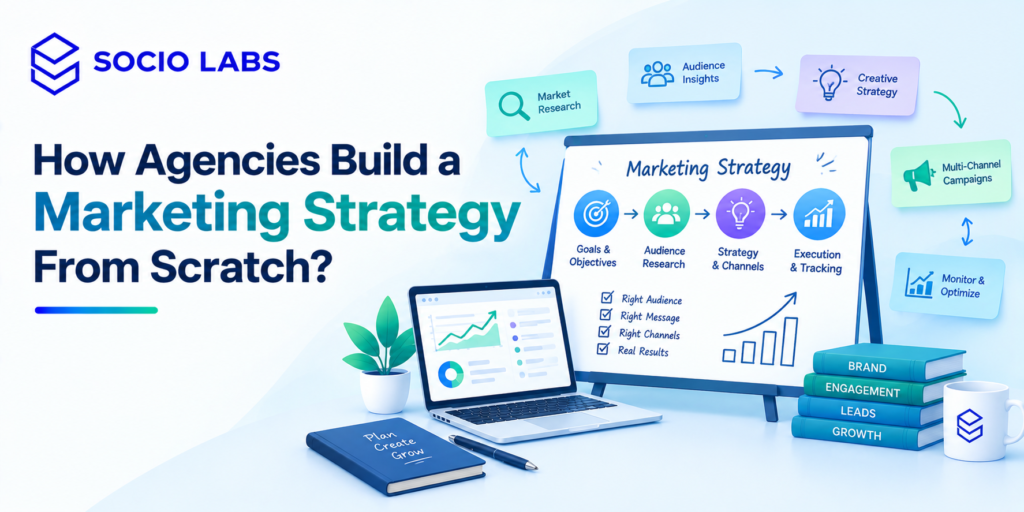
Most businesses don’t fail at marketing because they lack effort they fail because they start with tactics before they’ve built a real marketing strategy. A founder decides to “do Instagram and some Google Ads” without first defining who they’re targeting, what success looks like, or how each channel connects to revenue. Agencies approach this differently: strategy comes first, execution comes second.
This guide walks through exactly how an agency builds a marketing strategy from zero the research, decisions, and structure involved so you can either do it yourself or know what to expect from a partner. Along the way, we’ll reference how an agency such as Socio Labs typically structures this process for businesses across India.
What Does a Marketing Agency Do Before Building a Strategy?
Before writing a single tactic, agencies spend time understanding the business itself its model, revenue goals, existing customers, current marketing performance, and competitive environment because a strategy built without this context is just guessing with extra steps.
This discovery phase typically covers the business model and how it actually makes money, the products or services being sold, current revenue and growth targets, who’s already buying and why, what’s currently working or failing in marketing, and where the business sits relative to competitors. Skipping this step is the single biggest reason marketing plans fail to connect to real business outcomes.
An agency like SocioLabs generally treats this stage as non-negotiable no channel gets chosen and no budget gets allocated until this picture is clear.
Step 1 Define Business and Marketing Goals
Every marketing strategy starts by separating business goals from marketing goals, then translating the former into specific, measurable marketing objectives that actually support them.
A business goal might be “grow revenue by 30% this year.” That’s not yet a marketing goal it needs translation into something actionable, like “generate 200 qualified leads per month” or “increase online sales conversion rate by 2 percentage points.” SMART goals (specific, measurable, achievable, relevant, time-bound) turn a vague ambition into something a strategy can actually be built around.
- Revenue targets → translated into lead or sales volume needed
- Brand-awareness goals → translated into reach, impressions, or search visibility targets
- Conversion goals → translated into specific conversion rate or CAC targets
Without this translation step, “grow the business” stays too abstract to guide any actual channel or budget decision.
Step 2 Research the Market and Target Audience
Agencies research the market and target audience by combining demographic data, customer interviews or existing feedback, search behavior analysis, and buyer persona development to understand not just who buys, but why and how they decide.
This goes beyond basic demographics. Understanding pain points, the questions customers ask before buying, where they search for solutions, and what triggers a purchase decision all shape everything downstream content topics, ad messaging, and channel selection alike.
Practical example: A B2B SaaS company might discover through research that their buyers spend weeks comparing options, read technical comparison content, and are heavily influenced by case studies very different behavior from a D2C brand’s impulse-driven, social-media-triggered purchase journey. That difference alone reshapes the entire strategy.
Step 3 Analyze Competitors and Positioning
Agencies analyze competitors by reviewing their websites, SEO visibility, paid advertising, social presence, content strategy, pricing, and customer reviews not to copy what’s working, but to find gaps and build genuine differentiation.
This research reveals where competitors are strong (hard to compete head-on) and where they’re weak or absent (real opportunity). A competitor with strong SEO but poor social engagement suggests a different entry point than a competitor with the opposite pattern.
Positioning comes out of this analysis defining what makes your business the right choice for a specific audience, distinct from simply listing features. Good positioning answers “why us, specifically” in a way competitors can’t easily claim for themselves.
Step 4 Choose the Right Marketing Channels
Agencies choose marketing channels based on audience behavior, budget, industry, sales cycle, and expected return not every business needs every channel, and trying to run all of them simultaneously usually means doing all of them poorly.
SEO and content marketing suit businesses with longer sales cycles where being found during research matters. Paid channels like performance marketing strategies across Google Ads and Meta Ads suit businesses needing faster, more immediate results. Social media suits brands with strong visual appeal or community-building potential. Email marketing suits businesses with an existing customer base worth nurturing.
- B2B, long sales cycle: SEO, content marketing, LinkedIn, case studies
- D2C, impulse-driven: Social media, influencer marketing, paid social
- Local service business: Local SEO, Google Business Profile, local paid ads
- High-budget, fast growth target: Performance marketing across multiple paid channels simultaneously
The right combination depends entirely on where your specific audience actually spends time and how they make decisions not which channels are trending.
Step 5 Build the Marketing Funnel and Customer Journey
Agencies build the marketing funnel by mapping activities to each stage a customer moves through awareness, consideration, conversion, and retention ensuring no stage gets neglected in favor of just chasing top-of-funnel traffic.
Funnel Stage | Customer Mindset | Typical Marketing Activities |
Awareness | “I have a problem” | SEO content, social media, broad-reach ads |
Consideration | “What are my options?” | Comparison content, case studies, retargeting ads |
Conversion | “I’m ready to decide” | Landing pages, offers, sales-focused ads |
Retention | “Should I stay/buy again?” | Email marketing, loyalty programs, customer content |
A strategy focused entirely on driving traffic (awareness) while ignoring conversion and retention typically produces disappointing results despite healthy visitor numbers the funnel only works when every stage gets deliberate attention.
Step 6 Create the Campaign and Content Plan
Agencies turn strategy into execution by defining content pillars, campaign themes, offers, and the specific assets landing pages, ad creatives, SEO content, social posts needed to support each funnel stage.
This is where strategy becomes tactics. Strategy says “build awareness among small business owners researching SEO help”; tactics are the actual blog posts, social captions, and ad creatives that execute on that. Content pillars (broad themes your content consistently returns to) keep execution organized rather than scattered across unrelated topics.
Lead magnets, gated resources, and conversion-focused landing pages typically get built at this stage too, specifically designed to move prospects from one funnel stage to the next rather than existing as generic marketing collateral.
Step 7 Set Budget, KPIs, and Measurement
Agencies set budget and KPIs by allocating spend across channels based on expected return, then defining specific metrics CAC, conversion rate, ROAS, qualified leads that will actually indicate whether the strategy is working.
Budget allocation typically follows expected impact and funnel stage, not equal distribution across every channel. KPIs should tie directly back to the marketing goals defined in Step 1 if the goal was qualified leads, vanity metrics like impressions or followers shouldn’t be the primary measurement.
- CAC (Customer Acquisition Cost): What it actually costs to acquire one customer
- CPL (Cost Per Lead): Cost efficiency of lead generation specifically
- Conversion rate: How effectively traffic turns into leads or sales
- ROAS: Revenue generated per unit of ad spend
- Organic traffic and qualified leads: Tracked via GA4 and Google Search Console
Measurement infrastructure proper tracking through GA4 and clean conversion setup needs to exist before launch, not retrofitted afterward once questions arise about what’s working.
Step 8 Launch, Test, Analyze, and Optimize
A marketing strategy isn’t a one-time document agencies treat launch as the beginning of a continuous cycle of testing, analyzing, and optimizing based on real performance data.
This means A/B testing ad creative and landing pages, monitoring performance against the KPIs set in Step 7, refining audience targeting based on what’s actually converting, adjusting budget allocation toward better-performing channels, and reporting results back against the original goals regularly. Businesses working with social media marketing services or other specialized channel partners typically see this optimization cycle happen weekly or monthly, not just at quarter-end.
A strategy document that never gets revisited after launch is effectively a strategy that stopped being used the day it was written.
Strategy vs Tactics: What's the Difference?
Strategy defines the overall direction and goal; tactics are the specific actions used to execute that strategy confusing the two is one of the most common reasons marketing efforts feel scattered and disconnected from actual business results.
Marketing Strategy | Marketing Tactics |
Generate qualified B2B leads from high-intent search traffic | SEO landing pages, Google Ads campaigns, lead forms |
Build brand awareness among urban millennials for a D2C skincare line | Instagram content, influencer partnerships, paid social ads |
Increase repeat purchase rate among existing customers | Email flows, loyalty program, retargeting ads |
Establish thought leadership in a niche B2B category | LinkedIn content, guest articles, webinars |
Strategy answers “what are we trying to achieve and for whom”; tactics answer “how exactly do we execute that this month.” Both matter, but strategy has to come first, or tactics end up disconnected from any real goal.
A Practical Example: Building Strategy From Scratch
Illustrative example, not an actual client case study: Consider a growing Indian e-commerce business wanting more qualified sales.
- Business objective: Increase monthly online sales by a defined target
- Audience research: Identify who’s currently buying and why, through existing customer data and interviews
- Competitor analysis: Review 3–5 direct competitors’ SEO, ads, and social presence
- Positioning: Define what makes this brand the right choice for its specific audience
- Channel selection: Likely a mix of SEO for product/category pages, Meta Ads for discovery, and email for retention
- Funnel: Map awareness (social/content) through retention (email, loyalty)
- Content/campaign plan: Product page optimization, seasonal campaign themes, retargeting creative
- Budget allocation: Weighted toward channels with the clearest expected ROI given current data
- KPIs: CAC, conversion rate, ROAS tracked through GA4
- Optimization: Weekly review of what’s converting, monthly budget reallocation
This sequence not the specific channels chosen is what an agency actually repeats across different businesses and industries.
Common Mistakes Businesses Make Building a Marketing Strategy
- Starting with tactics instead of goals pick channels only after defining what success means
- Trying every marketing channel at once spreading budget thin rarely outperforms focused effort
- Copying competitors directly differentiation gets lost when strategy is just imitation
- Ignoring customer research assumptions about your audience are rarely as accurate as real data
- Targeting everyone a strategy for “anyone who might buy” usually resonates with no one specifically
- Focusing only on traffic visitors who don’t convert don’t help the business grow
- Ignoring conversion rates driving more traffic to a weak funnel just wastes more budget
- Setting unrealistic expectations meaningful results typically take months, not weeks
- Not tracking KPIs without measurement, there’s no way to know what’s actually working
- Never optimizing after launch a strategy document isn’t “finished” once campaigns go live
Marketing Strategy Checklist
Business goals defined Marketing goals defined (SMART format) Target audience researched Customer journey mapped Competitors analyzed Positioning established Channels selected based on audience and budget Marketing funnel created (awareness through retention) Content/campaign plan prepared Budget allocated by expected impact KPIs selected and tied to goals Tracking implemented (GA4, Search Console, conversion tracking) Testing plan created (A/B testing, creative variations) Optimization process established (regular review cadence)
Conclusion
Building a real marketing strategy from scratch means starting with goals and research, not channels and tactics the sequence matters as much as the individual decisions. Agencies follow a structured process: define objectives, understand the audience and competition, choose channels deliberately, build a complete funnel, and measure everything against clear KPIs, then keep optimizing after launch rather than treating the plan as finished. At SocioLabs, this same sequence shapes how strategy work gets approached for businesses across India, combining structured planning with the flexibility to adjust as real data comes in.
Thinking through your own marketing strategy and not sure where to start? Explore SEO services for businesses from SocioLabs and see how a structured approach could apply to your specific goals.
FAQs
Agencies start by understanding the business and its goals, then research the audience and competitors, select appropriate channels, build a funnel, create a campaign plan, set budget and KPIs, and continuously optimize after launch.
Timelines vary by business complexity, but a thorough strategy typically takes several weeks to develop properly, covering research, planning, and internal alignment before execution begins.
Far far away, behind the word mountains, far from the countries Vokalia and Consonantia, there live the blind texts. Separated they live in Bookmarksgrove right at the coast
Agencies choose channels based on target audience behavior, available budget, industry, sales cycle length, and expected return, rather than defaulting to whichever channels are currently popular.
A complete strategy includes clear goals, audience research, competitor analysis, positioning, channel selection, a funnel structure, a campaign/content plan, budget allocation, KPIs, and an ongoing optimization process.