

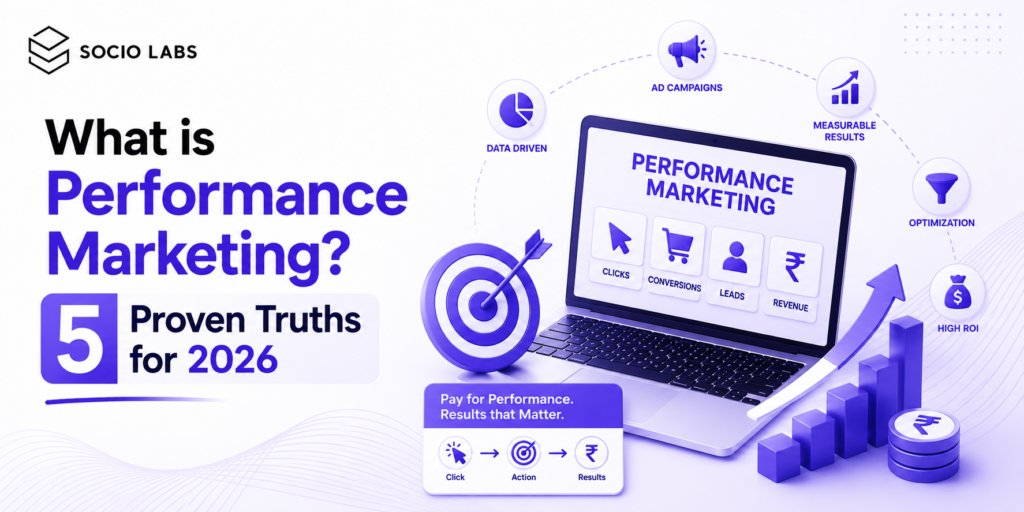
What is Performance Marketing, and why does nearly every growing business in India now budget for it separately from “regular” advertising? In simple terms, it’s a form of digital marketing where you pay only for measurable outcomes a click, a lead, a sale, an app install instead of paying upfront for exposure and hoping it converts.
For a startup founder or SME owner, this distinction matters more than it sounds. Traditional advertising asks you to trust that brand visibility will eventually turn into revenue. Performance marketing removes that guesswork by tying spend directly to results you can track in real time through GA4, Meta Ads Manager, or Google Search Console.
This guide breaks down exactly what performance marketing means, how it’s different from a traditional ad agency’s approach, the services you should expect from a performance-focused partner, and the metrics that actually indicate whether a campaign is working. Our team at Socio labs manages these exact metrics daily across client accounts, so this comes from applied experience, not textbook theory.
What Is Performance Marketing and How Does It Differ From Traditional Advertising?
What is Performance Marketing? It’s a results-driven form of digital advertising where businesses pay based on specific, measurable actions such as a click, lead, sign-up, or completed sale rather than paying a flat fee for ad placement or airtime regardless of outcome. Every rupee spent is tied to a trackable action, which is what separates it fundamentally from traditional media buying.
Traditional advertising think TV spots, print ads, billboards, or radiois priced on reach and impressions. You pay for the audience’s attention, but there’s no direct mechanism to confirm that attention led to a sale. It works well for brand recall over time, but it offers little short-term accountability.
Performance marketing flips this model. Campaigns run on platforms like Google Ads, Meta Ads, and programmatic networks, where every impression, click, and conversion is logged and attributed. This is why businesses working with Socio labs typically see weekly, not quarterly, performance data the entire model is built around continuous optimization.
Why This Distinction Matters for Budget Planning
Businesses with limited budgets benefit from performance marketing because spend can be reallocated within days based on what’s actually converting, rather than committing to a media plan for months. A campaign underperforming on Google Ads can be paused and shifted to Meta within the same week.
How Attribution Changes the Conversation
Because every action is tracked, performance marketing forces a conversation about attribution which channel, ad, or keyword actually drove the sale. This is a conversation traditional advertising rarely has to have, since it isn’t built for granular tracking.
- Traditional advertising: pay for reach, measure brand recall
- Performance marketing: pay for outcomes, measure ROI directly
- Traditional cycle: months-long campaigns with limited mid-flight changes
- Performance cycle: weekly or even daily optimization based on live data
Expert Tip: Before running any performance campaign, confirm your tracking (GA4 + Google Tag Manager, or Meta Pixel) is firing correctly. Without accurate tracking, “performance” data is just noise.
Understanding this difference is the first step before evaluating any Performance Marketing Agency in India because an agency that can’t explain this distinction clearly likely can’t execute it well either.
What Is the Core Difference Between a Traditional and a Performance Marketing Agency?
The core difference between a traditional and a performance marketing agency is what they’re accountable for: a traditional agency is typically judged on creative quality and campaign reach, while a performance marketing agency is judged on measurable business outcomes like cost per acquisition and return on ad spend. This changes how each type of agency structures its team, pricing, and reporting.
Traditional agencies are often structured around creative directors, copywriters, and media planners whose success is measured through awards, brand recall studies, or campaign reach. Their pricing is usually a flat retainer or a percentage of media spend, regardless of whether sales moved.
Performance marketing agencies, by contrast, build teams around media buyers, data analysts, and conversion rate specialists. Compensation models increasingly include performance-linked components, and reporting happens through live dashboards built on GA4 and Looker Studio rather than end-of-campaign brand studies.
Team Structure and Accountability
A performance agency’s account team typically includes a dedicated media buyer per platform (Google, Meta, programmatic) plus an analyst who owns attribution and reporting a structure rarely found in traditional agencies focused on creative output alone.
Pricing and Contract Models
Traditional agencies commonly work on 6–12 month retainers tied to campaign calendars, whereas performance agencies increasingly offer shorter pilot engagements (30–60 days) since results are visible much sooner.
| Factor | Traditional Agency | Performance Marketing Agency |
|---|---|---|
| Primary KPI | Reach, brand recall | CPA, ROAS, conversions |
| Reporting cadence | Monthly/quarterly | Weekly or real-time |
| Team composition | Creative-led | Data and media-buying led |
| Pricing model | Flat retainer | Retainer + performance-linked |
| Typical contract length | 6–12 months | 1–6 months, pilot-friendly |
Businesses working with Socio labs often come from a traditional agency background and are surprised by how much faster decisions move once reporting is tied directly to revenue rather than reach.
What Are the Common Services Offered by a Digital Performance Agency?
A digital performance agency typically offers paid search, paid social, programmatic display, conversion rate optimization, analytics setup, and landing page testing all built around driving a measurable action rather than general brand visibility. Most agencies bundle these services because they depend on each other for accurate attribution.
Paid search (Google Ads, Microsoft Ads) captures existing demand from people actively searching for a solution, while paid social (Meta Ads) creates and captures demand among audiences who aren’t actively searching yet. Both are usually run in parallel for e-commerce and SaaS brands.
Beyond media buying, most performance agencies also manage the technical backend tagging, tracking, and analytics since inaccurate data makes every other service ineffective.
Core Media Buying Services
- Google Ads (Search, Shopping, Performance Max)
- Meta Ads (Facebook and Instagram)
- Programmatic and display advertising
- Microsoft Ads for supplementary search coverage
Supporting Technical Services
- GA4 and Google Tag Manager setup and auditing
- Conversion rate optimization and A/B landing page testing
- Merchant Center feed management for e-commerce catalogs
- Custom reporting dashboards via Looker Studio
Expert Tip: If an agency proposes running Meta or Google Ads without first auditing your GA4 and Tag Manager setup, treat that as a red flag spend without clean tracking is close to unmeasurable.
For businesses also investing in organic visibility alongside paid channels, pairing this with AI SEO Services typically compounds results over a longer timeline than paid channels alone can sustain.
Best Services Offered by a Performance Marketing Company
The best-performing services offered by a performance marketing company are the ones tied most directly to revenue: full-funnel paid media management, conversion rate optimization, and retention marketing through retargeting and email/SMS automation. These three, used together, typically outperform any single-channel approach.
Full-funnel management means running awareness, consideration, and conversion campaigns simultaneously across platforms, rather than treating each stage as a separate project. This is where a lot of the “best” positioning in the market genuinely earns its claim not through bigger budgets, but through coordinated execution across the funnel.
Full-Funnel Paid Media Management
This includes prospecting campaigns for new audiences, retargeting for users who engaged but didn’t convert, and loyalty campaigns for repeat customers all managed as one connected system rather than isolated campaigns.
Retention and Retargeting Programs
Retargeting website visitors and cart abandoners through Meta Pixel and Google Ads remarketing lists typically delivers a notably lower cost per acquisition than cold prospecting, since the audience already has intent.
- Full-funnel paid media strategy across Google and Meta
- Landing page and creative A/B testing for conversion lift
- Retargeting and retention campaigns (email, SMS, push)
- Cross-channel attribution reporting via GA4 and Looker Studio
- Ongoing budget reallocation based on weekly performance data
Based on campaigns managed by Socio labs, businesses that invest in retention alongside acquisition tend to see more stable month-over-month performance than those focused purely on new customer acquisition.
Key Metrics Used by Performance Marketing Agencies, Explained
The key metrics performance marketing agencies track are Cost Per Acquisition (CPA), Return on Ad Spend (ROAS), Click-Through Rate (CTR), Conversion Rate, and Customer Lifetime Value (LTV) together, these show not just whether ads are getting clicks, but whether they’re generating profitable business outcomes. Tracking only surface metrics like impressions or reach without these is a common and costly mistake.
CPA tells you how much you’re spending to acquire one customer or lead, while ROAS shows the direct revenue return for every rupee spent on ads. Both should always be evaluated against your actual margins, not viewed as standalone numbers.
Metrics That Indicate Campaign Health
CTR and Conversion Rate together indicate whether your ad creative is attracting the right audience and whether your landing page is converting that interest into action a low CTR often points to creative fatigue, while a low conversion rate usually points to landing page or offer issues.
Metrics That Indicate Long-Term Business Impact
LTV and repeat purchase rate reveal whether the customers you’re acquiring through paid channels are actually valuable long-term, which matters more for sustainable growth than short-term CPA alone.
| Metric | What It Measures | Why It Matters |
|---|---|---|
| CPA | Cost to acquire one customer/lead | Core efficiency indicator |
| ROAS | Revenue per rupee of ad spend | Direct profitability signal |
| CTR | % of viewers who click the ad | Creative and targeting relevance |
| Conversion Rate | % of clicks that complete the goal action | Landing page and offer effectiveness |
| LTV | Total revenue from a customer over time | Long-term profitability of acquisition |
Expert Tip: A campaign with a low CPA but poor LTV isn’t actually efficient — it’s often acquiring low-quality customers cheaply. Always evaluate CPA and LTV together.
At Socio labs, campaign reviews always pair short-term metrics like CPA and CTR with longer-term signals like LTV, since optimizing for one in isolation often quietly damages the other.
Conclusion
So, what is Performance Marketing in practical terms? It’s advertising built around accountability every rupee spent is tied to a measurable action, tracked through platforms like GA4, Google Ads, and Meta Ads Manager, rather than hoping reach eventually converts. The right approach combines full-funnel media management, clean tracking, and metrics like CPA, ROAS, and LTV evaluated together, not in isolation. At Socio labs, this measurable, accountable approach is the foundation of how every campaign is planned and reported.
Curious how performance marketing could work for your specific business? SocioLabs offers a free walkthrough of your current tracking setup and channel opportunities. Explore our Performance Marketing Services or see how our approach compares with other Digital Marketing Services before you commit to a channel strategy
FAQs
No — SaaS companies, service businesses, and B2B brands all use performance marketing, though the key metrics (like lead quality over immediate sales) may differ from e-commerce.
Performance marketing typically refers to paid channels with direct attribution, while SEO builds organic visibility over a longer timeline; most mature marketing strategies use both together.
No — many agencies now offer pilot campaigns starting with smaller monthly budgets specifically to test channel performance before scaling spend.