
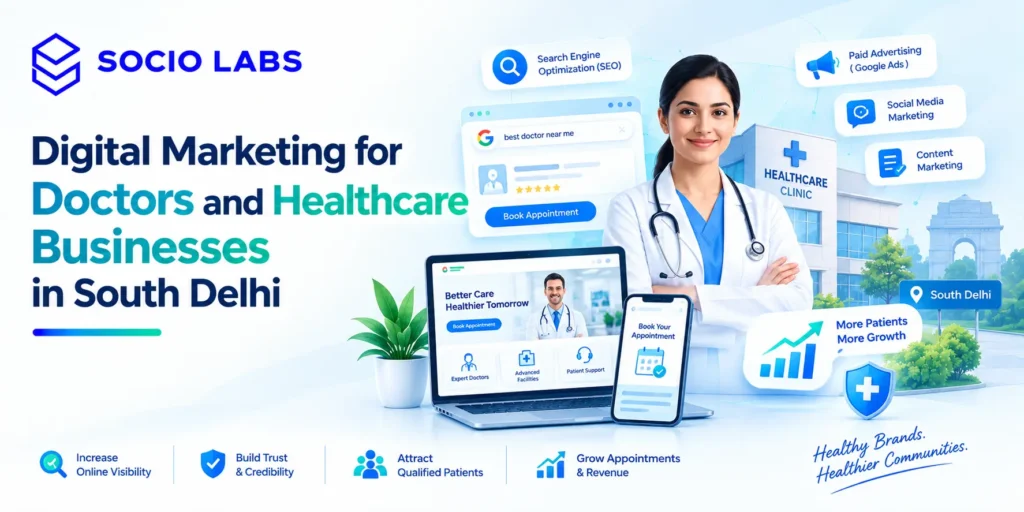
South Delhi’s healthcare market is dense and competitive clinics, specialist practices, diagnostic centers, and hospitals across areas like Saket, Greater Kailash, Defence Colony, and Hauz Khas are all drawing from overlapping neighborhoods of patients who increasingly search online before booking an appointment. For doctors and healthcare businesses here, digital marketing is no longer optional but it also now operates under meaningfully tighter rules than it did even a few months ago. This guide covers what digital marketing for doctors and healthcare businesses in South Delhi should actually look like in 2026, including the new ethical advertising guidelines every practice needs to understand before running any campaign. Along the way, we’ll reference how an agency such as SocioLabs approaches healthcare marketing compliance for clients in this space.
Why Does Digital Marketing Matter for Doctors in South Delhi?
Digital marketing matters for doctors in South Delhi because patients routinely research a doctor, clinic, or hospital online before booking checking Google search results, reviews, and a practice’s own website making visibility and trust-building online directly tied to patient acquisition, not a separate, optional activity.
South Delhi specifically has a dense concentration of hospitals, specialist clinics, and diagnostic centers competing for overlapping patient catchment areas, which means a practice relying only on walk-ins or word-of-mouth referrals is likely losing visibility to competitors who show up when a patient searches for a specific specialty or symptom nearby. That said, healthcare marketing carries real regulatory weight that most other industries don’t which is exactly why the next section matters as much as any marketing strategy itself.
What Changed: The New 2026 NMC Advertising Guidelines
The National Medical Commission issued new Guidelines on Ethical Advertising and Public Communication by Hospitals/Medical Institutions and Registered Medical Practitioners on October 6, 2026, significantly tightening what doctors, hospitals, and the marketing agencies working with them are permitted to do in digital advertising.
The guidelines bring social media, influencers, AI-generated promotions, and digital marketing under ethical advertising rules, with violations potentially leading to suspension or removal from the medical register. The NMC has specifically included artificial intelligence within the definition of advertising, and recognizes the growing role of influencers, digital marketing agencies, and online platforms in healthcare promotion placing responsibility on healthcare providers to oversee their digital marketing arrangements. The guidelines cover digital marketing campaigns, sponsored posts, AI-generated promotions, public interviews, news articles intended for promotion, online healthcare platforms, and audio-visual and digital communication broadly. This followed findings from the Advertising Standards Council of India that healthcare was the single most violative advertising category, with digital media responsible for over 85% of objectionable advertisements.
This is an active, recent regulatory shift as of this writing, it’s only weeks old, and enforcement patterns are still forming. Any marketing activity for a doctor or healthcare business should be checked against the NMC’s current published guidelines directly, and ideally reviewed with legal or compliance counsel rather than relying solely on secondary summaries, including this one.
What Can Doctors and Hospitals No Longer Do in Marketing?
Under the new guidelines, doctors and hospitals can no longer use patient testimonials, paid or AI-generated reviews, celebrity or influencer endorsements, guaranteed-cure claims, or paid ranking placements on healthcare platforms.
The NMC has barred AI testimonials and paid reviews for doctors as part of these new advertising guidelines. The guidelines specifically prohibit promotional use of doctors’ photographs and bar paid rankings on healthcare platforms. More broadly, the NMC bars self-promotion and misleading reviews, and regulates AI use and social media activity by doctors. Aggressive digital marketing, unverified patient testimonials, and exaggerated claims related to private practice will now face censure under these rules. Healthcare facilities also cannot deploy commercial influencers, celebrities, or digital marketing agencies specifically to solicit patients. The guidelines also make clear that patient consent alone is not sufficient to justify promotional use of patient stories or images.
Practically, this rules out a significant share of tactics that were common in healthcare marketing even recently patient success story posts, “verified patient” review widgets, influencer-driven clinic promotions, and “Top Doctor” or “Best Clinic” paid ranking placements should all be reviewed and likely removed or restructured.
What Is Still Allowed Under the New Guidelines?
What remains allowed generally includes factual, educational health content, accurate practice information (location, hours, services, qualifications), and transparent, non-misleading communication about a practice’s offerings the guidelines target deceptive and promotional tactics specifically, not accurate informational content.
The guidelines are intended to align hospital advertising practices with professional standards applicable to registered medical practitioners, promote transparency while discouraging commercialization of medical care, and regulate digital healthcare promotion while ensuring ethical conduct. This framing matters: the intent is curbing commercialized, misleading promotion — not preventing a legitimate practice from maintaining an accurate, informative online presence. Genuinely educational content (explaining a condition, a procedure, general preventive health information) written without promotional framing or guaranteed-outcome language generally sits in safer territory, though this distinction can be genuinely subtle in practice, which is exactly why compliance review matters more now than before.
What Digital Marketing Channels Work for Healthcare in South Delhi?
The channels that work best for healthcare marketing in South Delhi, within the new compliance environment, are local SEO, a well-structured informational website, Google Business Profile optimization, and carefully compliant paid search rather than channels historically built around testimonials, influencer content, or review-driven social proof.
Google Business Profile optimization matters significantly for healthcare marketing, since most patients searching for care nearby check Google’s local results and map pack before deciding where to go. A compliant approach for South Delhi practices includes a website structured around accurate service and specialty pages, local SEO targeting specific neighborhoods and specialties (for example, “pediatrician in Greater Kailash” rather than generic broad terms), Google Business Profile fully completed and kept accurate without manufactured review activity, and educational content blog posts or FAQ pages explaining conditions and procedures factually, without promotional or guaranteed-outcome framing.
How Should Local SEO Work for a South Delhi Medical Practice?
Local SEO for a South Delhi medical practice should center on an accurate, fully completed Google Business Profile, location- and specialty-specific website content, and consistent business information (name, address, phone) across directories all built around genuine, factual accuracy rather than promotional claims.
Practical steps include claiming and fully completing the Google Business Profile with accurate specialty, hours, and location details, building dedicated pages for each specialty or service rather than one generic “services” page, since patients often search by specific need (for example, “dermatologist near Hauz Khas” rather than just the clinic’s name), ensuring consistent NAP (name, address, phone) details across the website, Google, and any medical directories listed, and encouraging genuine patient reviews through normal, non-incentivized means while staying aware that the new guidelines specifically restrict paid or manufactured reviews and paid platform rankings.
Because South Delhi has multiple overlapping neighborhoods with their own distinct search behavior, specificity in both content and Google Business Profile categorization tends to outperform broad, generic positioning.
How Does Patient Trust Content Work Within These New Rules?
Patient trust content within the new rules should shift toward educational authority explaining conditions, procedures, and preventive care factually rather than relying on patient testimonials, success stories, or social proof that the new guidelines now restrict.
This is a genuine strategic shift for healthcare marketing broadly. Where trust was previously built partly through visible patient outcomes and reviews, it now needs to be built more through demonstrated expertise: clearly written, accurate educational content, transparent practice information, and professional credentials presented factually rather than promotionally. A first and common compliance failure in Indian healthcare marketing has historically been the superlative claim made without documentary evidence avoiding unverifiable “best,” “top,” or “number one” language, and any outcome guarantees, is now more important than ever given the tightened enforcement environment
Common Mistakes Healthcare Practices Make Now
Continuing to run patient testimonial or success-story content published before the October 2026 guidelines without reviewing it against the new rules. Assuming a marketing agency is automatically compliant without directly confirming their understanding of the current guidelines. Using AI-generated promotional content without recognizing it now falls explicitly under the advertising definition. Relying on paid or incentivized reviews and paid platform rankings that are now specifically restricted. Making superlative claims (“best doctor,” “guaranteed results”) without any evidentiary basis. Treating this as a one-time compliance check rather than an ongoing review process, given how recently these guidelines were introduced and how enforcement approaches may still be developing.
Conclusion
Digital marketing for doctors and healthcare businesses in South Delhi still works local SEO, accurate content, and a strong Google presence remain genuinely effective but the playbook has changed meaningfully following the NMC’s October 2026 ethical advertising guidelines. Patient testimonials, paid reviews, influencer promotion, and guaranteed-outcome claims are now restricted territory. The safer, more durable path forward is factual, educational content and transparent practice information, reviewed regularly against current guidelines as enforcement patterns continue to develop.
Want a healthcare marketing approach built around current compliance requirements, not outdated tactics? Explore SEO services from SocioLabs and see how a compliance-aware approach to local healthcare marketing could work for your South Delhi practice
FAQs
The National Medical Commission issued new Guidelines on Ethical Advertising and Public Communication on October 6, 2026, significantly restricting patient testimonials, paid reviews, AI-generated promotions, influencer marketing, and guaranteed-outcome claims by doctors and hospitals.
No, the new NMC guidelines specifically bar promotional use of patient testimonials and reviews, and clarify that patient consent alone doesn’t make such use permissible.
No,the guidelines specifically prohibit healthcare facilities from deploying commercial influencers or celebrities to solicit patients.
Yes, the NMC has specifically included artificial intelligence within its definition of advertising, meaning AI-generated promotional content falls under the same restrictions as traditional advertising.
Accurate, factual, educational content, transparent practice information, and genuine local SEO and Google Business Profile optimization generally remain appropriate, provided claims stay factual and non-promotional.