
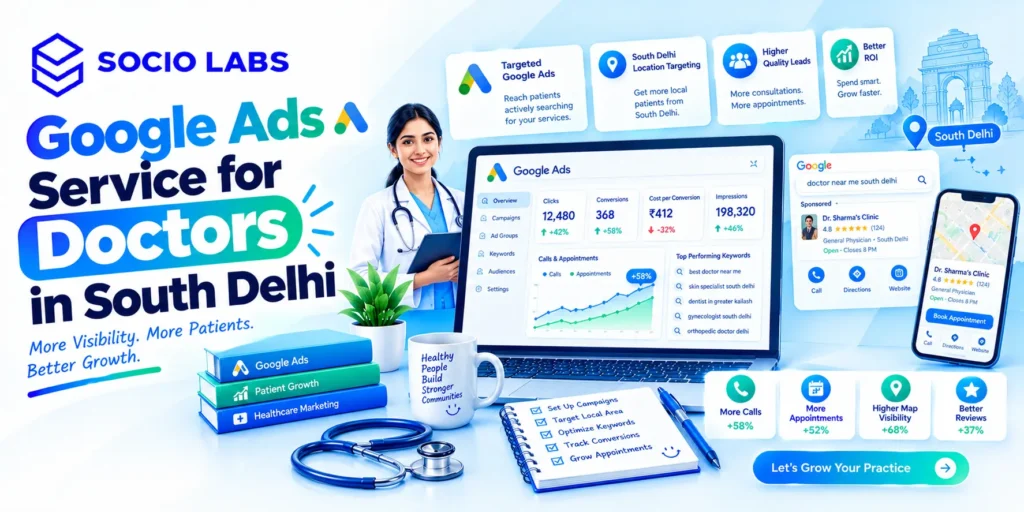
A doctor doesn’t need more impressions. They need the phone to ring with patients who are ready to book, not browsing symptoms at midnight. Most clinics that try Google Ads on their own, or hand it to a generalist agency, end up paying for broad healthcare keywords that pull in information-seekers rather than appointment-seekers. In a market as dense as South Delhi, where a patient can choose between three or four comparable clinics within a 15-minute drive, that distinction decides whether the budget turns into revenue or just spend.
The bigger issue is usually what happens after the click. A generic “Contact Us” landing page, a slow-loading site, or a form that doesn’t ask the right pre-qualifying questions quietly kills conversions that the campaign itself did everything right to earn. Doctors often assume the ad is the problem when it’s actually the three steps after the ad: the landing page, the call-to-action, and how fast the clinic follows up.
How Google Ads Should Actually Work for a Medical Practice
The short answer: campaigns should be structured around urgency and specialisation, not around the clinic’s name or general healthcare terms. A patient searching “emergency dental South Delhi” has a completely different intent, timeline and willingness to pay than one searching “teeth whitening cost Delhi.” Treating both the same way wastes budget on the wrong audience.
In practice, this means separating campaigns by treatment or speciality rather than running one blended “clinic” campaign, writing ad copy that states consultation availability and location clearly, and sending traffic to a page built for that specific search rather than the clinic’s homepage. Call tracking matters as much as the ads themselves, since a large share of patients in this category call directly from the search results instead of filling out a form. Negative keywords also carry real weight here filtering out job seekers, students researching for assignments, and patients looking for free government hospitals saves a meaningful share of budget in a city like Delhi.
What a Campaign Build Should Include
Speciality-Based Campaign Structure: Separate campaigns by treatment or department so budget isn’t blended across unrelated patient intents.
Call-Tracking Setup: Dedicated tracking numbers so every enquiry call or form can be attributed to the exact keyword and ad that generated it.
Landing Pages by Intent: Pages built around a single treatment or concern, not the general homepage, with the appointment action visible without scrolling.
Local Targeting by Locality: Geo-targeting tuned to the localities a clinic realistically draws patients from, instead of blanket “Delhi” targeting.
Negative Keyword Management: Ongoing filtering of searches that look relevant but never convert, such as free consultation or government hospital queries.
Google Business Profile Alignment: Ensuring the ad experience and the Business Profile tell the same story, since many patients check both before calling.
Conversion Tracking & Reporting: Clear visibility into cost per booked appointment, not just cost per click, reviewed on a schedule the practice can actually act on.
A Practical Example of How This Plays Out
Hypothetical example: a gynaecologist in Hauz Khas wants more consultation bookings for a specific procedure. A patient searches “gynaecologist consultation Hauz Khas” late in the evening, intending to call the next morning. If the ad copy mentions next-day availability and the landing page shows consultation fees and a map, that patient is more likely to call directly than to keep comparing clinics. If instead they land on a generic homepage with no clear next step, they move to the next search result often a competitor three localities away.
This is where most of the value gets won or lost: not in the auction itself, but in how quickly and clearly a patient can see that booking with this specific clinic solves their actual problem.
Why South Delhi Doctors Need More Than a Generic PPC Setup
Healthcare search behaviour in South Delhi doesn’t resemble retail or e-commerce, and a campaign built with retail logic underperforms quickly. A few things make the difference:
Understanding patient urgency levels. Not every click deserves the same bid or the same landing page urgent-care searches and elective-procedure searches need separate strategies.
Honest conversion tracking. Knowing which keyword produced an actual booked appointment, not just a form submission, changes how budget gets allocated month to month.
Compliance awareness. Medical advertising has restrictions on claims and testimonials that a generalist agency may not account for.
Landing pages built for a decision, not a brochure. Patients deciding between clinics want clarity on speciality, location and next steps within seconds.
Realistic reporting. Transparent numbers on cost per enquiry and cost per booked appointment, reviewed with the practice rather than buried in a monthly PDF.
Does Location Actually Matter Here?
Yes, more than in most service categories. South Delhi isn’t a single market a patient in Vasant Vihar rarely considers a clinic in Saket unless the speciality is rare enough to justify travel. Campaigns need locality-level targeting rather than a single “South Delhi” radius, and ad copy that reflects genuine proximity performs better than copy that simply repeats the area name. Competition also varies sharply by locality and speciality, which affects realistic cost per click and how aggressively a campaign needs to bid.
How the Process Works
1. Discovery & Goal Setting: Understand the practice’s specialities, appointment capacity, and which treatments are the priority to grow.
2. Research & Competitive Review: Look at what competing clinics in the same localities are bidding on and how they’re positioning their ads.
3. Campaign & Landing Page Setup: Build speciality-based campaigns and intent-matched landing pages with call tracking in place.
4. Launch & Monitoring: Run campaigns with close early monitoring to catch irrelevant traffic or tracking issues quickly.
5. Optimisation: Adjust bids, keywords and ad copy based on which searches actually produce booked appointments.
6. Reporting & Scale: Review cost per qualified enquiry and cost per booked appointment, then scale what’s working.
Metrics That Actually Matter
For a medical practice, clicks and impressions are vanity numbers. What matters is appointment enquiries generated, calls received and tracked, booking conversion rate from enquiry to confirmed appointment, and cost per qualified enquiry by speciality. These are the numbers worth reviewing every month not rankings or traffic volume.
What a Properly Run Campaign Should Deliver Over Time
A well-run Google Ads account for a medical practice should get more efficient over time, not just bigger. Early months are typically about data collection learning which keywords, localities and ad variations actually produce booked appointments rather than browsing clicks. This period matters because decisions made without that data, like cutting a keyword after three days or doubling budget after one good week, tend to undo the account’s early learning.
A strong strategy treats the landing page and follow-up process as part of the campaign, not separate from it. If a clinic’s front desk takes six hours to call back a web enquiry, even a perfectly targeted campaign will lose patients to a competitor who answers in ten minutes. Businesses evaluating a provider should expect clear visibility into where enquiries are coming from, honest conversation about what’s working and what isn’t, and a reporting rhythm that ties spend back to actual appointments rather than clicks or impressions. Results should be judged against the practice’s own booking data, not generic industry claims, since competition and cost per click vary significantly even between neighbouring South Delhi localities.
Conclusion
If your ads are producing enquiries but not enough confirmed bookings, the gap usually isn’t the ad itself it’s somewhere between targeting, the landing page and how fast those enquiries get followed up. A free audit can show exactly where that drop-off is happening before any budget changes. Request a Free Ads Audit or Book a Strategy Call to go through your current account together.
FAQs
Campaigns are built around treatment-specific keywords and locality-level targeting rather than broad healthcare terms, with call tracking and intent-matched landing pages so each enquiry can be traced back to the keyword that generated it.
It can be, if the account is structured around booked appointments rather than clicks. Clinics that see poor results are usually running broad, unsegmented campaigns rather than a problem with the platform itself.
Cost depends on speciality, locality competition, required landing pages and campaign complexity. There's no fixed figure that applies across specialities, since cost per click for dermatology differs substantially from general physician searches.
Most accounts need four to eight weeks of data collection before patterns become reliable enough to optimise confidently. Early weeks typically produce enquiries at a higher cost while the account learns which keywords convert.