
The Short Answer
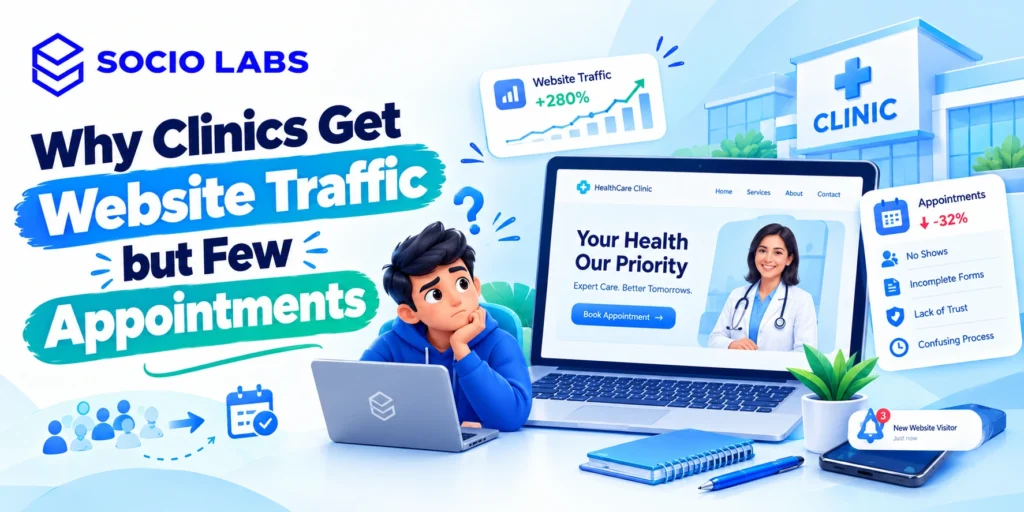
Most clinic websites get traffic without appointments for three reasons:
- The wrong people visit. Many visitors want free health information, not a doctor.
- The right people find it hard to book. The phone number, form or page makes it difficult, especially on mobile.
- Enquiries get lost. Calls go unanswered, messages are slow, and nobody tracks where patients came from.
Fixing these three things usually brings more appointments than adding more traffic. Let’s look at each one.
Why Visitors Come but Do Not Book
Search intent means the reason behind a search. It tells you what the person wants to do next.
Suppose a clinic has an article called “Causes of back pain.” It may bring in hundreds of visitors. Most of them want a quick answer. They read it and leave.
Now think of someone who searches “physiotherapist near me” or “acne scar treatment doctor.” This person has already decided to get treatment. They are choosing a clinic.
Both visits look the same in your report. But only the second person is likely to book.
If most of your traffic comes from information articles, you can have a busy website and a quiet phone. The articles are not bad. They just were not built to bring in appointments.
Why the Right Visitors Still Leave
Some visitors arrive ready to book and still leave. Usually the reason is small problems that add up.
Most people search for clinics on their phone. But many clinic websites are still hard to use on a small screen. The phone number may not be tappable. The booking form may have too many fields. The page may load slowly.
Any one of these can send the patient back to Google. The next clinic is only one tap away.
Trust is the other problem. Health is personal, so patients want to know who the doctor is. They want to know what the first visit involves. If this information is hard to find, they hesitate. And patients who hesitate often book somewhere else.
How to Turn Website Visits Into Appointments
Give each treatment its own page
One “Services” page that lists everything rarely works. A person searching for one treatment wants a page about that treatment.
A good treatment page explains who the treatment is for, what happens during it, how many visits it may need, and what the first consultation covers. Write it the way a doctor would explain it to a patient. Skip the brochure language.
This kind of page is called a landing page. It is the page a visitor “lands” on from Google or an ad. When it matches what the person searched for, more people book.
Make it easy to call or message
Add a tap-to-call button and a WhatsApp button that stay visible on mobile. Keep the booking form short. Ask for the name, phone number, preferred time and the health concern. You can collect the rest on the call.
Many patients prefer a quick WhatsApp message for a first enquiry. If you offer it, make sure someone is checking it every day.
Treat your Google Business Profile like a second website
Your Google Business Profile is the listing that appears on Google Search and Google Maps. It shows your reviews, photos, timings and call button.
For clinics, many patients decide here before they ever open your website. So keep your timings, services and photos up to date. Ask happy patients for reviews and reply to them politely. A neglected profile can lose the patient before your website gets a chance.
Show proof patients can check
Patients look for signs that a clinic is real and reliable. Useful proof includes:
- the doctor’s qualifications and registration details
- real photos of the clinic and team
- patient feedback you have permission to share
- a clear explanation of what happens in the first visit
Be honest about who a treatment is not suitable for. Do not promise results you cannot prove. Also follow the advertising rules that apply to doctors in India. If you are unsure, check your medical council’s guidelines.
Reply fast and track every enquiry
Suppose a patient fills in a form at 8 pm. If nobody replies until two days later, that patient has probably booked elsewhere. Set a simple rule, such as replying to every enquiry the same day. Give one person that job.
Then write down where each call, form and message came from. This is called tracking. Without it, you cannot tell if a slow month was caused by marketing or by missed follow-up.
Example: How One Patient’s Journey Might Go
This is a hypothetical example, not a real client case.
A dermatology clinic has a good article about acne scars. A visitor reads it and reaches the end. The only next step is a small “Contact Us” link. She does not click it.
Two days later she searches for an acne scar doctor. She finds another clinic on Google Maps with clear reviews and a call button. She calls that clinic.
The first clinic did the teaching. The second clinic got the appointment.
The fix is not always more articles. A better approach is to link that article to the acne scar treatment page. Then add a clear button to call, message or book.
Common Mistakes Clinics Make
Judging success by total visits. Traffic from the wrong searches makes the numbers look good without bringing patients. Look at visits to treatment pages, calls and Google Maps actions instead.
Sending all ad clicks to the homepage. If a patient searches for one treatment, send them to the page for that treatment. A homepage that talks about everything makes them work harder. Ad money gets used up, and appointments do not follow.
Missing calls from new patients. Reception staff are often busy during clinic hours. That is exactly when new patients call. A missed call from an unknown number is often a lost appointment.
Making patients fill long forms. Every extra field gives someone a reason to stop. Ask only what you need to book the first slot.
What Should a Clinic Measure?
Visits and clicks are a starting point. They do not tell you if the clinic is growing. These numbers are more useful:
- Appointment enquiries: the total calls, forms and messages you receive.
- Calls and WhatsApp messages from the website: this shows how many visitors take action.
- Google Maps actions: how many people tap call, directions or website on your profile.
- Conversion rate: the share of visitors who contact you. If 100 people visit and 5 enquire, your conversion rate is 5%.
- Booked appointments: how many enquiries actually turn into visits.
- Cost per appointment enquiry: how much you spend on marketing for each enquiry.
Track these every month. If enquiries are high but bookings are low, look at your follow-up. If enquiries are low, look at your pages and your profile.
Change the Strategy?
Yes, but only in a few ways.
Patients here can often choose between several clinics within a short distance. That means small details matter more. Reviews, photos, timings and how quickly you answer can decide who gets the call.
Many people also search with local words like “near me” or the area name. This makes your Google Business Profile and your location details very important. Make sure your address, map pin and service areas are correct everywhere.
You do not need to repeat all over your website. Use it where it helps patients, such as your contact page, your profile and a short “how to reach us” section.
When It Makes Sense to Get Professional Help
Many clinics can fix the basics themselves. Short forms, clear buttons and faster replies cost little.
Outside help starts to make sense when:
- you cannot tell which marketing is bringing patients
- ad costs keep rising but appointments do not
- you run ads, SEO and social media together and nobody connects the results
- the website needs changes, but nobody has time to test them
- enquiries are mixed and many are not suitable patients
At that point, a partner who understands clinic marketing can save time and money. The key is to choose one who talks about appointments and patient quality, not just clicks and rankings. Ask them how they will track enquiries, how they handle treatment pages, and how they report results in plain language.