
A cardiologist can publish fifty blog posts and still have patients land on a competitor’s website instead. Not because the content is wrong. Because it reads like something copied from a health magazine, not something written by a doctor who actually treats people.
This is the problem with most medical content. It covers the topic, technically. But it doesn’t sound like it came from a specialist. And both patients and Google notice the difference.
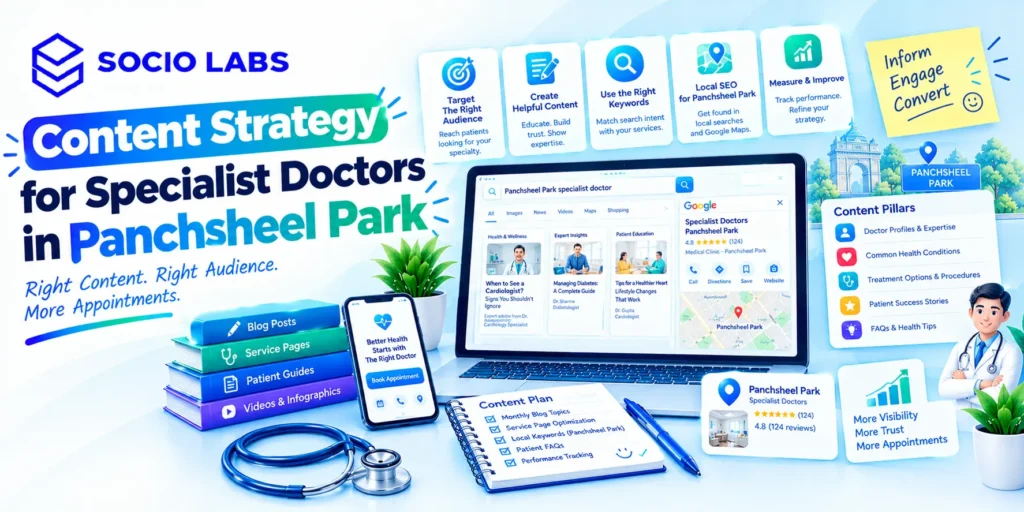
A real content strategy for specialist doctors isn’t about publishing more articles. It’s about publishing content that proves you understand the exact condition someone is dealing with, written in a way that sounds like it came from a doctor’s own experience, not a content mill. That’s what builds trust. And trust is what actually gets a patient to book an appointment instead of closing the tab.
Why Doctor Blogs Usually Don’t Work
Walk through most specialist websites in Panchsheel Park and you’ll find the same pattern. A blog titled “5 Tips for Healthy Joints” or “Understanding Diabetes.” Useful information, technically correct, but generic enough that it could have been written for any orthopedic clinic or any diabetologist in any city.
Patients searching for health information aren’t choosing between “good content” and “bad content.” They’re choosing between content that sounds like it understands their exact problem, and content that sounds recycled. A blog that reads like it was written to fill a content calendar, rather than to answer a real patient’s question, rarely gets read past the first two lines.
There’s also a search problem underneath this. Google has made it clear that medical content needs to show real expertise, not just cover the topic. Vague, generic health articles struggle to rank well against established medical sites, no matter how often they’re published.
How a Proper Content Strategy Actually Helps
A content strategy built around real specialist knowledge works differently. Instead of covering broad topics like “heart health,” it covers the specific questions a patient asks right before deciding to book a consultation.
For a cardiologist, that might be “why does my chest hurt only when I climb stairs” instead of “tips for a healthy heart.” For a dermatologist, it’s “why hasn’t my acne cream worked after 3 months” instead of “skincare tips for clear skin.” The difference isn’t subtle. One sounds like generic advice. The other sounds like a doctor who has actually seen this exact case before.
This approach does two things at once. It gives patients an answer specific enough to trust. And it gives Google content detailed enough to associate your website with real medical expertise, not just topic coverage.
A Practical Framework for Doctor Content
1. Start With Real Patient Questions, Not Topics
Instead of “writing about thyroid health,” write about “why thyroid symptoms get missed for months.” Base topics on the actual questions patients ask in consultations, not generic health topics.
2. Write From Clinical Experience, Not Textbook Explanations
A good article explains what a condition typically looks like in real patients, what gets misunderstood, and what the doctor has actually observed. This is what separates specialist content from copied health content.
3. Build Condition-Specific Pages, Not Just Blog Posts
A dedicated page on “slipped disc treatment” that explains symptoms, when surgery is needed, and recovery expectations works harder than a blog post that briefly mentions the condition among ten others.
4. Add Doctor Credibility to Every Piece
Each article should clearly connect back to the doctor writing it: their specialisation, years of relevant experience, and the kind of cases they regularly handle. This is a core part of what Google calls E-E-A-T, which simply means showing real expertise, experience, authority and trustworthiness, not just claiming it.
5. Answer the Hesitation, Not Just the Symptom
Patients researching a condition are often deciding whether it’s serious enough to see a doctor. Content that addresses that hesitation directly, “when this symptom needs urgent attention versus when it can wait,” builds far more trust than a general symptom list.
6. Keep a Consistent Publishing Rhythm
One detailed, specific article a month outperforms four generic ones. Depth and relevance matter more than frequency for specialist content.
A Realistic Example
Suppose a patient in Panchsheel Park has had knee pain for three weeks. They search “knee pain when climbing stairs.” A generic article titled “Common Causes of Knee Pain” gives them a broad list. It doesn’t tell them whether their specific situation needs a doctor.
An article written from real clinical experience, explaining what stair-related knee pain usually indicates, when it resolves on its own, and when it needs an orthopedic consultation, answers their actual concern. That’s the article they remember, and the one that makes them comfortable booking a consultation with that doctor.
Common Mistakes Specialist Doctors Make With Content
Publishing the same generic topics every clinic covers. “Tips for a Healthy Heart” has been written thousands of times. It gives Google nothing new to trust you for.
Writing content with no doctor behind it. Articles with no mention of who wrote them, or their actual experience, read as outsourced content, which reduces trust for both patients and search engines.
Explaining conditions without addressing real decisions. Patients don’t just want to understand a condition. They want to know what to do next. Content that skips this misses the actual search intent.
Ignoring the specific questions patients actually ask. Many practices write about broad categories instead of the precise, often anxious questions patients type into Google at 11 pm.
Treating content as a one-time project. A content strategy built around a handful of articles, then left untouched for a year, loses relevance as search behaviour and competition change.
What Should Be Measured?
For specialist doctors, the right metrics go beyond blog views:
- Appointment enquiries coming from specific condition pages
- Which articles are driving calls or booking form submissions
- How long patients stay on a page (an early sign of real relevance)
- Whether your content appears in Google’s AI Overviews for relevant health questions
- Return visitors researching a condition more than once before booking
Page views tell you content is being read. Enquiries tell you it’s actually working.
Does Panchsheel Park Matter Here?
Yes, though not in the way most people assume. Panchsheel Park has a high concentration of established specialists, which means patients searching here are often comparing multiple doctors before deciding, not just looking for basic information.
This changes what content needs to do. It’s less about ranking for broad local searches, and more about giving a patient enough specific, credible detail that they stop comparing and book a consultation. Location matters here mainly because it signals a more research-driven, higher-intent patient, not because the content needs to repeat “Panchsheel Park” throughout.
When Professional Help Makes Sense
Many specialist practices start by writing content themselves, usually in bursts, whenever time allows. That works for the first few articles. It becomes difficult to sustain once you need a consistent publishing schedule, condition-specific pages structured for both patients and search engines, and content that stays aligned with how patients are actually searching.
This is usually where Sociolabs comes in, helping specialist doctors turn real clinical knowledge into content that search engines trust and patients actually read before booking.
Conclusion
Generic health content gets read and forgotten. Content built around real clinical expertise gets remembered, and gets patients to book. For specialist doctors in Panchsheel Park, that difference is what turns a blog from a formality into something that actually brings patients in.
If your blog gets visitors but very few patients mention it when they book, the content likely isn’t building the trust it should. Sociolabs can help you turn real clinical expertise into content that does.
FAQs
It includes identifying the real questions patients ask, building condition-specific pages instead of generic blog posts, and writing content that reflects the doctor’s actual clinical experience rather than textbook explanations.
Generic blogs cover broad topics already written thousands of times elsewhere. They don’t demonstrate real expertise, which makes it harder to earn patient trust or rank well on Google.
Regular SEO content often focuses on keywords and topic coverage. A content strategy for specialist doctors focuses on clinical specificity and credibility, which matters more for both patient trust and medical search rankings.
Consistency matters more than frequency. One well-researched, condition-specific article a month usually performs better than frequent generic posts.
When content answers a patient’s actual decision-making question, not just the medical topic, it directly supports bookings, not just traffic numbers.