
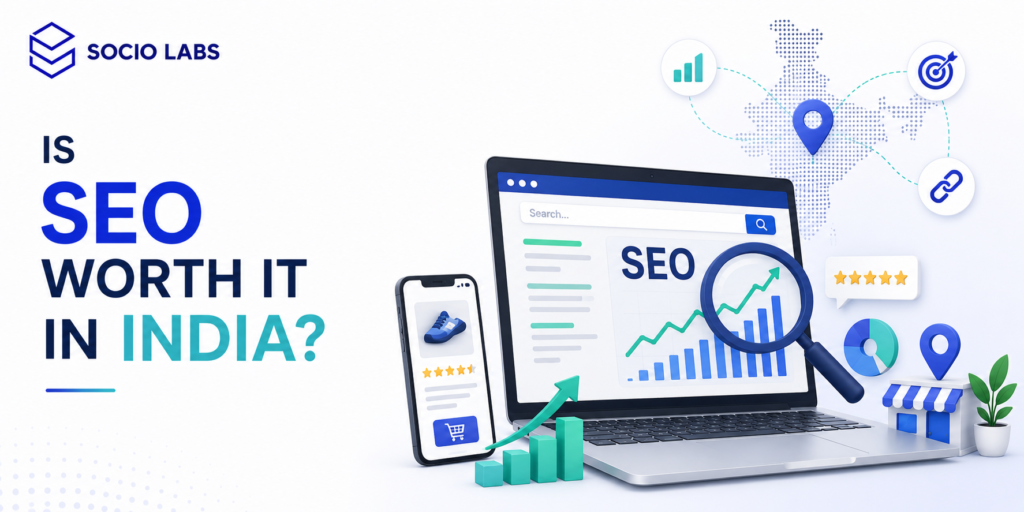
A founder recently asked us a version of this question that cuts through the usual SEO pitch: “If I put ₹50,000 a month into SEO instead of Google Ads, will I actually see it in revenue, or am I just buying patience?” That’s the real question behind seo india searches not whether SEO works in theory, but whether it’s worth it for a specific business, budget, and timeline.
This isn’t another “what is SEO” explainer. Our team at SocioLabs works through this exact ROI conversation with prospective clients regularly, and the honest answer is: it depends on specific, checkable conditions not blanket optimism. This guide walks through when SEO genuinely pays off, when it doesn’t, and how to decide for your own business.
Is SEO Worth It for Businesses in India?
SEO is worth it for Indian businesses when there’s measurable search demand for what they sell, healthy enough margins to support a multi-month payback period, and a business model that benefits from compounding, rather than one-off, customer acquisition.
Search demand is the first filter. A B2B SaaS company solving a problem people actively Google for has real SEO opportunity; a brand-new product category nobody searches for yet doesn’t, no matter how good the content strategy is.
Customer lifetime value matters just as much as demand. A local clinic with high repeat-visit value can justify months of SEO investment before seeing full payback, while a business selling a ₹200 impulse product with thin margins may find the payback period unrealistic relative to cash flow needs.
Expert Tip: Before budgeting for SEO, check actual search volume for your core terms using Search Console or a keyword tool “we assume people search for this” is a common, costly assumption to get wrong.
Why SEO in India Can Be a Strong Long-Term Investment
SEO in India creates long-term value primarily through compounding visibility content and rankings built once continue driving traffic for months or years, unlike paid ads that stop the moment spend stops.
This isn’t “free traffic,” despite how it’s often marketed. Ranking well requires ongoing investment in content, technical maintenance, and link building the difference from paid ads is that the investment builds an asset rather than renting attention month to month.
Organic visibility also builds brand discovery and authority in ways paid ads rarely do. A business ranking consistently for its category terms tends to be perceived as more established, which indirectly supports conversion rates across every channel, not just organic traffic itself.
- Compounding visibility that persists after initial investment
- Lower long-term dependence on rising paid acquisition costs
- Content assets that continue generating leads over time
- Brand authority signals that support conversion across channels
How Does SEO Generate ROI?
SEO generates ROI when organic traffic converts into leads or sales at a cost per acquisition lower than paid alternatives, calculated by tracking the full path from traffic through conversion to actual revenue.
The framework is straightforward: organic traffic → qualified visitors → conversion rate → leads or sales → average order value or customer value → revenue. Each stage needs to be tracked, typically through GA4, to know whether SEO investment is actually paying off.
A Simple Example Calculation
Consider a service business spending ₹40,000/month on SEO. If that investment eventually drives 500 organic visitors monthly, converting at 2% into 10 leads, and half those leads become clients worth ₹15,000 each, that’s ₹75,000 in monthly revenue against a ₹40,000 spend a rough 1.9x return, before accounting for the months it took to reach that traffic level.
This kind of calculation only works if conversion tracking is set up correctly from the start without it, businesses are left guessing whether SEO is contributing to revenue or just to a rankings report.
SEO vs Google Ads: Which Is More Worth It?
Neither SEO nor Google Ads is universally more worth it Google Ads delivers faster, more controllable results at an ongoing cost, while SEO takes longer to build but creates a compounding asset that doesn’t disappear when spend stops.
| Factor | SEO | Google Ads |
|---|---|---|
| Cost model | Ongoing investment, compounds over time | Pay per click, stops when spend stops |
| Speed | Slower — months to build momentum | Fast — visibility within days |
| Long-term value | Builds a lasting asset | No residual value after spend ends |
| Control | Less direct control over exact placement | High control over targeting and timing |
| Intent match | Strong for research and category terms | Strong for high-intent, ready-to-buy terms |
| Scalability | Scales with content and authority growth | Scales directly with budget |
| Best use case | Long-term, compounding visibility | Immediate demand, testing, seasonal spikes |
Most businesses with adequate budget benefit from running both together Google Ads capturing immediate demand while SEO builds toward lower-cost, sustainable traffic over the following months.
Is SEO Worth It for Startups and Small Businesses?
SEO is often worth it for startups and small businesses specifically because it lets them compete on niche, long-tail keywords where larger competitors haven’t built authority yet, rather than trying to outrank established players on broad terms immediately.
A small B2B service company, for example, is unlikely to rank for “marketing agency” but can realistically rank for a specific, narrower service combined with location or niche capturing highly qualified traffic with far less competition.
Limited budgets do mean startups need to prioritize carefully usually starting with local search terms, a handful of strong service pages, and technical fixes, rather than attempting broad content coverage across every possible topic immediately.
Is SEO Worth It for E-commerce and Online Businesses?
SEO is typically worth it for ecommerce businesses with a broad or repeatable product catalog, since category and product pages can capture ongoing commercial search demand without per-click costs scaling with every sale.
Product discovery through organic search often reaches customers earlier in their research than a Google Shopping ad would, and well-optimized category pages can capture high-volume commercial searches consistently once established.
Repeat customers add another layer of value a brand that ranks well for its category terms benefits not just from new customer acquisition, but from being easy to find again when existing customers return to search rather than navigating directly to the site.
When Is SEO NOT Worth the Investment?
SEO is not worth the investment when there’s no meaningful search demand for the product, the business model depends on immediate rather than compounding demand, or the underlying product-market fit is weak enough that no amount of traffic will fix it.
This is the section most SEO content skips, but it matters. A business testing an entirely new product category, running a short-term seasonal campaign, or lacking the operational capacity to convert traffic into paying customers is often better served by paid media or direct sales in the near term.
- No meaningful search volume for relevant terms
- Business model depends on urgent, immediate demand rather than research-driven search
- Poor unit economics that can’t support a multi-month payback period
- No conversion-ready website to actually capture traffic value
- No capacity to consistently produce or maintain content
- Fundamentally weak product-market fit SEO amplifies traffic, it doesn’t fix this
How Much Should a Business Invest in SEO?
How much a business should invest in SEO depends on industry competitiveness, website size, and how ambitious the growth goal is not a fixed universal number that applies regardless of business context.
Highly competitive industries require more sustained content and authority-building investment to see meaningful movement, while niche categories with less competition can see results with a comparatively modest, focused budget.
Rather than treating SEO as a fixed monthly expense, it’s more useful to frame it as an investment decision weighing the expected payback period against available cash flow, similar to how you’d evaluate any other growth investment with a multi-month return horizon.
- Industry competitiveness and existing organic visibility
- Website size and number of products or service pages
- Content and technical work required to reach a competitive baseline
- How ambitious the traffic and revenue goal actually is
How Long Does SEO Take to Show Results?
SEO typically shows early signal within 0–3 months from technical fixes, more visible ranking and traffic movement between 3–6 months, and meaningful, compounding results building over 6–12 months and beyond.
Results vary significantly based on existing site authority, competition level, technical health, and execution quality a newer site in a competitive category will generally take longer than an established site in a lower-competition niche, regardless of how well the work is executed.
No agency can guarantee a specific ranking or timeline, since search competition and algorithm behavior aren’t fully controllable by any single team realistic expectations set upfront prevent most of the frustration businesses experience with SEO.
How to Decide Whether SEO Is Worth It for Your Business
Deciding whether SEO is worth it comes down to checking a short list of specific conditions search demand, conversion readiness, patience for a multi-month timeline, and customer value rather than a gut feeling about SEO’s general reputation.
A practical decision checklist:
- Do customers actually search for what you sell?
- Is there measurable search demand for your core terms?
- Is your website ready to convert the traffic it would receive?
- How competitive is your specific market or category?
- Can you wait several months for meaningful, compounding growth?
- Is customer lifetime value high enough to justify the payback period?
- Can organic leads realistically improve your overall acquisition economics?
- Can you consistently produce or maintain content over time?
- Are competitors already gaining visible organic visibility in your space?
Decision framework:
- Mostly YES → Strong SEO opportunity worth prioritizing
- Mixed answers → Test with a smaller, scoped engagement before committing fully
- Mostly NO → Prioritize another acquisition channel first, and revisit SEO later
Conclusion
Seo India searches usually expect a simple yes, but the honest answer depends on specific, checkable conditions real search demand, adequate margins, and patience for a multi-month timeline. SEO in India works best as a compounding, long-term investment, not a quick fix, and it can’t rescue a business with weak product-market fit or poor unit economics. At SocioLabs, this exact evaluation happens before any strategy conversation, because recommending SEO to a business it doesn’t fit helps no one.
Not sure whether SEO fits your growth model right now? Explore digital marketing services with SocioLabs and identify where organic search can realistically contribute to your acquisition strategy.
FAQs
For many businesses, yes specifically when there's measurable search demand, adequate margins, and patience for a multi-month payback period, rather than as a universal default.
Neither is universally better Google Ads delivers faster, controllable results at ongoing cost, while SEO builds a slower but compounding asset; many businesses benefit from running both together.
Most businesses see early signal within 0–3 months from technical fixes, with more substantial results typically building over 6–12 months, depending on competition and execution quality.
Often yes startups can compete on niche, long-tail keywords with less competition rather than trying to outrank established players on broad terms immediately.
When there's little measurable search demand, the business needs immediate rather than compounding results, or underlying product-market fit is weak enough that traffic alone won't fix it.