
Segmentation targeting and positioning is the framework behind nearly every marketing decision that actually works from which Meta Ads audience gets shown a fashion ad to why one brand feels “premium” and another feels “for everyone.” Most businesses run some version of it instinctively, but few do it deliberately enough to get real leverage from it.
That gap matters more than it sounds. A business that skips deliberate segmentation typically ends up bidding on expensive, broad keywords, showing generic creative to everyone, and wondering why conversion rates stay flat. The STP model exists specifically to fix that.
This guide walks through every layer of the framework segmentation types, targeting strategies, positioning statements, and how it applies differently to startups versus e-commerce brands with real examples throughout. Our team at Socio labs applies this exact framework when structuring new client campaigns, so the examples here are grounded in applied practice, not just theory.
What Is Segmentation, Targeting and Positioning (STP) and Why It Matters
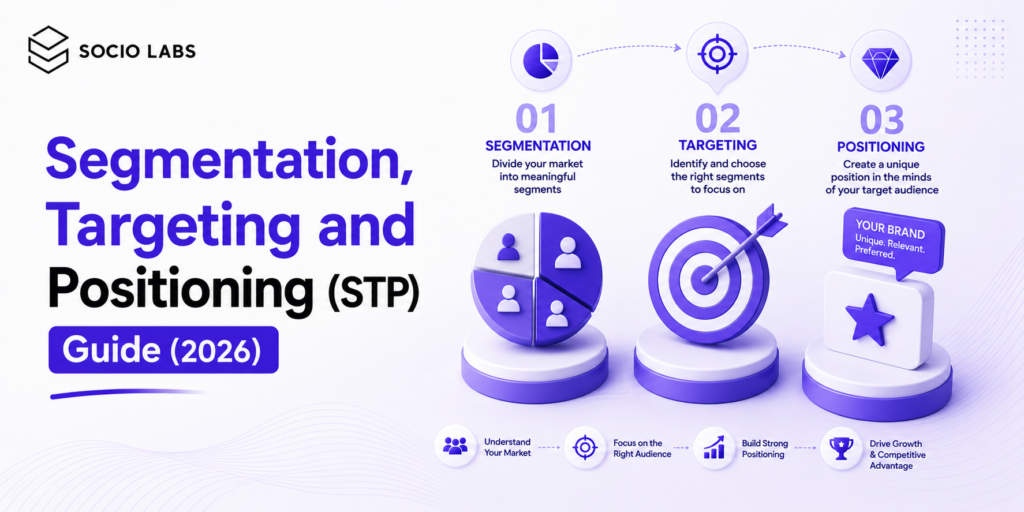
Segmentation targeting and positioning is a three-step marketing framework: dividing a broad market into distinct customer groups (segmentation), selecting which group(s) to focus on (targeting), and then defining how your brand should be perceived relative to competitors within that group (positioning). It’s the strategic layer that should happen before any campaign, creative, or channel decision.
The STP marketing model matters because it prevents the most expensive mistake in marketing: trying to speak to everyone and, as a result, resonating with no one. A skincare brand targeting “everyone who has skin” will always lose to a competitor targeting “women 25–35 with sensitive, acne-prone skin” on both ad efficiency and message relevance.
For Indian businesses specifically, where customer segments can vary enormously by region, income bracket, and language, skipping STP often means wasted spend on audiences that were never realistically going to convert in the first place.
Expert Tip: If your current marketing messaging could apply equally to five different competitors, that’s usually a sign your STP work particularly positioning hasn’t been done deliberately yet.
Types of Market Segmentation, Explained With Examples
Market segmentation divides a broad audience into four core categories: demographic (age, income, gender), geographic (location, region, climate), psychographic (values, lifestyle, interests), and behavioral (purchase habits, brand loyalty, usage frequency). Most effective segmentation strategies combine at least two of these rather than relying on just one.
Demographic segmentation is the most common starting point because it’s the easiest to gather through tools like Google Analytics 4 and CRM platforms, but it’s also the least predictive of actual buying behavior on its own.
Demographic and Geographic Segmentation
Demographic segmentation groups customers by measurable traits like age or income, while geographic segmentation accounts for regional differences a winter-wear brand, for instance, needs an entirely different strategy for Shimla versus Chennai.
Psychographic and Behavioral Segmentation
Psychographic segmentation looks at values and lifestyle (eco-conscious, luxury-seeking, budget-first), while behavioral segmentation groups customers by actual purchase patterns first-time buyers, repeat purchasers, or cart abandoners tracked via Meta Pixel and GA4.
| Segmentation Type | Based On | Example |
|---|---|---|
| Demographic | Age, income, gender, occupation | Targeting working professionals aged 25–40 |
| Geographic | City, region, climate | Different creative for metro vs Tier-2 cities |
| Psychographic | Values, lifestyle, interests | “Eco-conscious millennials” segment |
| Behavioral | Purchase habits, loyalty, usage | Retargeting cart abandoners specifically |
Businesses working with Socio labs typically start with behavioral segmentation from existing customer data, since it’s the most directly tied to revenue before layering in demographic or psychographic detail.
How to Identify Your Ideal Target Audience
Identifying your ideal target audience starts with analyzing existing customer data through GA4, CRM platforms, or Shopify/WooCommerce order history to find patterns among your most profitable, repeat customers, rather than guessing based on assumptions. This is what target marketing fundamentally is: focusing resources on the audience most likely to convert and stay loyal, instead of marketing broadly.
Many businesses skip this step and target based on who they want their customer to be rather than who’s actually buying a mismatch that quietly inflates acquisition costs for months before anyone notices.
Using Data Tools to Find Audience Patterns
Tools like Google Analytics 4, Hotjar, and CRM platforms reveal not just who’s buying, but how they browse, where they drop off, and what content they engage with before converting.
Building a Practical Target Audience Profile
A useful target audience profile combines a demographic snapshot with behavioral triggers for example, “urban working professionals who abandon cart most often at the shipping-cost step.”
- Pull your top 20% of customers by lifetime value and look for shared traits
- Use GA4 audience reports to identify highest-converting traffic sources
- Layer in Hotjar session recordings to understand on-site behavior
- Validate assumptions with a small paid test before scaling budget
Expert Tip: Don’t finalize a target audience from assumptions alone validate it with a two-week test campaign and real conversion data before committing a full quarter’s budget to it.
Targeting Strategies: Undifferentiated, Differentiated, Concentrated and Micromarketing
Businesses can choose from four core targeting strategies: undifferentiated (one message for the whole market), differentiated (tailored messages for multiple segments), concentrated (focusing entirely on one niche segment), and micromarketing (hyper-personalized targeting down to individual or local level). The right choice depends on budget, product type, and competitive intensity.
Concentrated targeting tends to work well for smaller businesses and startups with limited budgets, since it allows deeper resonance with one segment rather than shallow reach across many.
When Differentiated Targeting Makes Sense
Larger brands with multiple product lines like a skincare company selling both budget and premium ranges often use differentiated targeting to avoid one segment’s messaging diluting the other’s.
Micromarketing and Hyper-Personalization
Micromarketing, increasingly powered by AI customer analytics and first-party data, allows brands to tailor offers down to individual behavior patterns, such as personalized email flows triggered by specific browsing history.
| Targeting Strategy | Best For | Risk |
|---|---|---|
| Undifferentiated | Mass-market staple products | Weak resonance, higher ad costs |
| Differentiated | Multi-segment product lines | Higher complexity and budget need |
| Concentrated | Startups, niche brands | Vulnerable if segment shrinks |
| Micromarketing | Data-rich, personalized brands | Requires strong tracking infrastructure |
Expert Tip: Most early-stage startups underperform when they attempt differentiated targeting too early concentrated targeting on one strong segment usually delivers better ROI before expanding.
Positioning in Marketing: Building a Strong Brand Positioning Strategy
Positioning in marketing is the deliberate effort to shape how your target audience perceives your brand relative to competitors the specific space you want to “own” in the customer’s mind, such as “the affordable alternative” or “the premium, design-led choice.” Strong positioning makes every other marketing decision, from pricing to creative tone, easier to make consistently.
A strong brand positioning strategy usually starts with a clear positioning statement: a one-sentence internal reference point defining who the product is for, what category it competes in, and why it’s different.
Writing a Positioning Statement
A basic positioning statement format is: “For [target audience], [brand] is the [category] that [key differentiator], unlike [main alternative].” This forces clarity that vague brand messaging often lacks.
Positioning Statement Examples
A startup example: “For busy urban professionals, [Brand] is the meal-kit service that delivers chef-designed dinners in 15 minutes, unlike traditional meal kits that require 40+ minutes of prep.” An established business might position around scale or trust instead of speed.
- Identify 2–3 direct competitors and map their current positioning
- Define the one attribute you can credibly own that they can’t
- Write a clear positioning statement before writing any ad copy
- Test positioning language in small campaigns before full rollout
Expert Tip: If your positioning statement could be copy-pasted onto a competitor’s website without sounding wrong, it isn’t differentiated enough yet.
Segmentation vs Targeting vs Positioning vs the Marketing Mix (4Ps)
Segmentation identifies distinct customer groups, targeting selects which group(s) to pursue, and positioning defines how the brand should be perceived by that chosen group the three work sequentially, with each step narrowing focus before the next. The Marketing Mix (4Ps: Product, Price, Place, Promotion) is a separate but connected framework that comes after STP, translating strategic positioning into tactical execution.
A common point of confusion is treating STP and the 4Ps as competing frameworks rather than sequential ones STP defines who and how you’re perceived, while the 4Ps define what you actually do to deliver on that positioning.
Why the Sequence Matters
Deciding on pricing or promotion channels before finishing STP often results in tactics that don’t match the intended brand perception for example, discount-heavy promotions undermining a premium positioning strategy.
| Framework Element | Question It Answers | Comes Before/After |
|---|---|---|
| Segmentation | Who are the distinct customer groups? | First |
| Targeting | Which group(s) should we focus on? | Second |
| Positioning | How should we be perceived by them? | Third |
| Marketing Mix (4Ps) | How do we execute that positioning? | After STP |
SocioLabs recommends finalizing positioning before locking in pricing or promotional strategy reversing this order is one of the more common structural mistakes we see in new client audits.
STP for Startups, Small Businesses and E-commerce Brands
STP for startups and small businesses typically means starting with concentrated targeting on one clearly defined segment, since limited budgets can’t support differentiated messaging across multiple audiences yet. E-commerce brands, meanwhile, often layer behavioral segmentation like browsing and cart data on top of demographic targeting to personalize both ads and on-site experience.
For a startup, STP for e-commerce specifically starts with product-market fit signals: which customer segment is already buying repeatedly, even in small numbers, before scaling paid acquisition broadly.
Practical STP for Early-Stage Startups
Startups benefit from choosing one segment, launching a small test campaign, and refining positioning based on real response rather than finalizing a full STP strategy before any market feedback exists.
STP for Scaling E-commerce Brands
Scaling e-commerce brands typically use Shopify or WooCommerce customer data alongside GA4 to segment by purchase frequency and average order value, feeding these segments directly into Meta Ads custom audiences.
Based on campaigns managed by Socio labs, e-commerce brands that segment by purchase behavior not just demographics consistently see stronger retargeting performance than those relying on broad interest-based targeting alone.
Common Mistakes and How AI Is Changing Segmentation in 2026
The most common STP mistake businesses make is skipping straight to targeting and creative without doing the segmentation and positioning work first resulting in campaigns that reach people efficiently but say nothing distinctive to them. A close second is treating STP as a one-time exercise instead of revisiting it as customer data accumulates.
Heading into 2026, AI customer analytics tools are shifting segmentation from static, quarterly-updated groups toward dynamic, continuously updated micro-segments based on real-time behavioral signals.
Where Businesses Go Wrong With STP
- Skipping segmentation entirely and targeting “everyone interested in [category]”
- Writing positioning statements no one on the team can actually recite
- Never revisiting segments as customer data grows more detailed
- Letting pricing and promotions contradict the intended brand positioning
How AI Is Reshaping Segmentation
AI-driven predictive modeling now allows brands to segment by likely lifetime value or churn risk, not just past behavior — a shift from reactive to predictive segmentation increasingly common in tools connected to CRM platforms and AI customer analytics.
Expert Tip: Treat segmentation as a living model, not a one-time deliverable SocioLabs recommends revisiting core segments every quarter as new behavioral and purchase data comes in.
Real-World STP Examples: Apple, Nike, Amazon and Zomato
Well-known brands make STP visible in practice: Apple targets design-conscious, premium-willing consumers and positions around simplicity and status; Nike targets performance-driven and aspirational consumers and positions around achievement and inspiration; Amazon targets convenience-seeking, broad consumer segments and positions around selection and speed; Zomato targets urban, time-pressed consumers and positions around everyday convenience and discovery.
What’s notable across all four is consistency their pricing, product design, and messaging all reinforce the same positioning, rather than pulling in different directions.
What These Examples Teach Smaller Businesses
The lesson isn’t to copy these brands’ specific positioning, but to copy their discipline: every decision, from packaging to ad tone, should reinforce one clear position rather than trying to appeal broadly.
Even without Apple-level budgets, this same consistency principle is exactly what smaller brands working with Socio labs are guided toward a narrower, more consistent position outperforms a broader, diluted one at almost every budget level.
Best Practices for Implementing the STP Framework
Implementing STP effectively means doing the three steps in strict sequence segment first using real data, target deliberately based on budget and opportunity size, then position clearly before any creative or campaign work begins. Skipping or reordering these steps is the root cause of most underperforming campaigns.
A practical implementation checklist:
- Pull real customer data before assuming segments (GA4, CRM, Shopify/WooCommerce)
- Choose concentrated targeting first if budget or team bandwidth is limited
- Write a one-sentence positioning statement the whole team can repeat
- Align pricing and promotion decisions to reinforce, not contradict, positioning
- Revisit segments and positioning quarterly as customer data matures
- Test positioning language in a small campaign before full rollout
Conclusion
Segmentation targeting and positioning isn’t a theoretical marketing exercise it’s the strategic groundwork that determines whether every rupee spent on ads, content, or creative actually lands with the right audience. Getting the sequence right segment, target, then position before jumping into campaigns is what separates brands with consistent, efficient growth from those constantly tweaking creative without knowing why performance stays flat. At SocioLabs, this framework is applied at the start of every new client strategy, precisely because skipping it tends to cost far more in wasted ad spend later than doing it properly upfront.
Not sure if your current marketing strategy is built on solid STP foundations? SocioLabs offers a free positioning and audience review to identify quick wins before your next campaign. Explore our Performance Marketing Agency services or strengthen your organic presence with our Best SEO Company in India team.
FAQs
It's a three-step framework — group your market into segments, choose which segment(s) to target, then define how your brand should be perceived by that group.
Yes if anything, it's more relevant, since accurate STP work directly improves ad targeting efficiency and creative relevance across Google Ads and Meta Ads.
Segmentation identifies the distinct groups within a market; targeting is the decision about which of those groups to actually focus marketing efforts on.
Yes even a lightweight version (one clear target segment and a one-sentence positioning statement) meaningfully improves ad performance compared to undifferentiated targeting.
Ideally every quarter, or whenever significant new customer data becomes available, since customer behavior and market conditions shift faster than most annual marketing plans account for.