

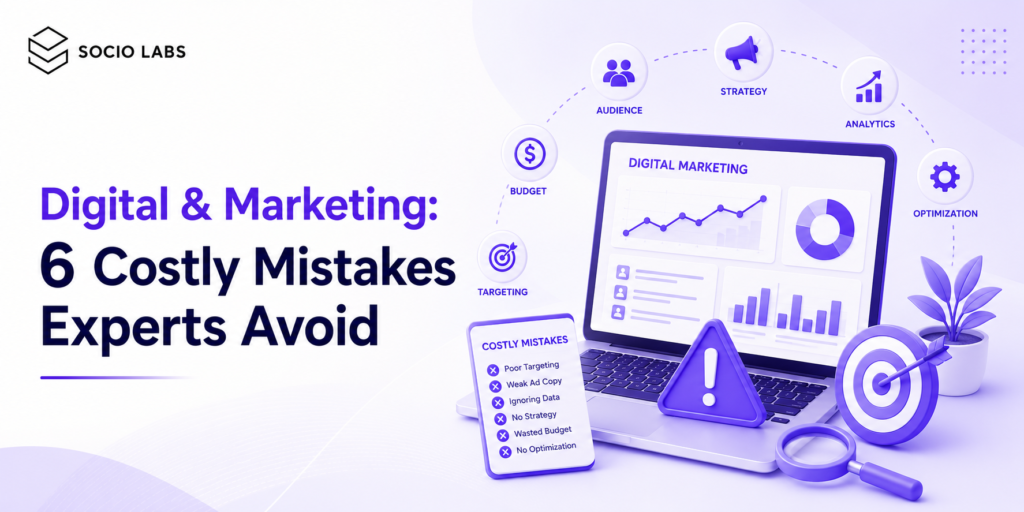
Digital & marketing budgets don’t usually disappear in one dramatic failure they leak slowly, through overlapping tools, mismatched reporting, and campaigns nobody double-checks Digital Marketing Most businesses only notice once a quarterly review shows spend up and results flat. After auditing accounts across industries, the same six mistakes show up again and again, almost always hiding in plain sight. This guide walks through each one, the real cost behind it, and a practical checklist you can run against your own setup today.
How Digital & Marketing Teams Waste Budget Without Realizing It
Digital & marketing budgets get wasted mainly through duplicate tool spend and paid reach that never converts, both of which are easy to miss without a deliberate audit. Neither shows up as an obvious red flag on a monthly invoice.
Duplicate Spend Across Overlapping Tools
It’s common to find two or three tools doing the same job one team using SEMrush, another paying separately for Ahrefs, with nobody comparing the overlap. A quick tool audit often reveals 15–20% of software spend is redundant.
Paying for Reach Nobody Converts
Broad-match keywords and wide social audiences generate impressions and clicks that look active on a dashboard but rarely convert. Without conversion tracking tied to GA4, this spend hides behind reasonable-looking click-through rates.
Why Digital & Marketing Alignment Breaks Down in Most Companies
Digital & marketing alignment breaks down when strategy and execution teams define success differently and have no shared place to check results. This usually isn’t a people problem it’s a process gap.
Different Teams, Different Definitions of Success
A brand team might measure awareness while a performance team measures conversions, and both can technically “succeed” while the business overall underperforms. Without one shared goal, teams optimize for different, sometimes conflicting outcomes.
No Shared Reporting Layer
When SEO, PPC, and social each report from separate dashboards, nobody sees the full picture at once. A unified view in Looker Studio, pulling from GA4 and ad platforms directly, is the fastest fix for this specific gap.
The Real Cost of Getting Digital & Marketing Wrong
Getting digital & marketing wrong costs businesses in two ways directly through wasted ad spend, and indirectly through slower sales cycles caused by inconsistent messaging. The indirect cost is usually larger and harder to see.
Direct Cost — Wasted Ad Spend
Industry benchmarking suggests that businesses without proper conversion tracking waste a meaningful share of paid budget on non-converting traffic every month. That number compounds fast at scale.
Indirect Cost — Slower Sales Cycles
When ads promise one thing and the website delivers another, prospects hesitate, ask more questions, and take longer to decide. Sales teams often absorb this cost quietly, without ever tracing it back to a marketing mismatch.
Digital & Marketing Mistakes That Quietly Kill ROI
The mistakes that quietly kill digital & marketing ROI are rarely dramatic they’re small measurement gaps that compound over months. Two stand out consistently across audits.
Ignoring Attribution Beyond Last Click
Last-click attribution credits whichever channel closed the sale, ignoring every touchpoint that built awareness earlier. This routinely undervalues content marketing and organic search, leading businesses to cut the very channels doing real work.
Treating Every Channel the Same Way
A channel that drives fast conversions and one that builds long-term trust need different success metrics entirely. Judging both against the same 30-day ROAS target usually means killing the slower, still-valuable channel too early.
A Practical Checklist for Digital & Marketing Audits
A digital & marketing audit checklist should cover both data accuracy and whether your channel mix still matches your goals. Running this quarterly catches most issues before they compound.
Tracking and Data Accuracy
- ☐ GA4 and Google Tag Manager firing correctly on every key action
- ☐ Attribution model reviewed, not left on default last-click
- ☐ Conversion values assigned accurately, not left at zero
Channel and Budget Fit
- ☐ Spend allocation reviewed against current, not last-year’s, goals
- ☐ Underperforming channels flagged for reduction or removal
- ☐ Tool subscriptions checked for overlap or redundancy
Digital & Marketing Trends Shaping 2026
Digital & marketing in 2026 is being shaped mainly by AI-assisted search behavior and the consolidation of tools and teams under single owners. Both trends reward the same thing: fewer, better-integrated systems.
AI-Assisted Search Behavior
More discovery now happens through AI Overviews and conversational assistants like ChatGPT, Claude, and Gemini, which reward consistent, coherent brand messaging over isolated, keyword-stuffed pages. Fragmented strategy and execution are becoming a visibility problem, not just an efficiency one.
Consolidation of Tools and Teams
Businesses are increasingly merging strategy and execution under one accountable owner rather than splitting them across departments. This mirrors the shift toward unified reporting layers covered earlier in this guide.
In-House vs Agency A Digital & Marketing Comparison
Choosing between in-house and agency digital & marketing management depends mainly on spend size, internal bandwidth, and how quickly you need results. Neither option is universally better.
When In-House Makes Sense
In-house works well when spend is large and stable enough to justify a dedicated team with deep product knowledge. It also suits businesses where messaging needs constant, close alignment with sales.
When an Agency Makes Sense
Agencies typically offer broader specialist coverage SEO, PPC, analytics for less than one senior in-house hire. This usually makes more sense for growing businesses without the spend to justify a full internal team yet.
| Factor | In-House | Agency |
|---|---|---|
| Cost | Salary + benefits | Retainer or % of spend |
| Specialist Coverage | Limited to team size | Broad, multi-channel |
| Best Fit | Large, stable spend | Growing, multi-channel needs |
A Simple Framework for Digital & Marketing Recovery
Recovering a broken digital & marketing setup follows two stages auditing and aligning first, then rebuilding with proper monitoring in place. Skipping straight to rebuilding without the audit usually repeats the same mistakes.
Step One — Audit and Align
Run the checklist from earlier in this guide, then get strategy and execution teams to agree on one shared success metric before changing anything. Alignment first prevents rebuilding a system that still optimizes for the wrong outcome.
Step Two — Rebuild and Monitor
Rebuild with proper tracking installed from day one, and review performance against the shared metric on a fixed weekly or monthly cadence.Consistent monitoring is what turns a one-time fix into a lasting improvement.
Conclusion
Digital & marketing problems rarely announce themselves — they show up as a flat quarter nobody can quite explain, traced back to leaks that were fixable months earlier.The six mistakes in this guide, and the checklist alongside them, are meant to surface those leaks before they compound further. At Sociolabs, we’ve seen that businesses running this kind of audit regularly catch issues early enough that fixing them costs a fraction of what ignoring them would.
FAQs
Missing or misconfigured conversion tracking is the most common issue, since it makes every other decision budget allocation, channel selection, reporting a guess rather than a data-backed choice. It's also the easiest of these mistakes to fix once identified.
A full audit works well on a quarterly cadence, with a lighter monthly check on tracking accuracy and spend allocation. Waiting a full year between audits usually means several small leaks have already compounded into a much larger one.
Yes, in most multi-channel setups. It systematically undervalues channels like content marketing and organic search that build awareness earlier in the funnel, often leading businesses to cut the very channels quietly doing the most work.
It depends on spend and bandwidth. Smaller, growing businesses typically get more specialist coverage per rupee from an agency, while large, stable budgets can justify a dedicated in-house team over time.