
A family in Rohini opens an AI tool and types, “Which hospital near me is good for knee replacement?” The tool gives a short answer and names two or three hospitals.
If your hospital is not in that answer, you never find out that family existed. There is no visit to count and no missed call to notice.
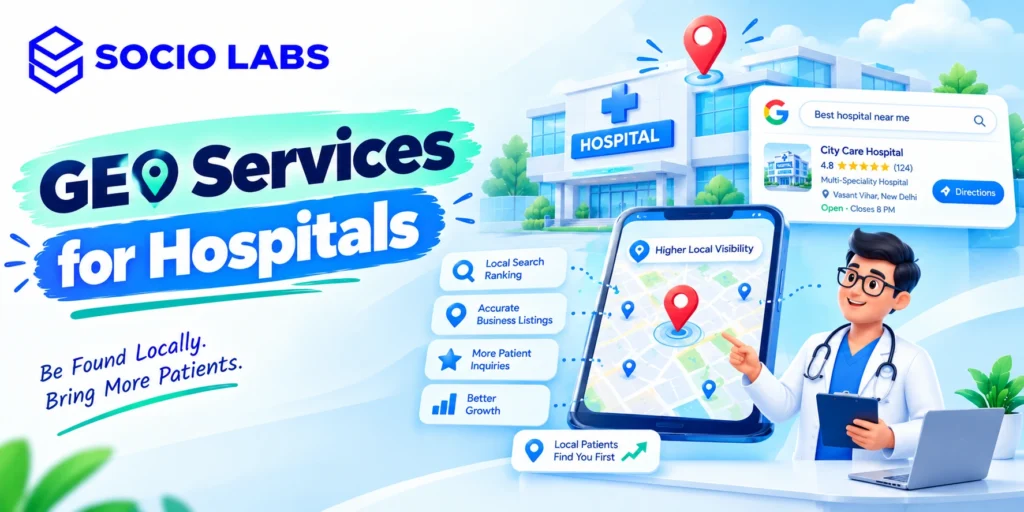
This is the gap that GEO services for hospitals try to close. GEO stands for Generative Engine Optimization. It means making your hospital easy for AI tools and AI search results to find, understand and recommend. This blog explains how it works, what to fix first and how to check if it is helping.
What GEO Does for a Hospital
GEO helps AI tools find correct and trustworthy information about your hospital. That makes it more likely they will mention you when patients ask about doctors, treatments and care nearby.
In practice, this comes down to three things:
- Clear pages. Each department, treatment and doctor has a page that answers real patient questions.
- Matching details. Your address, timings, services and contact numbers are the same everywhere online.
- Trusted proof. Doctor credentials, reviews and mentions on reliable websites back up what you say.
GEO builds on normal SEO. It does not replace it. And no one can guarantee that an AI tool will name your hospital. What you can do is remove the reasons it might skip you
How Patients Use AI Search to Choose a Hospital
Patients now ask full questions instead of typing short keywords. For example:
- “Best hospital for heart treatment in Rohini”
- “Does this hospital accept cashless insurance?”
- “What happens during a knee replacement surgery?”
- “Which orthopaedic doctor is available on Saturday?”
AI tools read many websites, listings and reviews. Then they write one short answer. If your information is unclear, outdated or missing, the tool has little to work with. It will use a hospital that explains itself better.
Search intent matters here. Search intent means what the person wants to do next. Someone asking “what is angioplasty” is learning. Someone asking “angioplasty hospital near me with cashless insurance” is choosing a hospital. GEO should help you show up for both, but the second group is closer to booking.
What GEO Services for Hospitals Actually Include
A good GEO service is mostly careful, practical work on your website and your online profile. Here are the main parts.
Build clear pages for each department and treatment
One page that says “Our Services” is not enough. A patient searching for one treatment wants a page about that treatment.
A strong page explains who the treatment is for, how it works and what the first visit involves. It names the doctors, lists the facilities and says if insurance is accepted. Write it in simple words, as a doctor would explain it across the desk.
Show doctor details that people can trust
Healthcare is a sensitive topic. Search engines and AI tools look for signs that the information comes from real experts.
Each doctor profile should show qualifications, registration details, areas of experience and OPD timings. Medical articles should show who reviewed them and when. A page that says “reviewed by a named doctor” is much easier to trust than an unsigned page.
Keep your hospital details the same everywhere
Your hospital name, address, phone number and timings should match across your website, Google Business Profile and any health listing sites. Your Google Business Profile is the listing that appears on Google Search and Maps.
Small differences cause confusion. If one site says 24-hour emergency and another says nothing, AI tools may not mention it at all. Check these details every few months.
Answer the questions patients really ask
Collect the questions your front desk and call centre hear every week. These are often about costs, insurance, visiting hours, test preparation and admission steps.
Answer each one on your website in two or three clear sentences. Put the direct answer first, then add detail. Never promise treatment results, and never give personal medical advice on a public page.
Earn mentions on trusted websites
AI tools do not rely only on your website. They also look at what others say about you. This includes patient reviews, health directories, medical association pages and local news.
Reply to reviews politely and never share patient details. Make sure your hospital is listed correctly on respected healthcare directories.
Add structured data to your website
Structured data, also called schema, is a small piece of code that tells search engines the facts on your page. It can show your hospital’s address, departments, doctors and opening hours in a format machines can read easily.
Your patients will never see it. But it helps search tools read your pages correctly. Your website team can add it.
Example: How One Patient’s Journey Might Go
This is a hypothetical example, not a real client case.
Suppose a son is looking for a knee replacement for his mother. He asks an AI tool for options near Rohini. The tool names three hospitals.
He then checks them on Google Maps, reads some reviews and visits their websites. Hospital A has a short “Orthopaedics” page with no doctor names, and no mention of insurance or recovery time. Hospital B has a full page. It names the surgeon, explains the procedure, covers the recovery period and lists insurance partners.
He calls Hospital B.
Both hospitals may offer similar care. But only one made it easy to understand. That is what GEO is meant to improve.
Common Mistakes Hospitals Make With AI Search
Treating GEO as a trick. Some providers promise to “rank you on ChatGPT” quickly. No one controls what AI tools say. Be careful of guarantees, and do not stuff pages with repeated phrases.
Leaving doctor and timing information outdated. A doctor who has left, or an old OPD schedule, spreads wrong information. In healthcare, wrong information also hurts trust and can affect patient safety.
Publishing medical content without doctor review. Content written quickly and posted without a qualified check can be inaccurate. AI tools and patients both notice this over time.
Ignoring practical questions. Patients often ask about emergency services, parking, insurance and visiting hours. If your site does not answer these, someone else’s will.
What Should a Hospital Measure?
Website visits alone do not show whether GEO is working. These numbers are more useful:
- Appointment and OPD enquiries: the total calls, forms and WhatsApp messages you receive.
- Enquiries by department: which services patients are asking about.
- Google Business Profile actions: how many people tap call, directions or website.
- AI mentions: ask the same 15 to 20 patient questions in major AI tools each month and note whether your hospital appears.
- Conversion rate: the share of visitors who contact you. If 200 people visit a page and 10 enquire, the rate is 5%.
- Booked appointments: how many enquiries become actual visits.
Be realistic about AI tracking. AI tools do not give clean reports yet, so part of the measurement is manual. That is normal. Use the same questions each month so you can compare fairly.
Does Rohini Change the Strategy?
Yes, in a few ways.
Rohini is a large residential part of North-West Delhi, and patients here often have several hospitals within reach. When choices are close, small details decide who gets the call. These include emergency availability, cashless insurance, specialist timings and how quickly your team replies.
Patients also search using area names and “near me”. So your address, map pin and service area must be correct everywhere. Do not repeat “Rohini” across every page, though. Use it where it helps, such as on your contact page, profile and a short “how to reach us” section.
When Professional Help Makes Sense
Many hospitals can start on their own. Updating doctor profiles, fixing timings and answering common questions costs little.
Outside help becomes useful when:
- you have many departments and doctors to manage
- nobody can tell where enquiries are coming from
- your website needs changes, but there is no time or technical skill
- medical content needs regular writing, review and updates
- listings and details differ across many websites
At that point, a team that understands healthcare marketing can save time. Choose one that talks about patient enquiries, doctor review and honest reporting. Be cautious about anyone who promises a fixed position in AI answers. Also confirm that all content follows the advertising rules for hospitals and doctors in India.
Conclusion
If your hospital gets calls but patients say they found you late, or not at all, check how you appear when someone asks an AI tool. Start with the basics: doctor details, department pages, timings and listings.
If you would like a second opinion, our team can review how your hospital appears in AI search and Google, and show you which fixes to make first.
FAQs
GEO services for hospitals make your hospital easier for AI tools and AI search results to find and recommend. The work includes clear department pages, verified doctor profiles, matching listings, patient-focused answers and structured data. The goal is to appear when patients ask AI about nearby care.
SEO helps your pages rank in normal search results. GEO helps AI tools understand and mention your hospital in written answers. They overlap a lot, because both need clear content and trusted information. Most hospitals should treat GEO as an extension of good SEO.
No, nobody can guarantee that. AI tools decide what to show using many sources, and they change often. GEO improves your chances by making your information clear, correct and trusted. Be careful of any provider who promises a fixed result.
Small fixes like correcting listings and improving key pages can help within weeks. Wider AI visibility usually takes a few months. The timing depends on your competition, how much content needs fixing and how often information is updated.
There is no standard price. Cost depends on the number of departments and doctors, how much content must be written or reviewed, the technical work on your website and how often reporting is needed. Ask for a clear list of what is included before you start.